If your manufacturing sales team keeps sending generic LinkedIn requests and hearing nothing back, the problem isn't LinkedIn. The problem is the system behind it. LinkedIn works when you treat it like an account-mapping and timing engine for technical buyers, not like a side hustle for personal branding.
The platform is too big and too buyer-dense to ignore. Microsoft reported 1.2 billion members and $17.8 billion in LinkedIn revenue for fiscal year 2025 in its LinkedIn business highlights, and independent summaries say LinkedIn passed 1.1 billion members globally by early 2025, up from 644 million in 2019, which means the audience roughly doubled in six years in the same source family. For B2B sellers, the point isn't raw scale, it's access. Published benchmarks say 79% of B2B marketers view LinkedIn as their most effective lead-gen channel, 76% of buyers are ready to have a sales conversation there, and LinkedIn generates 277% more leads per contact than Facebook in that same Microsoft-linked summary.
What matters for manufacturers is sequencing. Profile credibility, target-account lists, content signals, and follow-up need to reinforce each other, or the whole effort turns into noise. When those pieces line up, LinkedIn becomes a practical system for reaching committees, not a guessing game.
Table of Contents
- Why Most Manufacturers Get LinkedIn Sales Wrong
- Building a Sales-Ready Profile and Company Page
- Targeting the Right Buyers with Sales Navigator
- Outreach Sequences That Get Replies from Engineers
- Content That Builds Credibility Before the First DM
- Connecting LinkedIn to Your CRM and Workflow
- Metrics That Predict Pipeline, Not Vanity Counts
Why Most Manufacturers Get LinkedIn Sales Wrong
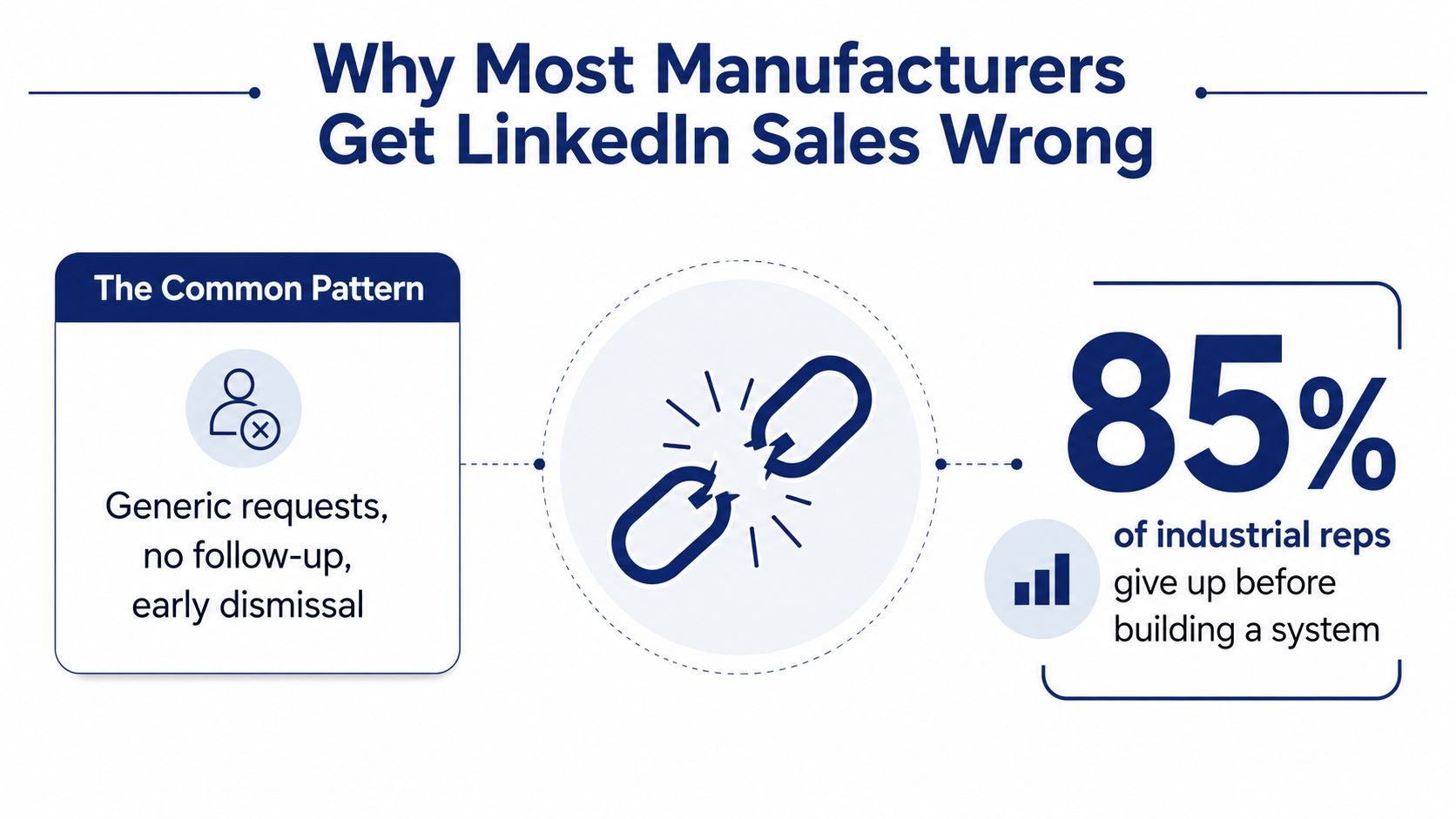
The most common failure mode is simple. A rep finds a few engineers, sends a batch of generic connection requests, gets ignored, and decides LinkedIn doesn't work for manufacturing. That conclusion is wrong. The issue is that the rep tried to skip the system and jump straight to the ask.
LinkedIn rewards relevance, timing, and credibility. LinkedIn's sales guidance says 89% of sellers are very active on the platform for business purposes in its State of Sales materials, and it also points to active sellers outperforming passive ones. Independent B2B benchmark data in the same source family says sellers who engage on LinkedIn are 51% more likely to hit quota, personalized connection requests can reach about a 42% acceptance rate versus 12% for generic requests, and InMail response rates are often reported around 18.5% versus roughly 1.2% for cold email.
That's why the “send more DMs” mindset fails. Mass outreach without profile proof and buyer context looks like spam, especially to technical audiences who can smell a templated pitch fast. The better model is an account system, not a broadcast channel.
Practical rule: if your profile, target list, post activity, and follow-up message don't all point to the same buyer problem, your outreach will feel random no matter how polished the wording is.
For manufacturers, this matters even more because deals rarely close on the first touch. You're usually selling into a committee, which means your job is to build recognition across roles, not chase one individual. LinkedIn is useful because it lets you map accounts, watch signals, and time outreach when the buyer is already active.
Building a Sales-Ready Profile and Company Page
Your profile is not a résumé. It's a credibility asset that either supports your outreach or kills it before the buyer reads your message. If a prospect clicks your name and sees a vague headline, a stock photo, and an About section that sounds like a job application, you've already lost trust.
What the rep profile should do
The headline should say what you help buyers achieve, not what title you hold. The banner image should reinforce your market, your product category, or your customer type, not generic branding. In the About section, write for buyers, not recruiters.
A solid profile checklist for a manufacturing rep looks like this:
- Headline: state the buyer outcome or market segment you serve.
- Banner: use a clean visual that reflects the company or industry.
- About section: explain the problems you solve in plain language.
- Featured section: pin proof, such as a case study, a technical article, or a useful resource.
- Experience section: focus on outcomes and types of accounts served.
Avoid the usual credibility killers. Generic stock photos make you look interchangeable. Headlines like “Helping companies grow” say nothing useful. An About section that reads like a CV tells buyers you're focused on yourself, not their process.
The company page has a different job. It should help a prospect confirm that you're a real operating business with a clear market position. Fill out specialties, keep the tagline specific, and publish content often enough that the page doesn't look abandoned. Employee advocacy matters here, because it gives your company page reach without making every rep act like a full-time creator.
If you need a manufacturing-specific reference point for how this fits into a broader industrial marketing system, we've covered the structure in this guide to LinkedIn marketing for manufacturers.
Buyers don't need you to be clever. They need to know, quickly, that you understand their environment and have solved similar problems before.
If you're not willing to publish proof, don't expect buyers to treat your message as credible. That's the trade-off.
Targeting the Right Buyers with Sales Navigator
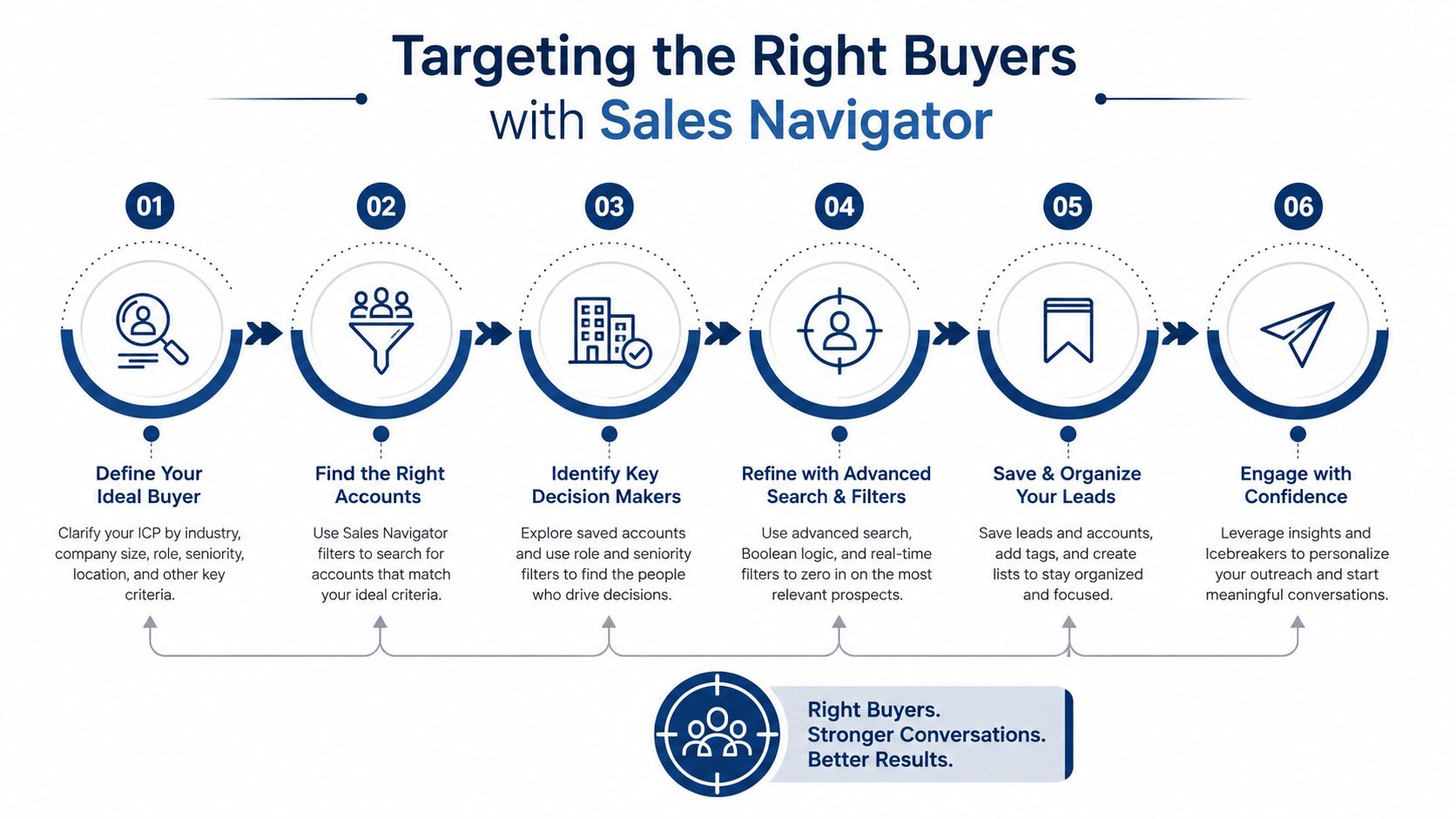
Sales Navigator only works when the team starts with a clear ICP, not a loose habit of searching for names. If each rep defines “good lead” differently, the account list turns into a pile of random contacts and the pipeline gets noisy fast. Use Sales Navigator to map the account first, then hold the team to one targeting standard.
Build the search around the account, not the person
Start with the buying committee, then work outward. Filter by job title, seniority, function, geography, and company attributes so you are looking at the same account profile every time, not whatever happens to pop up in search.
Save both lead lists and account lists. That keeps prospecting tied to named accounts and makes handoffs cleaner when multiple reps touch the same target.
Industrial deals rarely hinge on one contact. A plant manager, engineering lead, operations director, and procurement contact can all shape the outcome, and each one needs a different message. Sales Navigator helps you keep that structure visible instead of flattening every contact into a standalone opportunity.
Build the process in this order:
- Define the account profile: identify the industries, company sizes, and geographies that match your best customers.
- Map the stakeholder roles: list the titles and functions that show up in the buying committee.
- Save account searches: create reusable searches around those filters.
- Save lead lists: group the right contacts into named lists by account or segment.
- Watch trigger events: track job changes, promotions, company announcements, hiring patterns, and content engagement.
- Reach out only when the signal is real: don't message someone just because their name appeared in search.
That last step is where many teams waste time. LinkedIn prospecting works better when timing is tied to a real trigger, because a job change or company announcement gives you a reason to start a conversation. A cold pitch with no context gets ignored.
If you are choosing tools before standardizing the workflow, compare LinkedIn tools for sales and decide what belongs in the stack. Teams do not need more software. They need a tighter process.
For teams that want a stronger account-intent framework, our internal view on intent data fits here. Use LinkedIn signals as one timing layer, then confirm the account is showing real buying activity.
Outreach Sequences That Get Replies from Engineers
Engineers respond to relevance, not charm. If your message arrives before they have seen your name, your company, or a reason to care, it gets skipped. The sequence has to build familiarity first, then ask for attention, then make the next step easy.
Start with account warming before you send a pitch.
Use profile views, thoughtful comments, and a few measured likes to put your name in front of the buyer before the first direct message. A practical guide says people are 3x more likely to respond after 4–5 prior interactions, and it recommends engaging for 2–3 weeks before reaching out. That fits how technical buyers work. They answer people they have already noticed.
LinkedIn also rewards a wider network. RAIN Group's LinkedIn sales advice recommends accepting plausible connection requests because a larger network increases visibility through 2nd and 3rd degree connections. The same guidance says to use LinkedIn for at least 15 minutes per session and to connect within 24 hours after networking events or trade shows, with a personalized note in its LinkedIn sales tips.
The sequence is straightforward.
- Engage first: view the profile, like a relevant post, and leave a comment that shows you understood the topic.
- Wait for repeat exposure: stay visible for a couple of weeks before asking for anything.
- Send a personalized connection request: refer to a real trigger, not a generic introduction.
- Follow with a value message: point to a concrete result or operational issue.
- Stop after a few touches if there is no response: do not keep pushing the same contact.
Use language that sounds like a technical seller, not a campaign blast.
Hi [Name], I saw your post about [trigger event or challenge]. We work with manufacturing teams dealing with [relevant issue], and I'd like to connect and compare notes.
Thanks for connecting, [Name]. We helped a [company type] reduce [process] from [real number] to [real number], and I thought it might be relevant to your work on [specific topic]. If useful, I can share how we structured it.
LinkedIn's own sales-prospecting guidance says to use real numbers and metrics when you share results. Use that standard here. Do not say you improved efficiency. Say what changed, where it changed, and why it matters to the buyer.
For reps who need consistency, keep a simple follow-up library in sales follow-up email templates and adapt the strongest lines for LinkedIn messages. That gives the team a structure that stays human instead of sounding scripted.
One more thing. If you want to turn a technical explanation into a quick native video, the LinkedIn video posting guide is useful for showing how one clear point can support the sequence above.
Content That Builds Credibility Before the First DM
Content creates the trust layer that makes outreach easier to accept. A buyer who has already seen useful posts from your team is not meeting a stranger in the inbox, they are meeting a rep whose thinking already looks familiar.
Post like a technical seller, not a lifestyle creator
Manufacturing teams should publish content that proves judgment. Use case studies with measurable outcomes, point-of-view posts on industry problems, repurposed engineering FAQs, and short commentary on industry news. If a post does not help a buyer understand how you think, it is filler.
Keep the pace manageable. Two to three posts per week per rep is a practical floor. You do not need to flood the feed. You need enough consistency that the right buyers keep seeing your name in a useful context.
A strong cadence can look like this:
- One proof post: a customer result, a process improvement, or a lesson from a project.
- One educational post: an FAQ, a myth-busting post, or a practical checklist.
- One market post: a short take on an industry change, regulation, or buyer concern.
Use posts as prospecting fuel. Tag prospects only when it fits the conversation, and make sure the themes in your content match the themes you are already raising in outreach. If your team wants to turn one technical explanation into a short native video, Crowbert's LinkedIn video posting guide is a useful reference.
One long-form article can also become a week of posts. Pull one insight for Monday, one customer lesson for Wednesday, and one practical checklist for Friday. That keeps content tied to the sales motion instead of leaving it stranded as a separate marketing activity.
If a rep posts once and disappears, buyers notice. If that same rep keeps showing up with useful commentary, the profile starts to feel like a reliable source, not a sales pitch.
LinkedIn works hardest for manufacturers when it supports credibility before the first direct conversation. It shortens the trust gap, gives technical buyers a reason to take the message seriously, and makes the first DM easier to accept.
Connecting LinkedIn to Your CRM and Workflow
LinkedIn activity only matters when the rest of the sales team can see it. If connection requests, replies, and warm leads stay trapped in a rep's inbox or memory, leadership has no way to inspect the process or improve it.
A manufacturing sales team needs one system of record. Every meaningful LinkedIn touch should land in the CRM, including connection acceptances, InMail activity, profile engagement that leads to a conversation, and source tagging for the lead. Skip that step and the team loses the trail that shows which actions create pipeline.
Sales Navigator should connect to account and contact records, not sit beside them as a separate list. That avoids duplicate work and stops two reps from chasing the same committee at cross purposes. On multi-stakeholder deals, ownership needs to be clear, because mixed messages erode trust fast.
The workflow should be simple and strict.
- Tag the source: mark the lead as LinkedIn, Sales Navigator, or event follow-up.
- Log the touch: record the connection request, message, or InMail.
- Assign ownership: tie the account to one rep or one pod.
- Route warm replies: send them to the right BDR or AE with full context.
- Keep the note useful: capture the trigger, the pain point, and the next action.
Automation should handle routing and recording. It should not replace judgment or make the outreach feel mechanical. Mass connection tools that break platform rules are a bad trade, because they save a little time and create a bigger problem later.
One practical discipline helps more than any software feature. Add a short CRM note after every serious interaction, and include the signal that prompted the outreach. A plant expansion post, a job change, a visit to the booth, or a new technical need all belong in the record because they explain why the message was sent.
If you need a broader workflow partner, Machine Marketing handles CRM strategy alongside B2B growth work for manufacturers, so LinkedIn activity can be folded into a larger operating system instead of living in a silo. That matters more than squeezing one more message out of a rep's day.
The point is control. If the CRM cannot show who was contacted, when they were contacted, and what signal triggered the outreach, then the team is not running a sales process. It is running a memory test.
Metrics That Predict Pipeline, Not Vanity Counts
Most LinkedIn reporting is useless because it tracks the wrong thing. Likes, impressions, and follower counts might make the dashboard look healthy, but they don't tell you whether buyers are moving. You want metrics that predict pipeline, not numbers that flatter the room.
Track the actions that show buying momentum
Start with acceptance rate. If prospects are accepting your requests, your targeting and profile are doing their job. Then look at reply rate, because that tells you whether the message sequence is relevant enough to start a conversation. After that, track qualified meetings booked and pipeline generated per channel, because those are the outcomes that matter to a manufacturing sales leader.
A practical weekly scorecard should include:
- Connection acceptance rate: how many target prospects accept the request.
- Reply rate: how many accepted contacts respond.
- Qualified meetings booked: how many conversations move past small talk.
- Pipeline generated per channel: what LinkedIn contributes to the pipeline.
- Time to first response: how quickly the team gets a real reply.
You should also watch leading indicators. Profile views from target accounts tell you whether the market is looking. Engagement on posts from the right audience tells you whether the message is landing. Those aren't revenue by themselves, but they do point to future movement.
Use a simple benchmark table and a simple cadence
| Metric | What it measures | Benchmark |
|---|---|---|
| Acceptance rate | How well targeting and profile credibility are working | Use your own baseline, then improve it gradually |
| Reply rate | Whether the message sequence earns a response | Use your own baseline, then improve it gradually |
| Qualified meetings booked | Whether conversations are turning into sales motion | Track weekly and by account type |
| Pipeline generated per channel | Whether LinkedIn is contributing to revenue | Compare against other channels in the CRM |
| Profile views from target accounts | Whether buyers are checking you out | Track changes week to week |
| Post engagement from target buyers | Whether content is creating trust | Watch which topics attract the right audience |
That table is intentionally light on hard numbers. Your team needs its own baseline because audiences, markets, and deal sizes vary too much for borrowed averages to be useful.
Keep the program defensible
Don't use automation that violates platform rules. Don't spam connection requests. Don't send InMails or follow-up messages that ignore privacy and consent expectations. Keep outreach targeted, documented, and tied to a legitimate business purpose, especially if you operate across regions where GDPR or CAN-SPAM concerns apply.
A sane 30-day rollout is enough to start. Week one, fix the profile and company page. Week two, build the ICP list and save the searches. Week three, launch the outreach sequence. Week four, review the metrics and adjust the targeting, messaging, and cadence.
The weekly review doesn't need a BI stack. Fifteen minutes is enough if the CRM is clean. Ask three questions: who accepted, who replied, and which accounts showed the strongest signal? Then change one thing, not ten.
The teams that win on LinkedIn don't chase activity. They run a repeatable system, inspect it weekly, and keep the messaging close to the buyer's actual buying process.
If you want help turning LinkedIn into a real sales system for your manufacturing team, we can help you diagnose the gaps and build the workflow around them. Visit Machine Marketing if you want a practical review of your profile, targeting, CRM handoff, and follow-up process.