Your trade show leads are thinner, your sales team is spending more time prospecting, and your website still reads like a digital brochure. It lists machines, materials, and capabilities, but it doesn't answer the questions engineers, operations leaders, and procurement managers ask before they ever contact a supplier.
That gap is where B2B SEO marketing earns its place. Organic search contributes 53% of B2B inbound leads and 44.6% of B2B revenue in benchmark data frequently cited across the industry. Search-generated leads also close at 14.6%, compared with 1.7% for outbound leads, according to B2B SEO benchmark data. For a manufacturer, the opportunity isn't just more website traffic. It's a repeatable system for being discovered, trusted, and shortlisted during a long technical buying process.
Table of Contents
- The Manufacturing Lead Problem You Already Feel
- What B2B SEO Marketing Actually Means for Industrial Firms
- Keyword Research for Engineers and Buying Committees
- Technical SEO Foundations for Industrial Websites
- Content Formats That Earn Trust in B2B SEO Marketing
- Link and Authority Building in Niche Industrial Verticals
- Measurement and KPIs That Match Your Sales Cycle
- Your 90-Day B2B SEO Marketing Roadmap and Next Steps
The Manufacturing Lead Problem You Already Feel
A manufacturer can have excellent equipment, experienced machinists, and a sales team with deep industry knowledge, yet still struggle to create a consistent flow of qualified opportunities. The owner knows buyers use search engines, but nobody has mapped the questions those buyers ask or assigned the answers to the right pages.
The result is familiar. The website ranks for the company name and perhaps a few broad product terms, but it doesn't appear when an engineer searches for a process limitation, when an operations leader investigates an application, or when procurement compares suppliers against a specification.
How the gap compounds
A sales representative with an aging network may still generate conversations, but referrals and trade shows don't give the business reliable coverage across every market, application, or region. When those sources weaken, salespeople compensate with more cold outreach and manual follow-up.
That creates three operational problems:
- Prospecting consumes selling time. Salespeople work harder to find accounts that might already be searching for a solution.
- Close cycles become harder to control. Buyers arrive later in the process, often after competitors have shaped the requirements.
- Price becomes the easiest comparison. If your technical expertise isn't visible before the first conversation, buyers have less evidence for choosing you on capability, fit, or risk.
A manufacturing owner may say, “We need more leads,” but the underlying diagnosis is often different. The company needs a demand capture system that turns its engineering knowledge into searchable assets and connects those assets to sales follow-up.
The missing system
B2B SEO marketing builds that system around real buying behavior. It gives engineers answers about tolerances, materials, standards, and process constraints. It gives operations leaders evidence about throughput, reliability, implementation, and fit. It gives procurement teams the commercial and validation information they need before requesting a quote.
Google's launch in 1998, including Larry Page and Sergey Brin's PageRank research, helped shift search from directories toward algorithmic relevance and authority, as documented in this history of Google and PageRank. That shift created the foundation for scalable organic visibility. Manufacturers can now turn product knowledge, application expertise, and customer proof into a durable acquisition channel.
The fix isn't publishing random blog posts. It's diagnosing the buyer journey, repairing the site, building the right pages, and measuring whether those pages influence pipeline.
What B2B SEO Marketing Actually Means for Industrial Firms
B2B SEO marketing is the discipline of earning qualified visibility wherever industrial buyers research. That includes traditional search results, AI-generated answers, industry directories, supplier listings, and the technical pages buyers share internally.
The work starts with search intent, not content volume. A page for a product category serves a different job from an application page, a comparison page, a technical guide, or a certification page. Each needs a clear audience, query theme, and next action.
B2B and B2C SEO share basic principles, but manufacturers face a different operating environment.
| Dimension | B2B SEO, Manufacturing | B2C SEO |
|---|---|---|
| Sales cycle | Longer evaluation with technical and commercial review | Often shorter path from discovery to purchase |
| Buying committee | Engineers, operations leaders, owners, and procurement may all influence the decision | Frequently one primary buyer |
| Query specificity | Part numbers, materials, standards, tolerances, applications, and process terms | Broader product, category, and problem queries |
| Content depth | Requires specifications, constraints, proof, documentation, and implementation context | Often emphasizes features, benefits, reviews, and convenience |
| Trust signals | Certifications, technical expertise, references, case studies, and supplier credibility | Reviews, ratings, price, availability, and brand familiarity |
Why generic SEO advice fails
A consumer content strategy may prioritize broad topics that attract large audiences. An industrial program often succeeds with narrower pages that attract fewer but more relevant visitors. A query about a specific coating, machine configuration, or manufacturing application may never become a high-traffic term, yet it can signal a serious project.
The operational consequences are clear:
- Build fewer pages with stronger commercial purpose.
- Keep content useful after publication, because technical pages can support research for a long time.
- Connect every important page to sales evidence, such as specifications, drawings, certifications, process details, or application results.
- Track pipeline progression, not just rankings and sessions.
Search visibility also extends beyond blue links. An agent-readiness check from Agentable can help teams inspect whether important information is structured and accessible for automated systems. Treat that kind of review as part of technical quality control, not as a replacement for conventional SEO.
For manufacturers, the question is not, “How do we rank for more keywords?” It's, “Can the right buying committee member find a credible answer at the moment they need it?”
Keyword Research for Engineers and Buying Committees
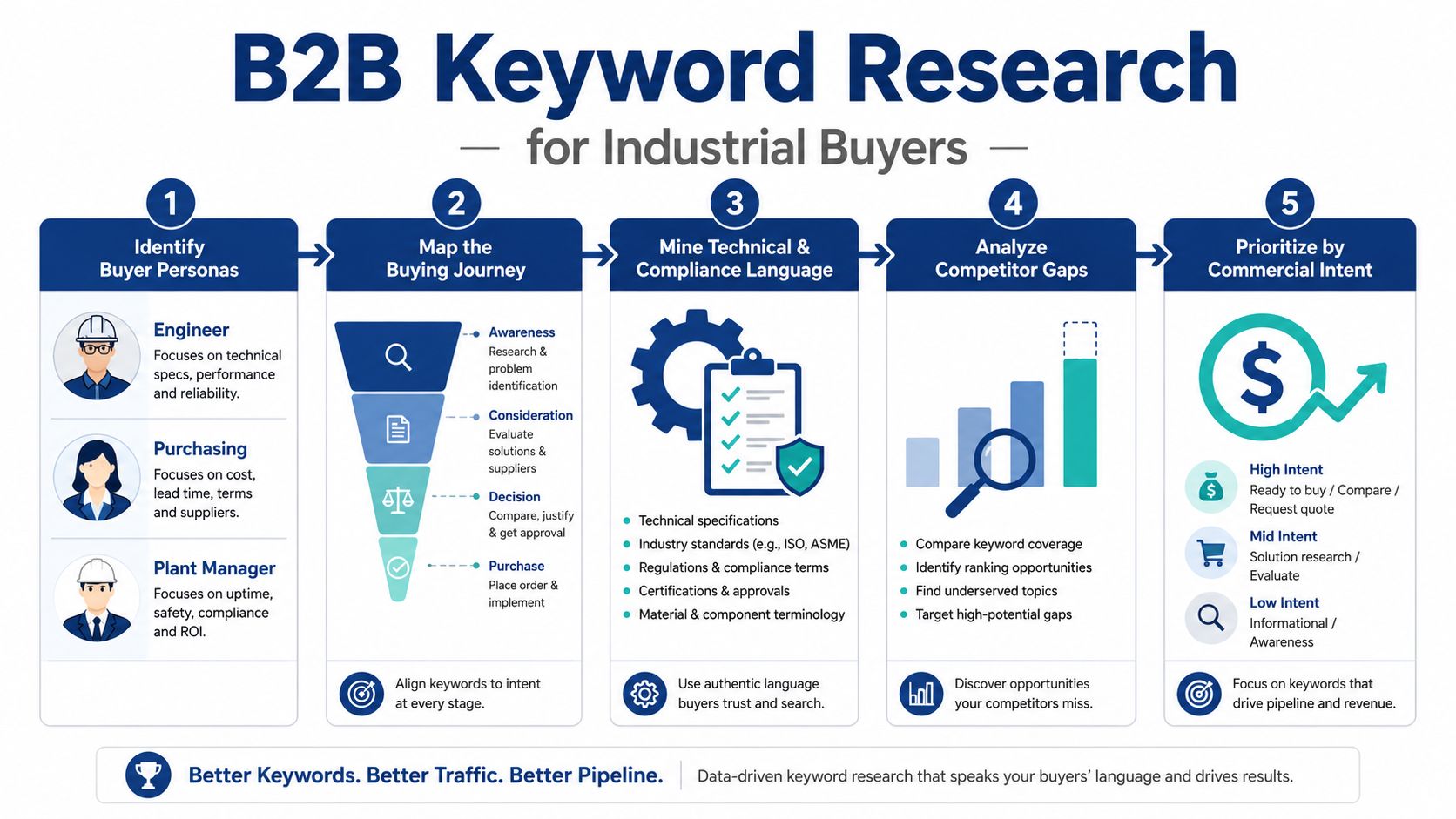
Industrial keyword research works best when we treat it as a vocabulary and intent-mapping exercise. Engineers, operations leaders, and procurement managers may describe the same commercial need in completely different language.
Google's own research says 71% of B2B researchers start with a generic search and 90% use search to research business purchases, according to Google's B2B research findings. A useful keyword map must therefore cover the early problem and the later vendor decision, not just the product category.
Start with the committee
Build three working lists before opening a keyword tool:
- Engineer language: Materials, tolerances, part numbers, failure modes, ASTM references, ISO references, performance requirements, and process terminology.
- Operations language: Downtime, throughput, maintenance, integration, staffing, quality control, changeover, and production constraints.
- Procurement language: Supplier, lead time, compliance, warranty, quote, total cost, approved vendor, and comparison terms.
Interview salespeople and application engineers. Review quote requests, support emails, drawings, lost-deal notes, and search queries in Google Search Console. The language already used by buyers is usually more valuable than a generic keyword list exported without context.
Add intent to every term
Assign each query to one of five stages:
- Problem-aware: The buyer identifies a defect, bottleneck, failure, or risk.
- Solution-aware: The buyer investigates process categories or possible approaches.
- Vendor-aware: The buyer looks for suppliers, manufacturers, or service providers.
- Comparison: The buyer evaluates alternatives, specifications, or trade-offs.
- Procurement-ready: The buyer wants pricing context, lead times, documentation, or a quote.
A single topic should support a cluster of related queries rather than one isolated phrase. Use the keyword strategy for manufacturers to organize those terms into pages that reflect how a buyer's questions change during evaluation.
Prioritize commercial fit
Validate each topic in traditional tools such as Google Search Console, Ahrefs, or Semrush. Then inspect the actual search results and ask whether the page types match your opportunity. If the results are dominated by forums, general education, or distributors, you may need a more specific angle or stronger proof.
Also test the language in AI answer engines. The same engineers who search Google may ask ChatGPT or Perplexity for supplier categories, material comparisons, or process explanations. The objective isn't to chase every answer surface. It's to identify which questions require clear definitions, structured facts, and evidence that an automated system can interpret accurately.
Score each topic on:
- Buyer relevance
- Application fit
- Commercial intent
- Existing authority
- Sales enablement value
- Proof available internally
A narrow query from a qualified buyer can outrank a broad topic in business value. Your final backlog should tell the team what to publish first because it can influence revenue, not because it's easy to write.
Technical SEO Foundations for Industrial Websites
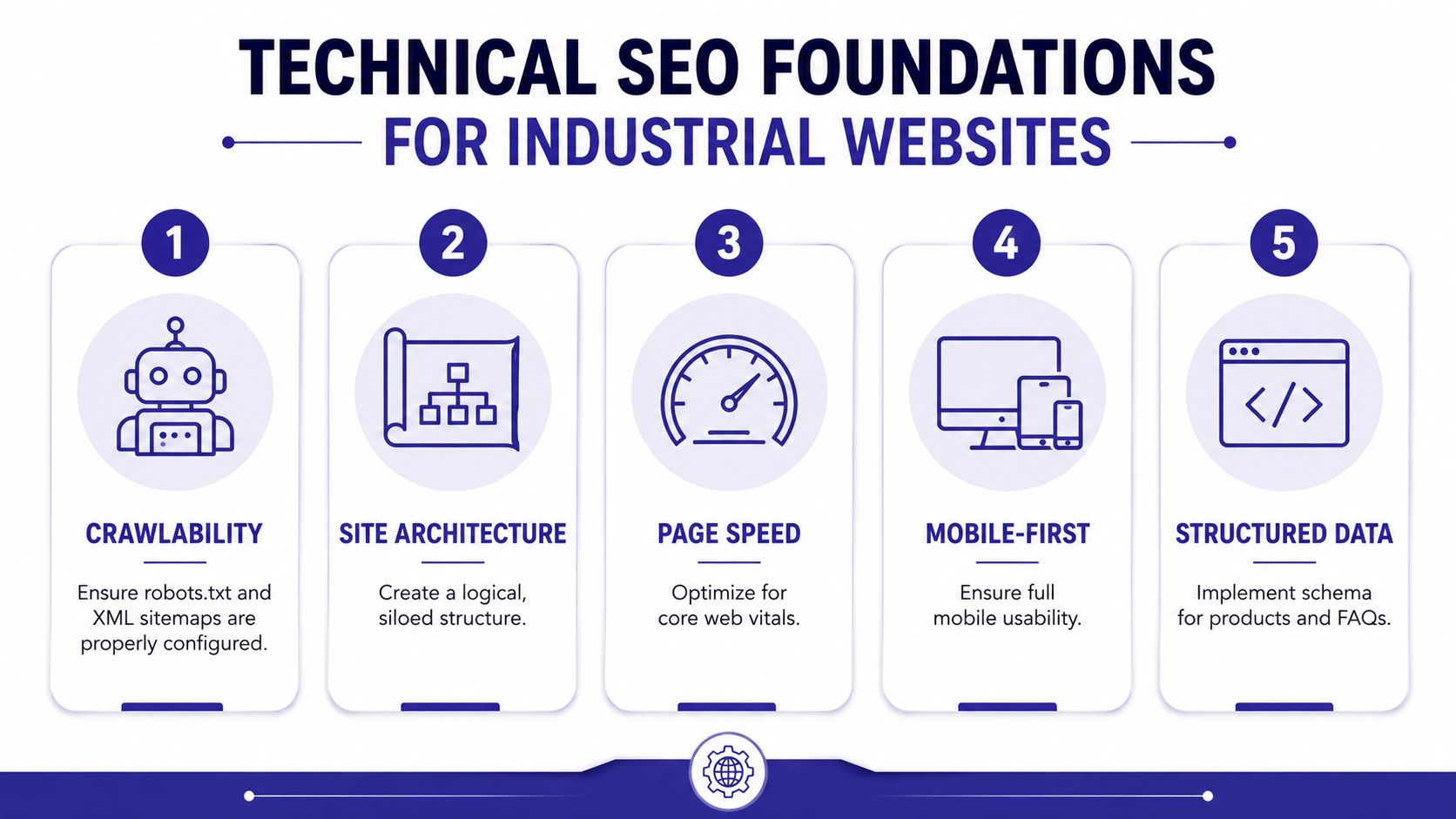
Technical SEO determines whether buyers and search systems can find the pages you worked hard to create. Google explains that pages blocked from crawling, marked noindex, or otherwise inaccessible can't appear in Search, as summarized in Google's indexability guidance.
Fix discovery first
Industrial sites often bury revenue pages beneath product filters, regional folders, or JavaScript navigation. Keep product families, application pages, case studies, and technical resources reachable through ordinary HTML links. Segment XML sitemaps by product family, content type, or language so developers can identify problems without sorting through one oversized file.
Use a crawl tool such as Screaming Frog or Sitebulb to inspect:
- Robots.txt rules: Confirm that important product and application sections aren't blocked.
- XML sitemaps: Include only canonical, indexable URLs.
- Internal link depth: Keep priority revenue pages within a shallow path from the homepage.
- Broken links: Repair links that lead to deleted products, redirected variants, or error pages.
Google's guidance on JavaScript SEO and rendering highlights a common industrial failure mode. A configurator or 3D viewer may look complete in a browser while critical product text remains difficult for search systems to process. Render essential specifications, navigation, descriptions, and links in HTML wherever possible.
Control duplication and meaning
Part numbers, SKU variants, filters, and parametric URLs can create several addresses for nearly identical content. Use canonical tags deliberately, consolidate duplicate pages, and decide which variants deserve unique search visibility.
Add structured data where it accurately describes the page:
- Product for eligible product information
- FAQPage for genuine buyer questions and answers
- Organization for company identity
- BreadcrumbList for hierarchy and navigation context
Schema doesn't compensate for weak content or inaccessible pages. It helps machines interpret information that already exists.
Developer handoff checklist
Give your developer this sequence:
- Crawl the full site.
- Export blocked URLs.
- Review noindex directives.
- Validate XML sitemaps.
- Check canonical tags.
- Identify duplicate product variants.
- Test JavaScript-rendered content.
- Review internal link depth.
- Repair broken internal links.
- Confirm mobile usability.
- Test page templates for speed.
- Add accurate breadcrumb markup.
- Validate organization and product data.
- Re-crawl after deployment.
The technical SEO audit checklist for manufacturers gives your team a practical handoff document. Fixing access and architecture before publishing content prevents your investment from disappearing into an indexation problem.
Content Formats That Earn Trust in B2B SEO Marketing
Manufacturing buyers don't trust a page because it contains a target keyword. They trust it when the page demonstrates that the supplier understands the application, constraints, risks, and decision criteria.
Four formats consistently support that job:
- Application pages: Connect a product or process to a specific use case, such as honing equipment for hydraulic cylinders. These pages capture solution-aware demand and help engineers determine fit.
- Comparison pages: Explain trade-offs between materials, equipment types, legacy systems, or competing approaches. A useful comparison defines where each option works and where it doesn't.
- Case studies: Show the original problem, the selected solution, implementation conditions, and measurable customer outcome. Don't publish vague praise when the customer can provide operational evidence.
- Technical guides: Address complex engineering questions in enough depth that a practitioner can use the page during internal research.
Match format to buying stage
Application pages introduce relevance. Comparison pages support evaluation. Case studies reduce perceived risk. Technical guides establish depth and give internal champions something credible to share.
A page can serve multiple stakeholders, but it should have one primary job. An engineer may enter through a technical guide, an operations leader may review an application page, and procurement may later inspect certifications, delivery information, or a supplier comparison.
| Content Format | Awareness Stage | Evaluation Stage | Validation Stage | Typical Production Effort |
|---|---|---|---|---|
| Application page | Strong | Strong | Moderate | Moderate |
| Comparison page | Moderate | Strong | Strong | Moderate to high |
| Case study | Low to moderate | Strong | Strong | High |
| Technical guide | Strong | Strong | Moderate | High |
Use evidence instead of polish
A polished page with generic claims won't outperform a plain page that answers the buyer's real question. Include drawings, process boundaries, material notes, certification details, test methods, implementation considerations, and clear limitations when available.
The proposed 100/100/40 distribution can serve as an editorial planning model for a mid-sized manufacturer, with roughly 100 application pages, 100 comparison pages, and 40 deeper assets. Treat it as a target library shape, not a rule to publish thin pages. If your team lacks the evidence to make a page useful, consolidate the topic or wait until engineering and sales can contribute.
Start with the format closest to existing proof. A strong application page may be faster to produce than a case study that requires customer approval. A comparison page may create more sales value than another general blog post if buyers already ask your reps how two approaches differ.
Link and Authority Building in Niche Industrial Verticals
Manufacturers rarely win authority by publishing more generic content than large media sites. They win by becoming the most useful technical source inside a defined industrial network.
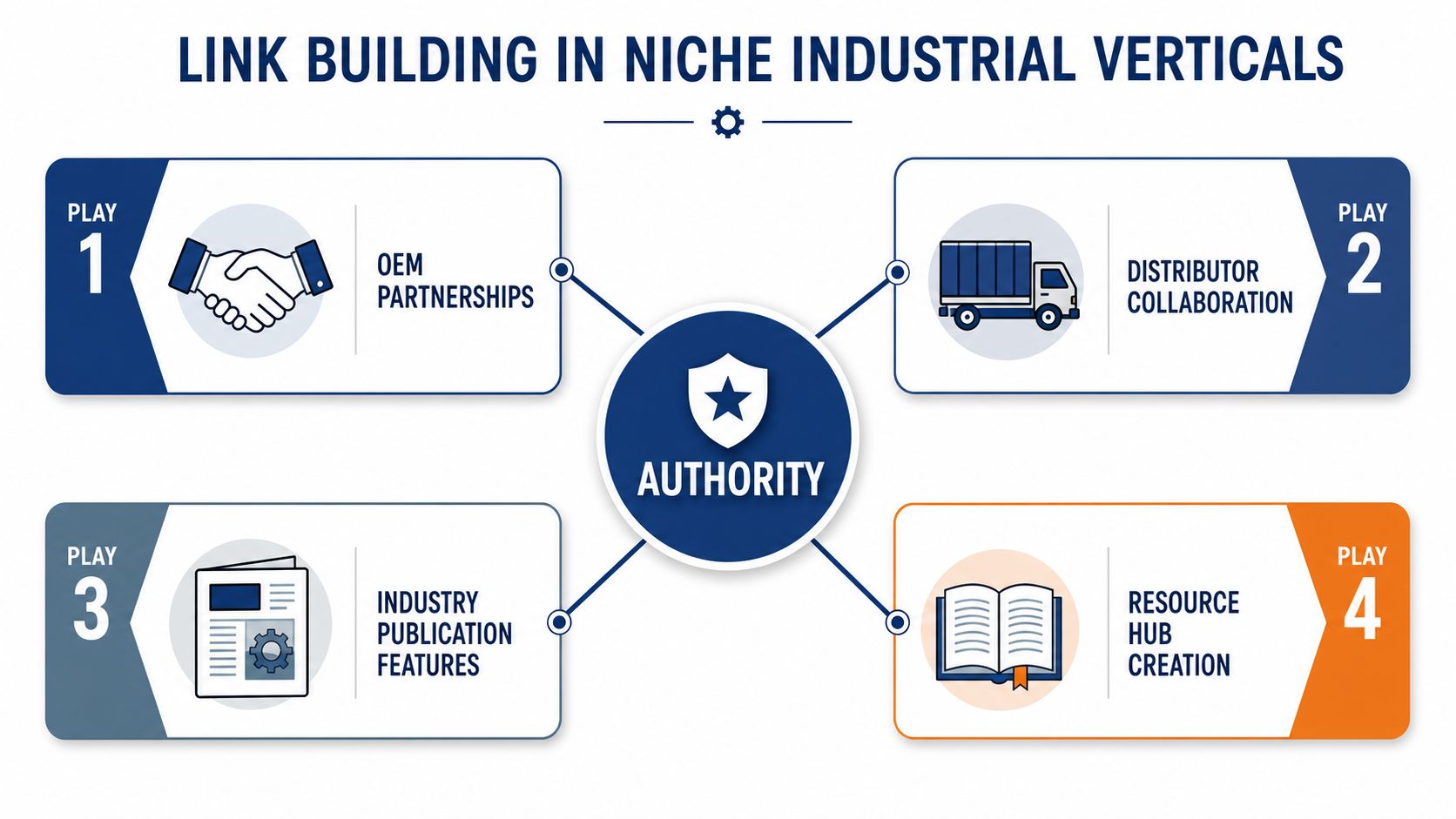
The strongest links usually come from places connected to the buyer's work:
- OEM partnerships: Publish a joint application note with a complementary equipment maker.
- Distributor collaboration: Create a technical guide that helps a distributor sell and specify the solution correctly.
- Trade publications and associations: Pitch useful engineering material to publications and industry organizations that serve your market.
- Supplier directories: Maintain accurate listings where procurement teams research vendors.
- Digital PR: Tie announcements to certifications, standards work, technical innovation, or original operational insight.
Qualify prospects before outreach
A relevant referring domain is usually more valuable than a long list of generic directory links. Score prospects using three questions:
- Topical relevance: Does the site serve your industry, application, or buyer?
- Authority quality: Does it publish credible material and earn genuine references?
- Traffic reality: Do real people appear to use the publication, association, or directory?
Don't rely on a single third-party authority score. A smaller trade association that engineers recognize can be more useful than a broad site with impressive software metrics but no connection to your market.
Use specific outreach
For a distributor:
Subject: Technical resource for [shared application]
We created a practical guide covering [application or process], including [specific technical detail]. Your customers already ask about this issue, so we'd like your review before we publish it. If it meets your standards, we can add your perspective and provide a version your sales team can share.
For an OEM:
Subject: Joint application note for [equipment and process]
We see a recurring integration question around [specific problem]. Our team can document the manufacturing side, while your engineers cover the equipment requirements. Would a co-branded technical note help your customers evaluate the application?
The backlink strategy for manufacturers can help turn those relationships into a structured prospecting and follow-up process. The aim isn't to collect links. It's to create assets that partners have a reason to reference.
Measurement and KPIs That Match Your Sales Cycle
A ranking report can look healthy while the sales pipeline remains unchanged. Manufacturers need measurement that follows a buyer from the first organic interaction through account engagement, opportunity creation, and revenue.
Industrial sales cycles often run 6 to 18 months, so a page published this quarter may influence a deal much later. That delay doesn't make SEO unmeasurable. It means the CRM, analytics, and reporting model must preserve the relationship between early research and later sales activity.
Use four measurement layers
| Layer | Metric | Why It Matters | Cadence |
|---|---|---|---|
| Leading indicators | Qualified search impressions, branded search lift, technical health | Shows whether visibility and access are improving | Monthly |
| Pipeline indicators | Organic MQLs, organic SQLs, opportunity creation | Connects search activity to sales progression | Monthly |
| Revenue indicators | Closed-won influenced deals, organic-sourced account value | Shows business contribution | Quarterly |
| Efficiency indicators | CAC payback, organic share of pipeline | Guides investment and channel decisions | Quarterly |
A monthly owner-led review can stay simple:
- Check priority landing pages and search queries in Google Search Console.
- Review organic contacts and account source data in the CRM.
- Confirm which contacts became qualified opportunities.
- Ask sales which pages prospects mentioned or shared.
- Record new questions from calls and add them to the content backlog.
- Note technical issues, page changes, and campaign activity.
Make attribution usable
Use consistent UTM conventions for campaigns and assisted distribution. Preserve the original source and landing page in your CRM, then connect contact records to accounts and opportunities. First-touch attribution shows how SEO introduces demand. Multi-touch or influenced attribution shows how content supports evaluation.
Cohort reporting is especially useful. Group pages published in the same quarter, monitor their early engagement and opportunity activity, then compare those accounts with later closed-won outcomes. Don't force a precise revenue claim before the sales cycle has matured. Label early results as leading evidence and revisit the cohort as opportunities progress.
Measurement rule: If a KPI doesn't change what your team does next, it belongs in the appendix, not at the top of the report.
Your 90-Day B2B SEO Marketing Roadmap and Next Steps
A practical launch doesn't require rebuilding the entire marketing department. It requires a controlled sequence, clear ownership, and decision gates that prevent the team from publishing before the foundation is ready.
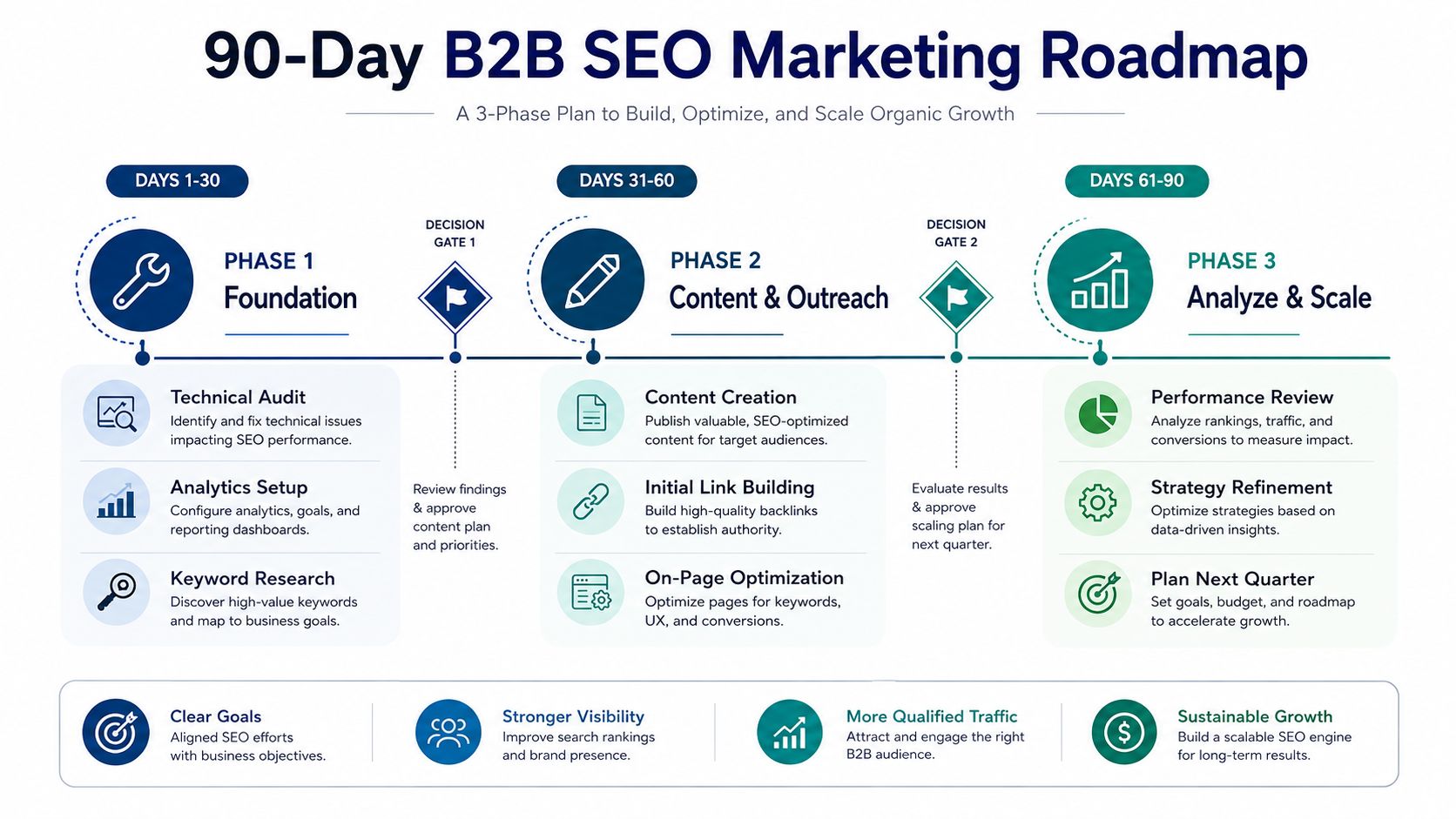
Days 1 to 30, foundation
Start with diagnosis:
- Complete a technical crawl and indexability review.
- Connect analytics, Search Console, and CRM source tracking.
- Capture baseline visibility, qualified inquiries, and opportunity data.
- Interview sales, engineering, operations, and procurement stakeholders.
- Build a buyer-committee keyword map covering the top 50 priority terms.
- Identify existing pages that should be improved before new pages are created.
An in-house marketing lead can coordinate interviews, export CRM data, document buyer language, and manage the priority spreadsheet. A specialist agency should handle complex JavaScript rendering issues, canonical problems, migration risks, and technical recommendations that require developer oversight.
Decision gate: Don't move to production until the team knows which pages matter commercially, who owns each technical fix, and how organic contacts will enter the CRM.
Days 31 to 60, build
Create four cornerstone assets:
- One application page tied to a high-value use case.
- One comparison page that addresses a real specification or supplier decision.
- One technical guide led by an engineer or subject-matter expert.
- One case study with customer-approved operational evidence.
Build the internal link architecture while publishing. Link from relevant guides to application pages, from application pages to products, and from proof assets to conversion paths. Prepare a prospecting list of 100 prospects across distributors, trade publications, and industry associations, as defined in the roadmap.
The in-house lead can manage interviews, approvals, editorial workflow, and stakeholder distribution. A specialist partner can provide technical SEO briefs, content architecture, editing, schema implementation, and outreach systems.
Decision gate: Review whether each asset answers one defined intent, includes credible evidence, and gives the buyer a sensible next step. If not, revise before increasing production.
Days 61 to 90, activate
Execute outreach to qualified partners, publications, and associations. Activate the reporting dashboard, reconcile organic source data with CRM records, and build a 12-month content calendar from sales questions, application priorities, and the keyword map.
Use this phase to decide whether the system deserves more investment:
- Scale when pages attract qualified visibility, sales uses the assets, and opportunity tracking is working.
- Iterate when technical access is sound but the content attracts the wrong audience or fails to support conversations.
- Pause and diagnose when tracking is unreliable, internal experts won't contribute, or the target market doesn't show meaningful search behavior for the proposed topics.
Budget should follow complexity, not a generic package. A site with a small product catalog may need focused strategy and implementation. A manufacturer with configurators, multiple product families, international sections, or a large legacy library needs deeper technical and content resources. Estimate internal time by deliverable and assign agency costs after the audit, rather than choosing a fixed program before the scope is known.
Use the roadmap as an operating system, not a campaign. SEO compounds when technical maintenance, expert content, partner authority, and CRM feedback continue working together.
The core diagnosis is straightforward. Your buyers already research online, but your expertise may not be organized into pages they can find, trust, and share. B2B SEO marketing gives manufacturers a way to capture that research demand and connect it to pipeline without relying entirely on trade shows, referrals, or outbound prospecting.
Machine Marketing helps manufacturers and industrial businesses diagnose SEO gaps, build buyer-focused content systems, improve technical website performance, and connect organic activity to sales pipeline. Visit Machine Marketing to request a practical assessment of your current site and identify the next highest-value SEO move.