If you're a manufacturer, you may already have the raw material for strong SEO and not realize it. Your suppliers know you. Your distributors list the lines they carry. Your OEM partners reference approved components. Your engineers have spec sheets, application notes, and process documentation that buyers utilize. Yet online visibility still lags because most link building advice assumes you're a software company publishing trend pieces, not an industrial business solving technical problems.
That gap matters because backlinks still sit close to the center of search performance. Thomas states that Google's three most important ranking factors are content, backlinking, and relevancy to a search query, which is why backlinks function as trust signals in industrial markets where buyers compare vendors carefully before they contact sales (Thomas on backlinks for manufacturers and distributors). If you're trying to boost industrial visibility and leads, the right question isn't “How do we get more links?” It's “Which links reinforce the authority we already have in practice?”
Table of Contents
- Why Generic SEO Advice Fails Manufacturers
- Your Backlink Audit A Systems Diagnosis
- Mapping Your High-Value Link Ecosystem
- Create Assets That Earn Links on Merit
- A Practical System for Outreach and Partnerships
- Your 90-Day Implementation Roadmap
Why Generic SEO Advice Fails Manufacturers
Generic SEO advice usually breaks at the first point of contact with an industrial company. It tells you to publish general blog posts, buy into broad guest posting campaigns, or chase links from sites that have no connection to your market. That might create activity. It rarely creates authority that matters to engineers, procurement teams, or technical evaluators.
A manufacturer's web presence works more like a supply chain than a media brand. Trust comes from fit, documentation, consistency, and proof. A single link from an industry association, a respected distributor, or a technical resource page can carry more strategic value than a stack of irrelevant blog placements because the context matches the way industrial buyers research.
Industrial buyers don't reward generic authority
When a buyer is comparing servo components, conveyors, machined parts, sensors, filtration systems, or contract manufacturing options, they aren't looking for whoever posted the most lifestyle content. They want confidence that your company belongs in the category and understands the application.
That changes the entire logic of a backlink strategy for manufacturers.
Practical rule: Relevance comes before volume. If a link wouldn't make sense to a buyer, it probably won't strengthen your authority much either.
Many manufacturers already have an offline reputation that never got translated into the site architecture. They have approved vendor status, certification pages, distributor relationships, media mentions, and technical documents scattered across PDFs and partner pages. Generic SEO misses that asset base completely.
What works better in manufacturing
A stronger approach starts with the assets and relationships already tied to your business:
- Supplier links: Component suppliers often maintain partner, integrator, or customer spotlights.
- Distributor references: Resellers and channel partners may be able to link directly to product families or technical resources.
- OEM partnerships: Joint applications, compatibility pages, and integration guides can support deep links.
- Association profiles: Membership listings often provide credible category signals.
- Documentation pages: Spec sheets, CAD resources, and application guides can become natural link targets.
That's the difference between borrowed authority and earned authority. One is rented attention. The other reflects your actual position in the market.
Your Backlink Audit A Systems Diagnosis
Before you ask for a single new link, diagnose the system you already have. In manufacturing, that means treating your backlink profile like an operational review. You're checking where authority comes from, where it's wasted, and where known relationships haven't been connected to the site.
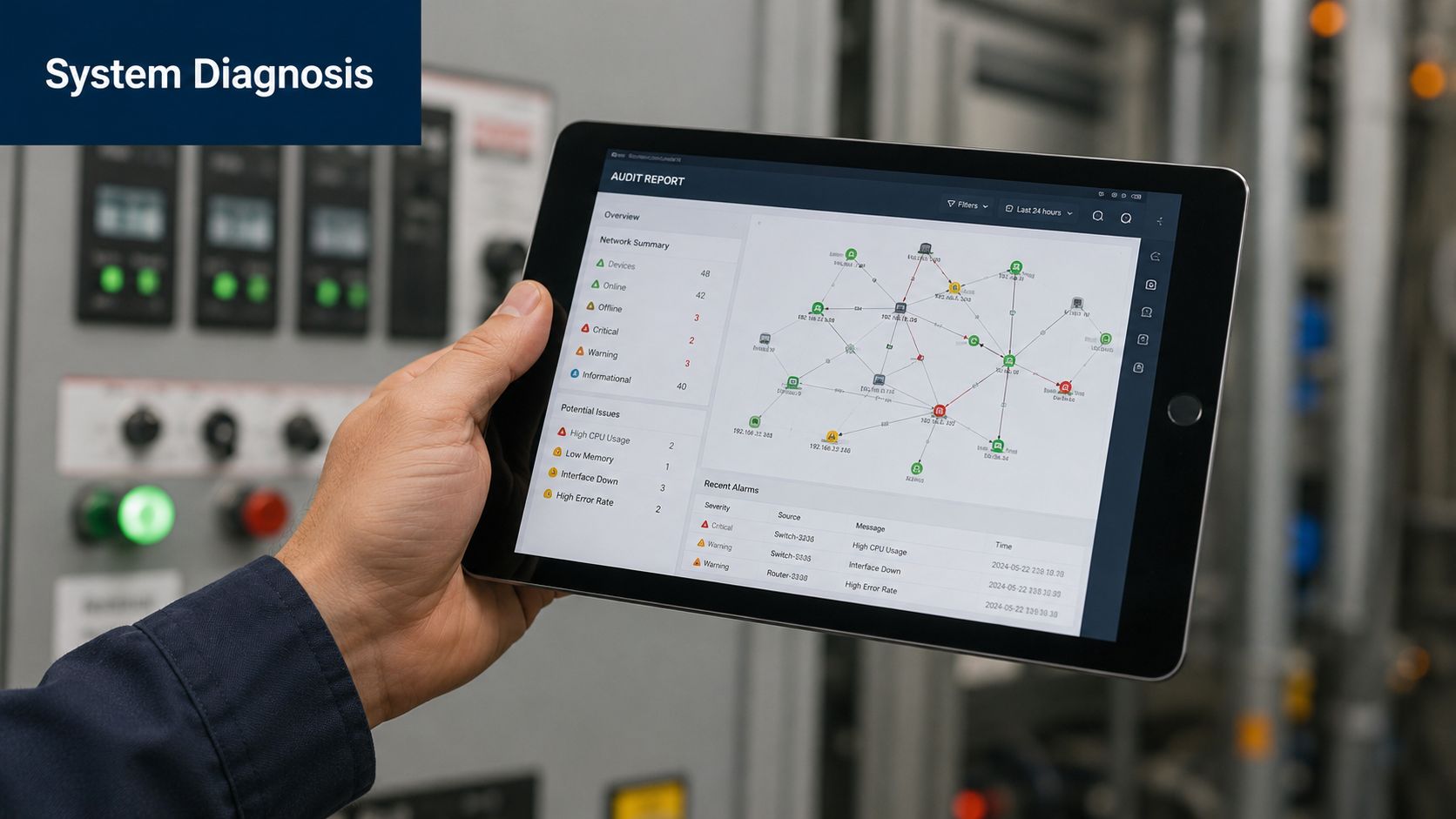
Tools like Ahrefs and Semrush help with the mechanics, but the true value comes from interpretation. If you need a clear baseline on what you're reviewing, this guide on a backlink profile is a useful primer before you start sorting good links from dead weight.
Start with the current state
Pull a list of referring domains and linked pages. Then stop looking at the report like a marketer and start reading it like an engineer.
Ask basic but important questions:
- Who links to you now?
- Which business relationships are already visible online?
- Are the links pointing to the homepage, or to real technical pages?
- Which pages attract links but don't help a buyer move forward?
- Which important pages have no external references at all?
You'll usually find one of three patterns.
| Pattern | What it usually means | What to do |
|---|---|---|
| Homepage-heavy profile | Brand awareness exists, but technical content isn't earning trust signals | Build links to spec, category, and application pages |
| Random low-fit links | Past SEO activity prioritized quantity over context | Stop replicating that pattern and focus on industry relevance |
| Thin link coverage overall | The company has relationships, but nobody has activated them digitally | Turn existing partnerships into structured outreach targets |
Use a diagnostic checklist
A solid audit doesn't need to be complicated. It needs to be honest.
- Check link relevance: Are linking sites in manufacturing, distribution, engineering, education, trade media, or local business ecosystems that actually relate to your company?
- Review destination pages: Are valuable pages such as product categories, spec sheets, resource libraries, or application guides receiving links, or is everything funneling to the homepage?
- Flag unlinked mentions: Search your brand name, product line names, and leadership names. Media coverage and directory mentions often cite the company without linking.
- Inspect broken opportunities: Old PDFs, retired product pages, and migrated resources often leave backlinks stranded.
- Look for relationship gaps: If you've sold through distributors for years and none of them link to you, that's not a visibility problem. It's a process gap.
- Assess site credibility of prospects: Broad outreach to off-topic sites creates noise. Prioritize sites that appear maintained, have identifiable authors, and show signs of real activity.
A backlink audit for manufacturers isn't a scorecard. It's a map of where your market already trusts you and where your site fails to reflect that trust.
One more point matters here. Don't only count links. Compare links against business value. A link to a technical resource that supports quoting, specification, or application fit is usually more useful than a branded mention that sends nobody deeper into the buying process.
Mapping Your High-Value Link Ecosystem
The strongest backlink opportunities for manufacturers usually aren't hidden in obscure SEO databases. They're sitting in plain view inside the commercial network you already depend on every week.
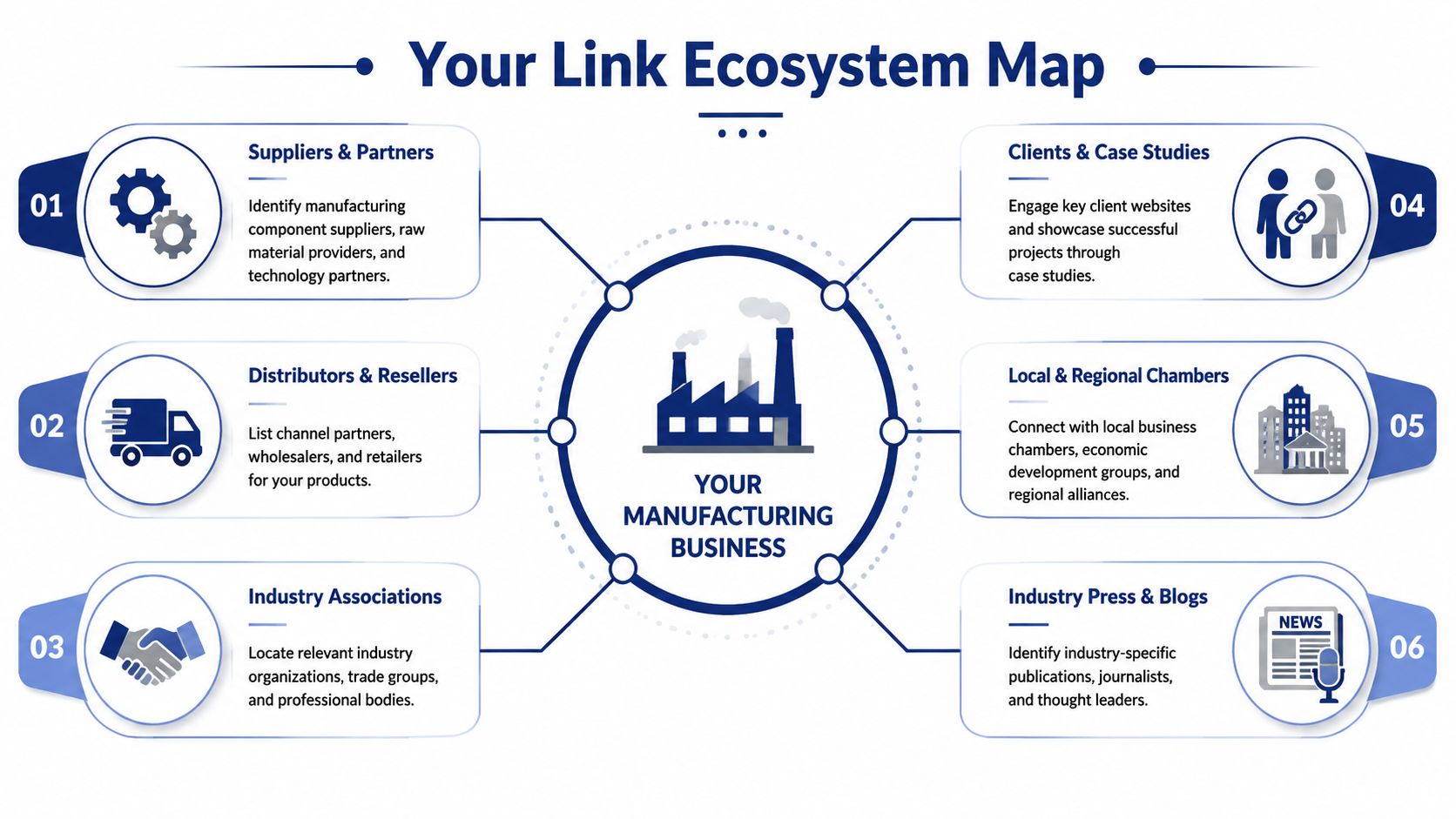
A useful backlink strategy for manufacturers starts by drawing that ecosystem out. Put your company in the center, then build outward based on relationships that already exist in operations, sales, distribution, engineering, and compliance.
The relationships you already have
Most industrial companies can build a meaningful prospect list without touching generic link prospecting software.
Consider these categories first:
- Suppliers and technology partners: If you integrate a motion component, resin, control system, or packaging technology into a finished solution, there may be a partner page, case story, or application listing where your company belongs.
- Distributors and resellers: Channel partners often maintain manufacturer pages, line card pages, territory pages, or resource hubs. These are often overlooked and highly relevant.
- OEM and integration partners: If your products are approved, compatible, or commonly paired with another company's system, there may be room for links through integration notes, recommended vendors, or application examples.
- Industry associations and certification bodies: Membership directories aren't glamorous, but they support credibility. They also tend to fit the category signals manufacturers need.
- Customers with public case studies: Some customers won't link. Others will, especially when the project has a technical or operational angle worth documenting.
- Regional business organizations: Chambers, manufacturing alliances, and economic development groups often feature member businesses, award recipients, exporters, or local employers.
- Trade media and niche blogs: These become far easier targets once you have a technical resource worth citing.
How to prioritize the map
Not every relationship deserves outreach at the same time. Prioritize by fit and feasibility.
A simple decision filter works well:
| Relationship type | Why it matters | Best link target |
|---|---|---|
| Supplier or partner | Strong topical fit and existing relationship | Partner page, application page, integration guide |
| Distributor | Product relevance and buyer-facing traffic | Product family page, manufacturer page, spec resource |
| Association | Category trust | Company profile or member listing |
| Customer | Proof and real-world use case | Case study, project page, application note |
| Trade publication | Reach and credibility | Research asset, how-to guide, benchmark piece |
What you're looking for is not just authority in the SEO sense. You're looking for defensible authority. Competitors can copy a guest post campaign. They can't easily replicate your long-term supplier status, your approved distributor network, your product validation in a customer environment, or your role in a niche industrial segment.
Diagnostic question: If a prospect removed all SEO value from the equation, would the relationship still make business sense? If yes, it's probably a good outreach target.
This is also where many companies realize they've been underusing existing materials. Sales teams know who the distributors are. Engineering knows which OEMs your parts fit into. Operations knows which certifications and standards matter. Marketing often just hasn't converted that knowledge into a link ecosystem map.
Build that map once, and your prospecting becomes far less random.
Create Assets That Earn Links on Merit
Manufacturers don't need more content for content's sake. They need assets that solve a technical problem, reduce friction in evaluation, or help someone make a specification decision. That's what earns links on merit.
Technical utility beats marketing fluff
The clearest pattern in backlink performance is that quality and usefulness beat volume tactics. One industry roundup reports that 94% of link builders prioritize quality over quantity, and it also states that original research reports and data-driven studies attract 6.4 times more backlinks than opinion-based articles. The same analysis says interactive data visualizations can earn an average of 487 referring domains per piece, versus 62 for standard blog posts on the same topics (backlink statistics roundup).
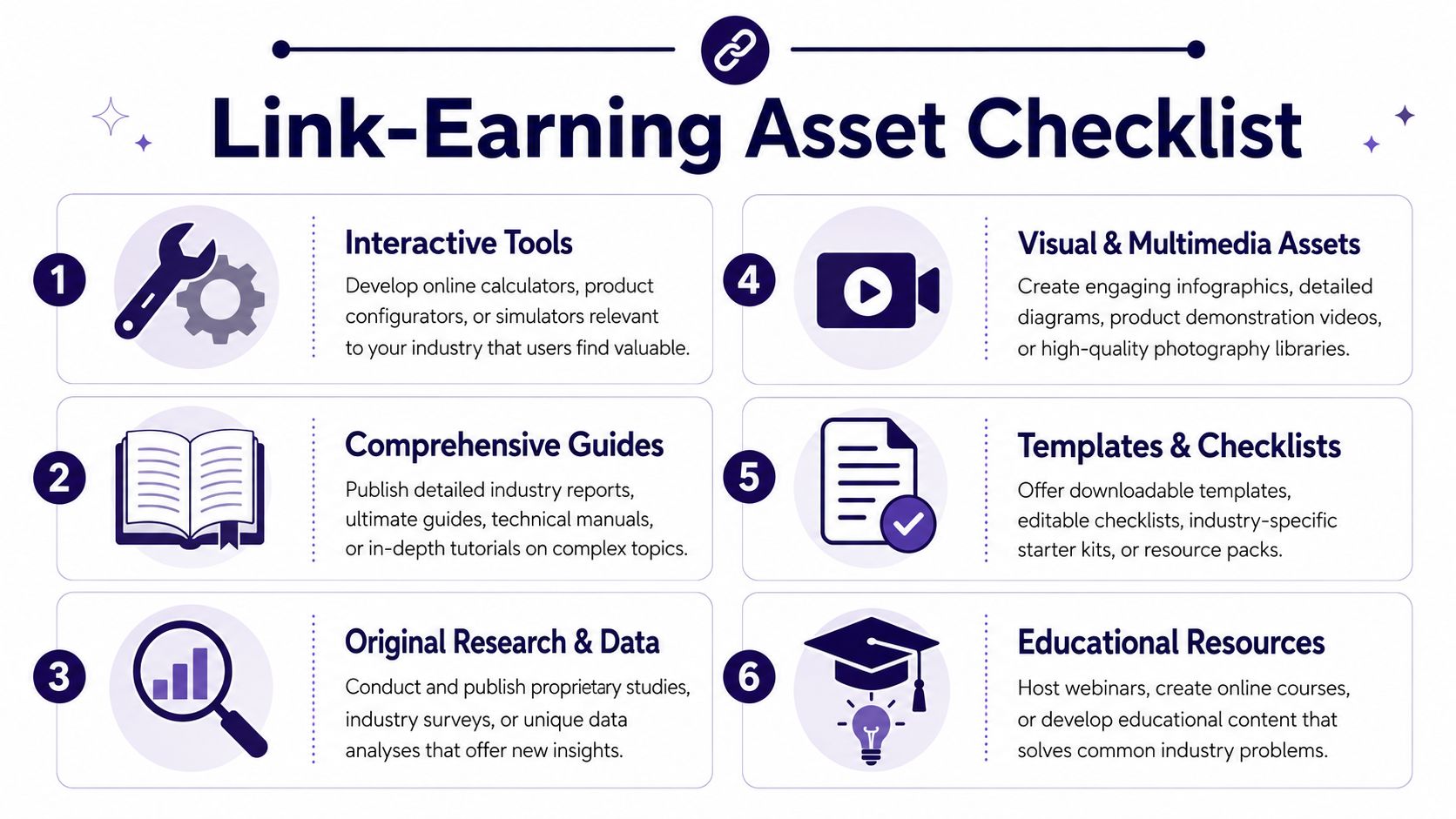
For manufacturers, that isn't abstract SEO theory. It points directly to the kinds of assets buyers, journalists, educators, and partners reference:
- benchmark studies
- engineering calculators
- spec comparisons
- application guides
- reference libraries
- technical data hubs
If you've been publishing lightweight thought leadership while your real knowledge sits locked inside internal PDFs, sales decks, or engineering folders, you're underinvesting in the pages most likely to attract links.
A practical example helps. If your company serves regulated or controlled environments, a page explaining standards and production requirements has real citation value. A technical resource on ISO 7 clean room compliance is the kind of page other sites can reference because it addresses a narrow, credible question instead of sounding like a sales brochure.
What manufacturers should build first
The best asset usually isn't the flashiest one. It's the one closest to an existing buying question.
Use this order of operations.
Start with repeated sales and engineering questions
If your team answers the same technical question in calls and emails, that topic should probably become a public asset.Turn internal knowledge into usable tools
A sizing calculator, material selector, tolerance guide, cleanability checklist, compliance explainer, or maintenance matrix can outperform a standard article because people use it repeatedly.Build depth where buyers evaluate fit
Many companies miss the mark. The highest-ROI links often belong on technical pages, not the homepage. Product pages, CAD libraries, application notes, and comparison resources often do more for both rankings and lead quality than broad corporate pages.Package proof into citation-ready formats
If you have field data, test comparisons, process benchmarks, or performance documentation, turn them into a page with clear charts, diagrams, and interpretation.
A related discipline is topical authority. If you're building clusters around a niche manufacturing subject, this resource on topical authority for a manufacturing blog gives a practical way to connect technical content into a stronger authority structure.
Here's a useful benchmark for your own planning.
| Asset type | Why it earns links | Best audience |
|---|---|---|
| Engineering calculator | Solves a recurring problem | Engineers, specifiers, educators |
| Spec comparison page | Helps evaluate options quickly | Procurement, design engineers |
| Application guide | Connects product to real use case | OEMs, integrators, buyers |
| Benchmark or test summary | Provides evidence others can cite | Trade media, partners, technical buyers |
| Resource library | Centralizes documentation | Distributors, customers, sales teams |
This walkthrough is worth watching if you're thinking about how content format affects visibility and discoverability:
The pages that win links in industrial SEO usually answer a narrow question better than anyone else. They don't try to sound impressive. They try to be useful.
If you want links that support revenue, build pages another site can justify citing.
A Practical System for Outreach and Partnerships
Once the asset exists, outreach becomes much simpler. You're no longer asking someone to “check out our company.” You're offering a resource that fits a page they already maintain, a buyer problem they already address, or a relationship they already recognize.
A practical workflow for link acquisition follows a clear sequence: build useful resources, find relevant opportunities like unlinked mentions, broken backlinks, and resource pages, then send a short value-first email while focusing on sites that are credible and on-topic (Semrush backlink outreach workflow).
The workflow that keeps outreach credible
Use a pipeline, not a blast.
- Step one, match asset to audience: A supplier page may fit your integration guide. A trade publication may fit your benchmark piece. A university lab may fit your technical explainer.
- Step two, segment prospects by relationship strength: Existing partners first. Warm industry contacts second. Cold but highly relevant prospects third.
- Step three, verify page fit before outreach: Find the exact page where your resource belongs. Don't ask a distributor for a generic homepage link if they have a manufacturer index or product resource center.
- Step four, keep the ask small: Ask for inclusion, replacement, or citation. Don't send a long pitch deck.
- Step five, log outcomes: Track contact, page, asset, status, follow-up date, and whether the final link points to the intended page.
If you're coordinating this with channel marketing or partner campaigns, a documented co-marketing strategy can help align who owns outreach, approvals, and shared content.
Field note: The best outreach in manufacturing feels like professional coordination, not demand generation.
Two outreach templates that fit manufacturing
Template one for a supplier or OEM partner
Subject: Resource for your partner or application page
Hi [Name],
We noticed your site includes information on [product line, application, or partner category]. We've published a resource on [specific topic] that helps engineers and buyers evaluate [problem or specification question].
If it's useful for your audience, it may fit on your [partner/resources/application] page:
[insert page link]
If there's a better page for it, feel free to point us there.
Thanks,
[Name]
Why this works: it's specific, short, and based on existing commercial alignment.
Template two for a trade publication or industry resource page
Subject: Data-backed resource on [technical topic]
Hi [Name],
I'm reaching out because you've covered [topic] and your audience seems focused on practical implementation. We recently published a resource on [topic] that includes [benchmark data, comparison framework, calculator, application notes].
If you update your coverage or maintain a resource list on this subject, this may be useful:
[insert page link]
Either way, thanks for the work you're publishing on [industry topic].
Best,
[Name]
Why this works: it respects editorial judgment and frames the asset as useful, not self-promotional.
A few things usually don't work well:
- Mass guest post outreach: It creates weak placements with little industrial relevance.
- Pushing commercial pages too early: Most sites are more willing to link to a guide, tool, or technical reference than a sales page.
- Ignoring unlinked mentions: If people already reference your brand or products, those are often easier wins than cold outreach.
- Targeting neglected websites: If the site looks abandoned, the link usually won't justify the effort.
One practical note on tools. Ahrefs and Semrush are standard options for finding mentions, broken links, and competing resource pages. For companies that want a more guided planning process tied to industrial SEO systems, Machine Marketing is one option that supports manufacturers with strategy around authority building, content structure, and lead-focused visibility.
Your 90-Day Implementation Roadmap
Most manufacturers don't need a massive campaign to get started. They need a disciplined sprint plan that connects audit, asset creation, and outreach into one operating rhythm.
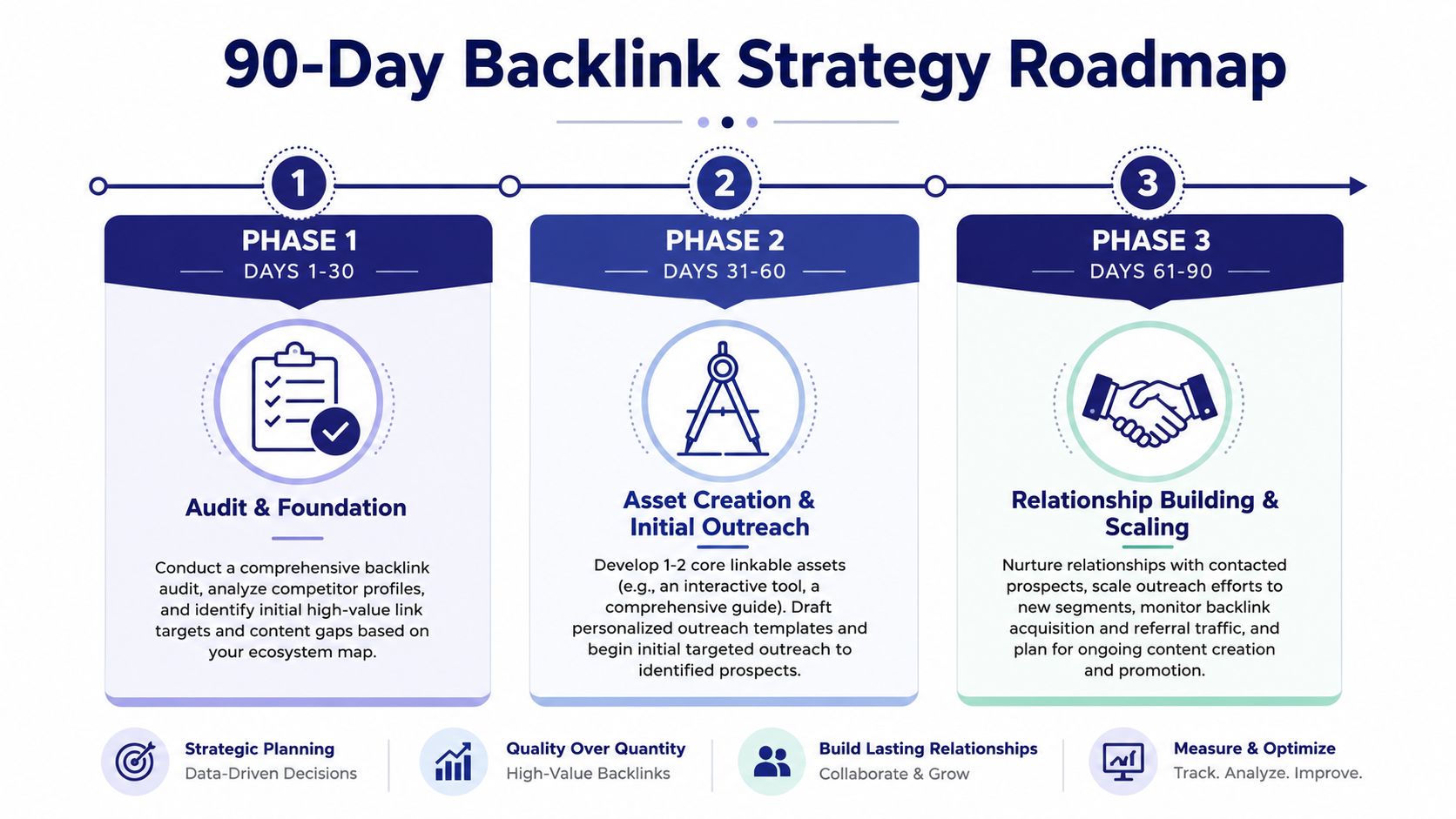
Days 1 to 30 audit and foundation
Use the first month to establish the baseline and clean up obvious misses.
- Complete the backlink audit: Review referring domains, linked pages, and missing relationship categories.
- Identify low-hanging fruit: Unlinked mentions, broken backlinks, outdated PDF links, and directory gaps belong here.
- Build your ecosystem map: List suppliers, distributors, OEM partners, associations, trade media, and customer categories.
- Choose one target topic: Pick a technical question your market repeatedly asks.
Track these indicators during this phase:
| KPI | Why it matters |
|---|---|
| Relevant referring domains | Shows whether authority is tied to your market |
| Link distribution by page type | Reveals whether technical pages are underlinked |
| Unlinked mention count | Identifies fast outreach opportunities |
| Priority partner opportunities | Turns relationships into a working pipeline |
Days 31 to 60 asset creation and initial outreach
Month two is for publishing something worth linking to and testing response with warm contacts first.
- Build one core asset: A guide, calculator, comparison page, reference library, or benchmark summary.
- Prepare destination pages: Make sure the page is clear, scannable, and useful on its own.
- Write segmented outreach templates: One for partners, one for distributors, one for media or resource pages.
- Contact your warmest prospects first: Existing relationships produce faster feedback and better language for later outreach.
A good internal checkpoint here is simple. Can a distributor, partner, or editor understand the page's value in under a minute? If not, revise before scaling.
Days 61 to 90 relationship building and scaling
The third month is where the process starts compounding. Follow up, expand into adjacent prospect groups, and review which assets attract useful links.
Focus on measurement that connects SEO to business outcomes:
- Referral traffic quality: Are visitors reaching technical pages and exploring further?
- Lead source visibility: Are inquiry forms, quote requests, or tracked calls tied to referral sessions?
- Page-level performance: Which linked assets support rankings and buyer movement?
- Relationship momentum: Which outreach categories respond well enough to systematize?
A good backlink strategy for manufacturers doesn't end with link counts. It ends with stronger visibility on the pages buyers use to evaluate fit.
By day 90, you should have three things: a clean baseline, at least one serious linkable asset, and a repeatable outreach process tied to real industry relationships. That's enough to move backlink work out of the “marketing experiment” category and into an operating system.
If you want help diagnosing where your current authority is leaking, Machine Marketing works with manufacturers to turn existing technical content, partner relationships, and SEO gaps into a clearer growth system. The fastest next step is usually a focused audit of your backlink profile, technical assets, and partner ecosystem so you can see what's worth fixing first.