You can have the best machinists, engineers, and production knowledge in your market, yet still lose an opportunity because buyers never see that expertise before they build a shortlist. A competitor with louder marketing may appear safer because they publish clearer answers to the questions your prospects are already asking.
Learning how to become a thought leader in manufacturing isn't about turning an engineer into an influencer. It's about building an operating system that captures shop-floor knowledge, supports it with evidence, publishes it consistently, and connects it to commercial decisions such as vendor selection and RFP invitations.
Table of Contents
- Why Thought Leadership Matters for Manufacturers Right Now
- What Thought Leadership Really Means and Who You Serve
- Build Your Positioning and Proof System
- Create Content That Engineers Trust and Share
- Distribute Your Ideas and Activate Hidden Buyers
- Measure What Matters and Take Your Next Step
Why Thought Leadership Matters for Manufacturers Right Now
A manufacturer can solve difficult tolerance, material, scheduling, and quality problems every week without making that capability visible to the market. Sales teams then enter conversations late, after a buyer has already formed opinions about which suppliers understand the work. The problem isn't always capability. Often, it's an evidence and visibility gap.
Thought leadership closes that gap by showing how your people think before a buyer asks for a quote. Useful content helps a prospect assess technical judgment, understand operational risk, and explain internally why your company deserves consideration. It gives hidden buyers, such as engineering, procurement, quality, and operations stakeholders, something more useful than a product sheet.
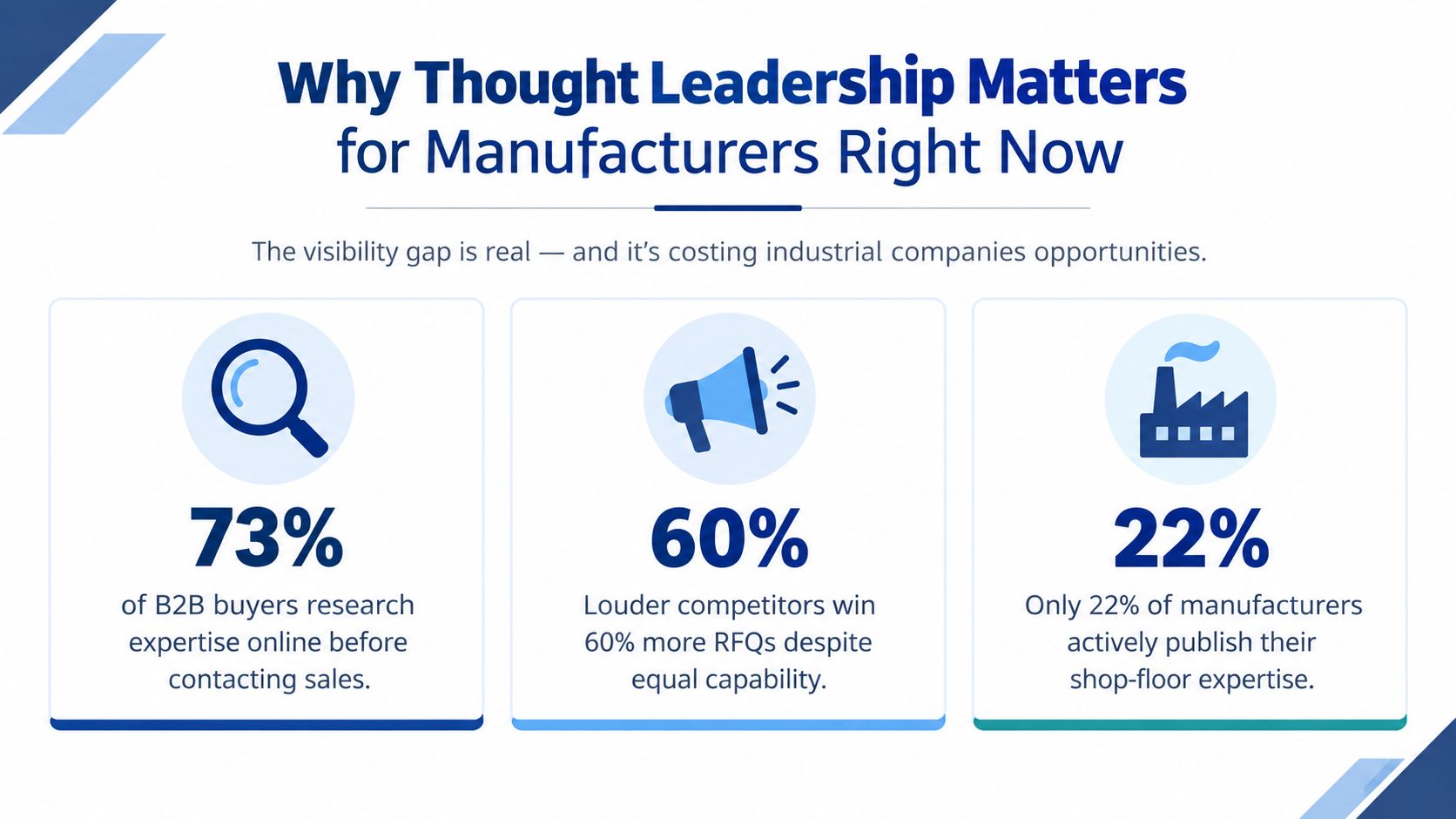
The commercial case is stronger than many industrial teams expect. In a 2024 Edelman-LinkedIn study, 99% of B2B buyers said thought leadership was important or critical to decision-making, while 66% said they wouldn't work with a provider producing poor-quality thought leadership. The same research found that 86% of buyers would invite a vendor to an RFP after strong thought leadership, and 60% would consider paying a premium for it. These figures are summarized in B2B thought leadership statistics from SHN.
Why generic content fails with technical buyers
Generic posts fail because they don't reduce uncertainty. “Quality matters” tells an engineer nothing about how you control quality. “Efficiency is important” doesn't explain which process decision prevents rework or protects delivery.
Engineers trust content that shows its working:
- A defined problem: Explain the manufacturing condition, constraint, or decision.
- A defensible position: State what you believe and where conventional practice falls short.
- Operational evidence: Use process knowledge, customer questions, test results, certifications, or clearly labeled internal observations.
- A useful consequence: Tell the reader what to inspect, compare, change, or ask a supplier.
Practical rule: If a piece of content could be published by any competitor after changing the logo, it isn't thought leadership yet.
The transformation from expertise to authority
The transformation is straightforward to describe, though it requires discipline to operate. Your team moves from answering the same technical questions privately to documenting the patterns behind those answers. Marketing then turns those patterns into useful assets, and sales uses them in the right buying context.
That system creates a visible trail of judgment. You aren't claiming to be a thought leader. You're giving the market repeated opportunities to evaluate the quality of your thinking.
What Thought Leadership Really Means and Who You Serve
Thought leadership is original thinking that helps a defined audience make better decisions. It isn't a stream of promotional announcements, a collection of credentials, or a personal branding exercise disconnected from business outcomes.
The phrase has a longer history than its modern corporate use suggests. It was already applied to public intellectuals such as Henry Ward Beecher and Ralph Waldo Emerson in the 1870s. The modern business meaning is often traced to the late 1980s and early 1990s, while Strategy+Business, launched in 1995 under Booz Allen Hamilton, helped popularize it in corporate strategy circles. This history is documented in the origin of the term thought leadership.

Define the audience before the topic
A manufacturer shouldn't try to become known for everything it can do. Choose the audience that has a costly, recurring problem and enough influence over supplier selection to act on your insight.
You might serve:
- Contract manufacturers evaluating process risk before outsourcing production.
- OEM engineering teams comparing suppliers for a difficult component.
- Procurement leaders trying to reduce late deliveries and quality surprises.
- Machine builders deciding how to improve maintainability, uptime, or serviceability.
Then narrow the subject. “Advanced manufacturing” is a category, not a position. “Helping OEM engineering teams design manufacturability into low-volume machined components” gives your team a problem to investigate and a buyer to help.
Ask yourself:
- Which technical or operational problem do customers repeatedly bring to us?
- Where does our experience contradict a common assumption?
- What decision becomes easier when a buyer understands our approach?
- Which audience would recognize the value of this insight?
- Can our engineers and operators support the position with real evidence?
Your answer should produce a working statement:
We help [specific audience] make [specific decision] by showing [distinct point of view], supported by [evidence source].
This statement gives marketing a boundary, sales a language pattern, and subject-matter experts a reason to participate. It also prevents a common failure mode, publishing broad content that attracts attention from people who will never buy.
Thought leadership becomes commercially useful when the audience can connect your idea to a decision, a risk, or a measurable operational priority. If the only outcome is that readers know your company exists, you've created awareness content. Valuable, but not yet authority.
Build Your Positioning and Proof System
Positioning tells the market what you believe. Proof tells the market why it should listen. Manufacturing companies need both because a strong opinion without evidence sounds like advertising, while evidence without interpretation becomes a technical document few buyers can apply.
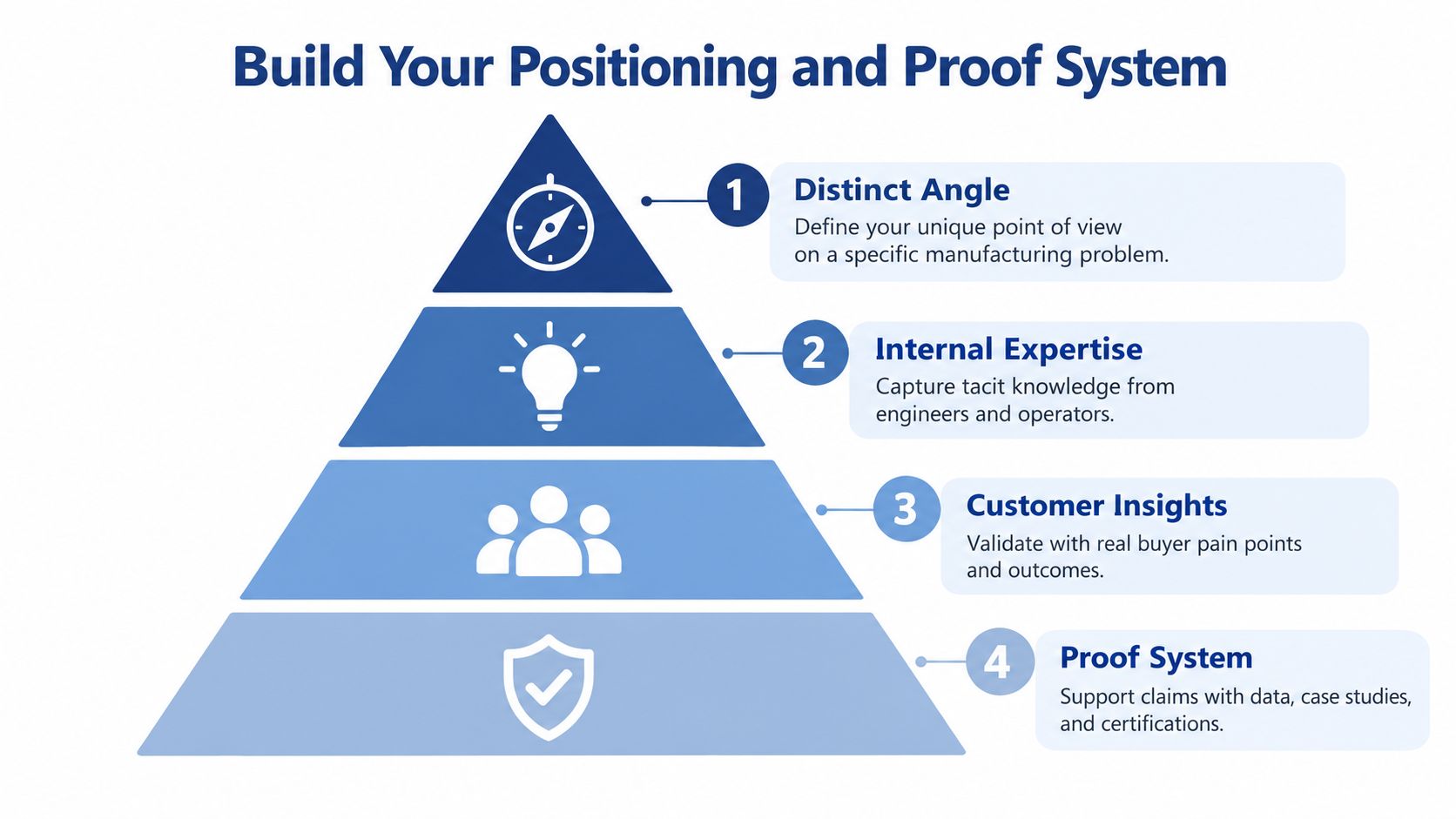
A practical system starts at the base and works upward:
- Proof system: Create a controlled inventory of data, process records, certifications, customer-approved examples, test findings, and documented lessons. Label what can be public, what requires permission, and what must remain internal.
- Customer insights: Collect the questions buyers ask before, during, and after a project. Sales calls, estimating notes, service conversations, quality reviews, and lost-opportunity feedback all reveal the decisions your audience struggles with.
- Internal expertise: Interview engineers, operators, quality leaders, and project managers. Ask them to explain where jobs go wrong, which trade-offs matter, and what inexperienced buyers tend to overlook.
- Distinct angle: Choose the point of view that connects the problem to your company's earned experience. A useful angle might challenge a common sourcing habit, clarify a design trade-off, or show why a familiar metric hides operational risk.
Turn one narrow question into original research
Proprietary research is a high authority asset because it gives you something the market can't obtain by rewriting existing articles. A 2025 industry report found that 78% of organizations use proprietary research as their main credibility driver, while only 17% have a dedicated thought leadership team with budget control. The report is available from iResearch Services.
Don't begin with “What should we publish?” Begin with one business question:
- What causes OEM teams to reject an otherwise capable supplier?
- Which information do buyers need before approving a new manufacturing partner?
- Where do design decisions create avoidable production risk?
- Which supplier-selection criteria receive attention too late?
Define the audience before collecting responses. Record the question wording, audience profile, collection method, limitations, and interpretation. Even a modest internal benchmark can become useful if you explain exactly what it represents and what it doesn't prove.
Build content pillars from evidence
Group your findings into a small set of repeatable pillars. One pillar might cover design-for-manufacturing decisions. Another could address supplier qualification, while a third examines quality documentation or production planning.
Each pillar should support several formats:
- A research report or benchmark article.
- An engineer interview that explains the finding.
- A technical breakdown of the underlying decision.
- A sales enablement summary.
- A short post that challenges a common assumption.
Use a proof inventory before drafting. For every planned claim, record its source, owner, approval status, and intended audience. Never fill an evidence gap with a confident-sounding statistic.
For an additional perspective on defining a durable authority position, review the WaveGen.ai strategy for thought leaders. You can also connect this positioning work to a broader long-term engineering brand strategy.
Create Content That Engineers Trust and Share
A content system must fit the way your experts work. Most engineers won't write polished articles between production meetings, and asking them to do so creates friction that eventually kills the program. Your job is to capture the insight in its natural form, then use a repeatable editorial process to make it clear.
Match the format to the buyer's job
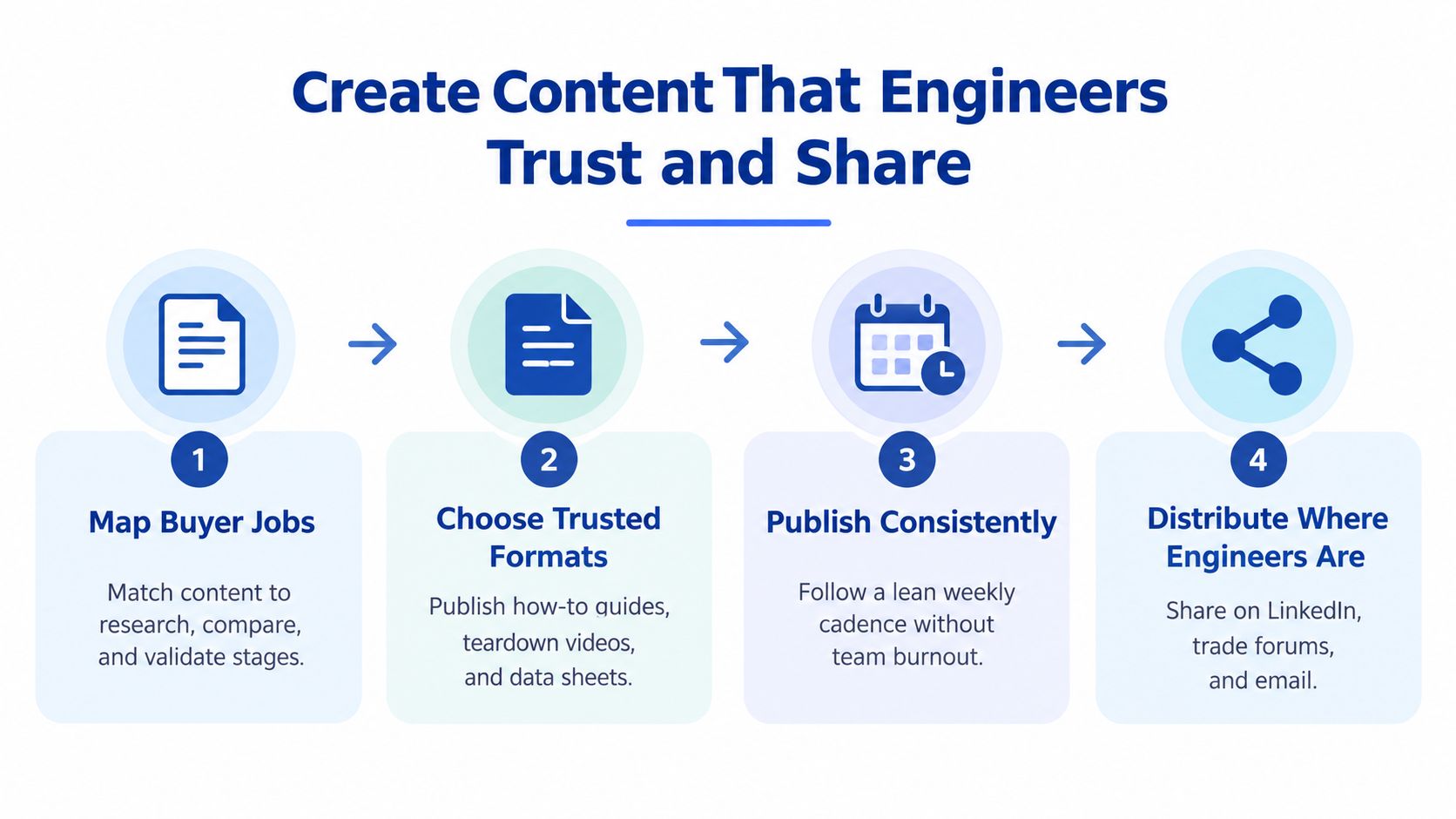
Different formats support different decisions. A research report helps a buyer understand a pattern. A technical article answers a specific question. A video can show a process or component more clearly than prose. A short LinkedIn post can introduce the idea and direct the right audience to the deeper asset.
The 2025 iResearch Services report gives a useful planning benchmark. Organizations produced an average of 43 thought-leadership pieces per year, including about 11 videos, 7 blog posts, and 6 reports or articles. Those figures aren't a target you must copy. They're a reference point for designing a multi-format rhythm, and the report details the benchmark in its full thought leadership report.
A lean production calendar might assign:
- Research stage: A report, benchmark, or technical investigation.
- Evaluation stage: A comparison guide, teardown, or decision checklist.
- Validation stage: A case example, process walkthrough, or quality explanation.
- Distribution stage: Short posts, email commentary, and sales talking points.
Use an expert interview SOP
Marketing shouldn't ask, “Can you write 1,000 words about this?” Ask a focused sequence instead:
- What problem were you trying to solve?
- What did the buyer or production team assume at first?
- Which constraint changed the decision?
- What evidence did you inspect?
- What would you recommend to someone facing the same situation?
- Where does your recommendation not apply?
Record the conversation with permission. Have marketing draft from the transcript, then let the expert verify technical accuracy, scope, and confidentiality. A second reviewer should check whether the article makes an unsupported leap from one experience to a universal conclusion.
Before publishing, run this checklist:
- Specificity: Does the piece identify a real decision?
- Traceability: Can every factual claim be tied to a source or named internal owner?
- Restraint: Does it acknowledge exceptions and limitations?
- Utility: Can a reader apply the insight without contacting sales first?
- Repurposing: Can the core idea become several smaller assets?
For help turning technical knowledge into a repeatable publishing process, see technical content marketing for industrial companies. If LinkedIn is a major channel, a LinkedIn content creation tool from ViralBrain can support drafting and organizing posts, but it shouldn't replace expert review or your point of view.
A single substantial research asset can feed a report, a technical article, a recorded explanation, an email, and several short posts. Repurposing works when each version has a distinct job, not when the same paragraph is copied into every channel.
Distribute Your Ideas and Activate Hidden Buyers
Publishing solves only the production problem. Distribution solves the access problem.
Many industrial buyers consume expertise without submitting a form or requesting a call. In the 2024 Edelman-LinkedIn research, 52% of decision-makers and 54% of C-suite executives spent at least one hour per week consuming thought leadership, as summarized by Datum Review. Your distribution system must reach those readers before they identify themselves.
Build a repeatable distribution loop
Start with the primary asset, then assign every channel a specific role:
- LinkedIn: Publish the point of view, a finding, an engineering question, or a short interpretation from the full asset.
- Email: Send the insight to relevant contacts with a clear explanation of why it matters to their work.
- Industry communities: Contribute useful answers where technical buyers already compare practices and suppliers.
- Sales enablement: Give representatives a short message, the source asset, and guidance on when to share it.
- Website search: Organize the full article or report so buyers can find it when they research the problem independently.
Sales outreach becomes more welcome when it follows the buyer's context. A representative can share a technical guide after a design conversation, a benchmark after a sourcing discussion, or a process explanation when a quality concern appears. The content should help the prospect make progress, not force a meeting.
Use intent signals carefully. A practical explanation of what intent data is can help your team distinguish general readership from accounts showing relevant research behavior, but intent data should guide prioritization rather than serve as proof that an account is ready to buy.
Make distribution part of governance
Assign an owner for publication, review, repurposing, and sales handoff. Store approved claims and source files in one location. Keep a simple record of which audience received which asset and what response followed.
Manufacturing has an opening because many competitors still publish only capabilities, announcements, and occasional project updates. A 2026 industry analysis says thought leadership is the most effective lead-generation tactic in manufacturing, yet only around one in six marketers use it, according to Considered Content's 2026 analysis. The opportunity isn't to publish louder. It's to publish more usefully and distribute with greater consistency.
Measure What Matters and Take Your Next Step
Thought leadership measurement fails when teams track activity instead of commercial movement. Publication volume, impressions, and follower counts can describe reach, but they don't tell you whether buyers trust your judgment or involve your company earlier in a decision.
Use a measurement stack that follows the buying system:
| Measurement layer | What to inspect |
|---|---|
| Reach | Relevant account engagement, qualified readership, and repeat exposure |
| Trust | Direct replies, invitations to discuss findings, and references to your ideas |
| Sales receptivity | Whether prospects become more open to outreach after consuming useful content |
| Pipeline influence | Assets viewed or shared during active opportunities |
| Shortlist access | RFP invitations and supplier conversations connected to the program |
| Commercial value | Evidence that buyers understand your differentiation and accept its value |
The business case includes strong signals beyond visibility. In the 2024 Edelman-LinkedIn B2B Thought Leadership Impact Report, 73% of decision-makers said thought leadership was more trustworthy for judging organizational capabilities than marketing materials or product sheets, and 90% said it made them more receptive to sales outreach. Those findings are reported by Christoph Olivier Consulting.
Run a disciplined pilot
A pilot should test the system, not promise an instant transformation. Choose one audience, one business question, one expert group, and one proof asset. Define the approval process before production begins.
Your launch checklist:
- Select the lane: Write the audience, problem, point of view, and evidence source.
- Interview the experts: Capture decisions, trade-offs, exceptions, and lessons.
- Create the anchor asset: Produce a report, guide, or technical analysis with clear sourcing.
- Repurpose intentionally: Create channel-specific posts, email content, and sales support.
- Instrument the journey: Record engagement, replies, influenced opportunities, and RFP activity.
- Review with sales: Identify which questions became easier to answer and which objections remain.
- Improve the SOP: Keep what works, remove unnecessary approvals, and clarify ownership.
The operating challenge is real. A 2026 global survey found that 74% of organizations weren't running thought leadership programs strategically, while only 26% had reached strategic maturity, according to the iResearch Services report covered by Morningstar. The lesson is not to add more content. It's to build governance, original research, distribution, and measurement into one system.
Manufacturers already possess the raw material: practical expertise, production history, customer questions, and technical judgment. The next step is to make that knowledge findable, provable, and useful to the people deciding which supplier can carry the risk.
Machine Marketing helps manufacturers, machine shops, and industrial business owners turn engineering expertise into a coordinated content, SEO, distribution, and measurement system. Visit Machine Marketing to request a practical diagnosis of your current authority and lead-generation process, then identify the first thought leadership asset worth building.