Your annual marketing plan looked sensible in January. By spring, a product launch has moved, sales is pursuing a different segment, an engineer has found a better customer objection to address, and half the planned content is still waiting for approval. Your team is busy, but you can't clearly explain which work is improving pipeline or what should happen next.
Agile methodology for marketing gives B2B and industrial teams a practical operating system for that reality. It replaces oversized commitments with visible priorities, short delivery cycles, useful feedback, and clear ownership. The challenge is adapting the method to long sales cycles, technical buying committees, delayed revenue, and agencies that work on entirely different schedules.
Table of Contents
- Why Traditional Marketing Plans Fail in B2B
- Adapting Agile Roles and Ceremonies for Small Teams
- Building Your Marketing Backlog and Running Sprints
- Measuring Impact When B2B Attribution is Fuzzy
- Avoiding Agile Theater and Agency Friction
- Your 90-Day Agile Marketing Rollout Checklist
Why Traditional Marketing Plans Fail in B2B
Traditional planning fails when it treats uncertainty as a planning defect instead of a normal operating condition. An industrial marketing team can spend months developing a campaign around a product specification, target segment, or value proposition that changes before launch. The plan may be complete, the assets may be polished, and the outcome can still miss the market.
Annual plans also encourage teams to measure what they produce. They count campaigns, articles, trade show materials, emails, and social posts because those outputs are available immediately. B2B buyers, however, may need technical validation, internal approval, budget alignment, and conversations with sales before a marketing interaction becomes commercial progress. A plan that rewards volume can hide weak positioning, poor handoffs, and stalled demand.
Agile marketing addresses the feedback-loop problem. Teams still set strategic goals, but they break execution into smaller deliverables, review evidence frequently, and change priorities when new information matters. The Adobe overview of Agile marketing describes sprints as short work cycles in which teams deliver specific work, review results, and improve the next iteration.
Adoption is real, but capability determines results
The shift isn't theoretical. Agile marketing moved from software roots into a formal marketing framework in 2012, when the Agile Marketing Manifesto was created after a 48-hour meeting described as “Sprint Zero” (AgileSherpas State of Agile Marketing report). By 2018, 37% of marketing teams were using an Agile process, while 61% of traditional marketers planned to adopt it within 12 months. The same report identified lack of training or knowledge as the biggest barrier for 37% of marketers.
Later findings show a category that's widely understood but unevenly implemented. A 2020 report found 32% of respondents described their teams as Agile, with hybrid approaches used by 54% of Agile marketers. A separate 2022 report cited 43% of marketing departments using some form of Agile methodology, while 91% of non-adopters planned to adopt it within the next year. More recent 2026 data reported 25% currently using Agile marketing, 25% as past users, and 27% never having used it (AgileSherpas report PDF).
The lesson for a manufacturer isn't to copy a software team's ceremonies. It's to shorten the distance between a buyer signal and a marketing decision. A campaign backlog, a defined owner, a recurring review, and a small number of measurable outcomes can outperform a larger annual plan that nobody is willing to revise.
For additional demand-generation planning ideas, review these resources for marketing leaders, then test the advice against your own sales process, technical constraints, and approval path.
Adapting Agile Roles and Ceremonies for Small Teams
You don't need a large marketing department, a certified Scrum Master, or a new layer of management. A small industrial team can often move faster because the marketing lead, salesperson, engineer, and owner can speak directly instead of passing decisions through several departments.
The important distinction is between titles and responsibilities. Someone must own priorities. Someone must protect the workflow. Someone must provide technical or commercial input. Those responsibilities can sit with existing employees, provided everyone understands who decides and who delivers.
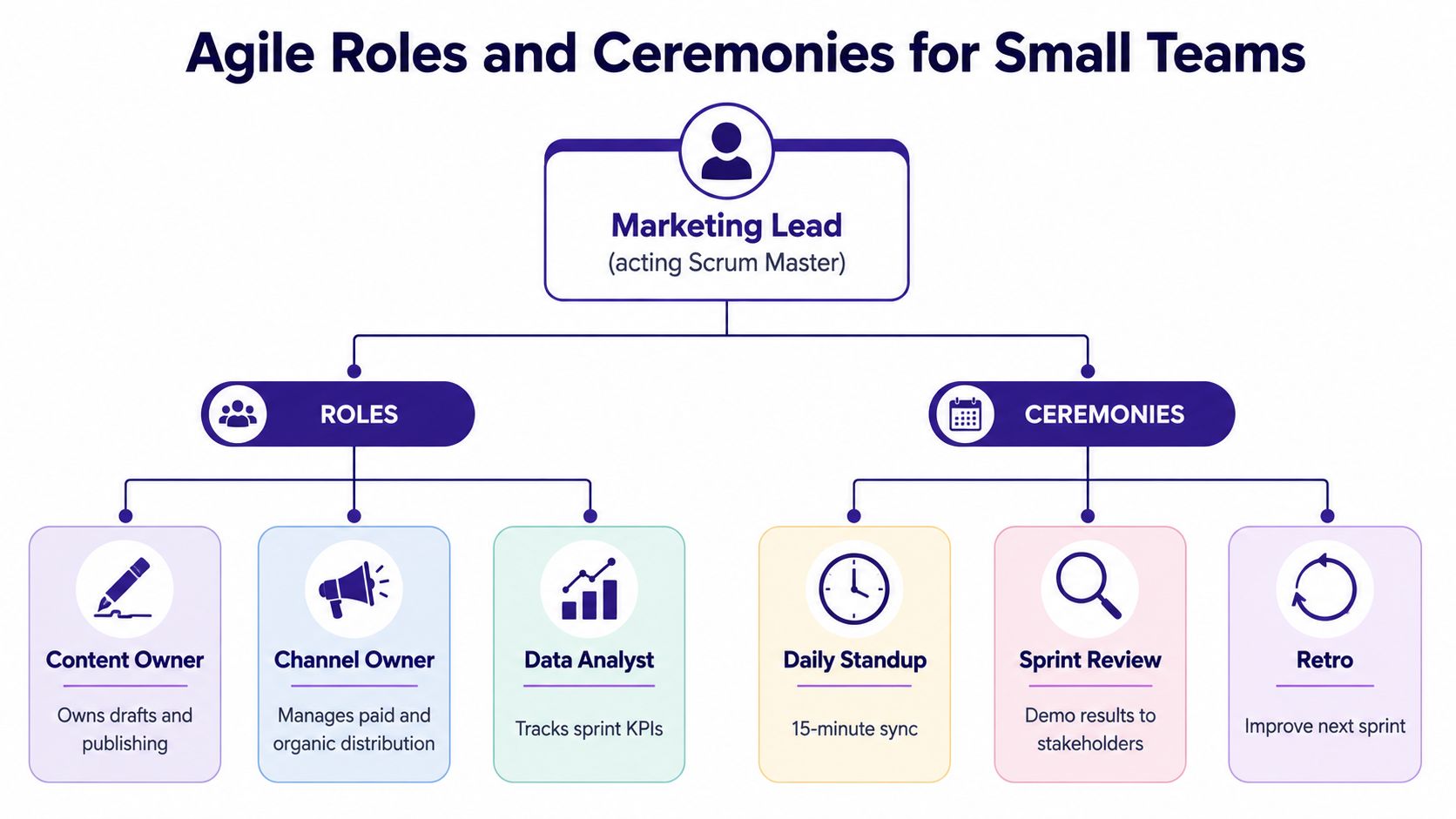
Assign practical equivalents
Use a simple structure:
- Marketing lead: Owns the backlog order, facilitates the process, and resolves priority conflicts. This person acts as the final decision-maker when every request can't fit.
- Content owner: Turns technical input into usable pages, articles, emails, case material, or sales resources. The content owner also confirms what “done” means before work starts.
- Channel owner: Manages distribution through search, email, paid media, social channels, or industry platforms. They bring channel evidence into the review.
- Sales or engineering subject matter expert: Supplies customer language, objections, specifications, and field context. Their contribution should be scheduled, not treated as unlimited on-demand support.
- Data owner: Maintains tracking, reports the agreed KPIs, and distinguishes missing data from poor performance.
A weekly prioritization meeting should produce a ranked backlog and a committed sprint goal. Bring new requests, review dependencies, remove stale items, and make trade-offs visible. Don't let the meeting become a debate over who feels busiest. Ask which item has the clearest business value, which dependency could delay it, and what evidence would justify changing its priority.
The daily standup should be a 15-minute coordination meeting, not a sequence of status reports. Each person answers what they completed, what they will move next, and what is blocked. A delayed engineering review, missing product image, or unapproved claim belongs on the board so the owner can solve it immediately.
Keep ceremonies lightweight and consequential
A sprint review demonstrates completed work to stakeholders. A retrospective examines how work moved, where approval or handoff friction appeared, and which one improvement the team will test next. If a ceremony doesn't produce a decision, a visible change, or a clear next action, shorten it or remove it.
Teams working with experiments can also benefit from practical Otter A/B Agile testing tips, particularly when they need to connect test planning with delivery discipline. For the workflow itself, use a shared marketing project management system that shows ownership, status, approvals, and dependencies in one place.
Building Your Marketing Backlog and Running Sprints
A backlog is not a storage bin for every idea anyone has ever mentioned. It's a prioritized decision system. Anyone can add a request, but one person must decide what comes first and what won't be done yet.
Start with a business outcome. Suppose an industrial manufacturer wants more qualified conversations for a specific machine category. “Launch a campaign” is too large to manage. Break the initiative into deliverables that can be completed, reviewed, and measured independently.
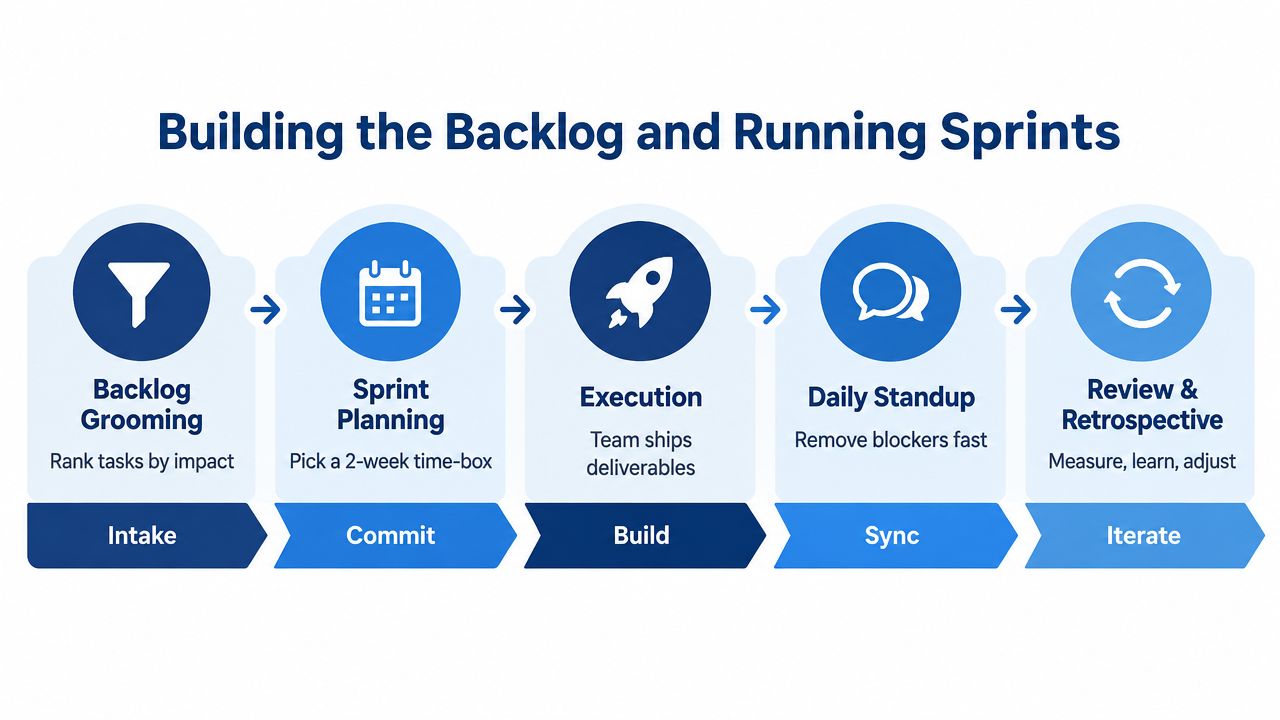
Turn a campaign into usable backlog items
A useful backlog item contains:
- Audience and problem: Identify the buyer, application, or sales objection.
- Deliverable: Name the specific output, such as a landing page, technical comparison, email, calculator, or sales sheet.
- Owner: Assign one person accountable for moving the item to completion.
- Acceptance criteria: State what must be true before the item is complete, including technical review, tracking, compliance approval, and publishing.
- Learning goal: Define the assumption the work will test.
- Evidence: Specify the metric, timeframe, and owner responsible for reviewing it.
A technical landing page might be written as: “For maintenance managers evaluating machine downtime, create a page that explains the operating problem, shows the relevant application, answers common objections, and gives sales a trackable inquiry path.” That item is clearer than “improve product page” because the team can assess its audience, scope, and completion standard.
Rank work by business value, urgency, dependency, and effort. A request isn't high priority just because a stakeholder sent it with an urgent subject line. If an item doesn't have a defined outcome or a person who can provide the required input, it may not be ready for a sprint.
Run a time-boxed cycle
A two-week sprint works well as a starting structure for a small team because it creates urgency without forcing the entire quarter into a fixed sequence.
- Refine the backlog. Remove duplicates, clarify briefs, and make dependencies visible.
- Choose a sprint goal. Select a small group of related deliverables that support one outcome.
- Confirm capacity. Account for sales support, engineering reviews, customer meetings, and operational work.
- Define “done.” Agree on quality, approvals, tracking, and publishing requirements before work begins.
- Execute through a visible board. Use columns such as ready, in progress, review, blocked, and done.
- Review evidence. Compare the result with the sprint goal, not with a vague expectation of instant revenue.
- Hold a retrospective. Choose one process improvement and put it into the next sprint.
A trade show campaign could begin with a registration page, a follow-up email, a sales handout, and tracking validation. The next cycle might refine the message based on questions from prospects, improve the follow-up sequence, or add content that addresses a recurring technical concern. This approach lets the team learn before it commits to a larger campaign build.
The HubSpot implementation guidance for Agile marketing reinforces the basic mechanics, prioritize projects, plan the sprint, coordinate daily, test the work, and use the data to improve the next iteration.
Use the following video as a practical visual reference for the sprint process:
Measuring Impact When B2B Attribution is Fuzzy
A two-week sprint and a long industrial buying journey appear incompatible until you separate decision speed from revenue timing. You don't need a signed order before you can decide whether a sprint created useful evidence. You do need a measurement system that distinguishes immediate signals from later commercial outcomes.
B2B attribution is often fuzzy at best, particularly when several people research a purchase, engage through different channels, and speak with sales offline. Marketing can also be rewarded for output rather than outcomes, which encourages teams to publish more work without learning whether buyers understood it or sales could use it.
Measure three layers of progress
Use a scorecard with different time horizons:
| Measurement layer | What it answers | Examples |
|---|---|---|
| Outcome | Did the work contribute to business progress? | Qualified inquiries, sales-accepted opportunities, pipeline contribution |
| Flow | Did the team deliver efficiently? | Cycle time, work in progress, completed items |
| Learning | What did the team discover? | Validated message, rejected assumption, improved objection handling |
Outcome metrics mature slowly. Flow and learning metrics give the team information while a larger opportunity is still developing. A sprint focused on a technical page may be successful because it clarifies an objection, improves the sales handoff, or establishes a reliable measurement path, even if the eventual purchase decision occurs much later.
Set one primary sprint outcome and a small number of supporting indicators. For example, a sprint could aim to improve the quality of inquiries from a defined application segment. Supporting evidence might include form completion quality, sales feedback on fit, engagement with the technical explanation, and whether the CRM owner recorded the next step consistently.
This isn't permission to celebrate activity forever. The team should connect early evidence to later lifecycle stages in the CRM. Mark the original source, campaign touchpoints, handoff status, opportunity stage, and eventual commercial result. Review those records over time instead of forcing every sprint to prove revenue immediately.
Reward learning without losing commercial discipline
Agile teams need permission to stop weak experiments. They also need rules that prevent “learning” from becoming an excuse for vague work. Every experiment should state what changed, what signal would support the hypothesis, what signal would challenge it, and what action follows.
AI can support this process when it helps teams organize customer language, compare channel evidence, or identify patterns across touchpoints. Adoption remains uneven. One cited report found Agile marketers were more likely to have AI fully integrated into their processes, 39% compared with 13%, according to AgileSherpas' 2026 State of Agile Marketing analysis.
Use a cross-channel attribution framework to connect short-cycle activity with longer-cycle opportunity data. It won't eliminate uncertainty, and it shouldn't pretend that every touchpoint deserves precise credit. Its value is making assumptions visible so your team can improve the measurement system as evidence accumulates.
Measurement rule: A sprint should produce a deliverable, a decision, and evidence that changes what the team does next.
Avoiding Agile Theater and Agency Friction
Agile theater looks productive from a distance. The team has a board, holds standups, uses sprint language, and fills out retrospective notes. Yet decisions still wait for weeks, work remains stuck in approval, and urgent requests enter without a visible trade-off.
The test is operational, not ceremonial. Can your team explain what it will finish, who can approve it, what is blocked, and what decision the latest evidence supports? If not, more meetings won't solve the problem.
External partners need explicit operating rules
Agencies, freelancers, and specialist suppliers won't automatically adopt your cadence. McKinsey found that only 3% of marketing executives described the shift to Agile with agencies or third parties as “smooth,” while 83% rated the transition at 3 or lower on a 1-to-5 difficulty scale (McKinsey analysis of Agile marketing and the agency model).
Treat the partner relationship as part of the system. Put the following rules in writing:
- Shared intake: Every request enters the same brief and priority process.
- Sprint contract: Define the sprint goal, deliverables, dependencies, reviewer, and acceptance criteria.
- Review window: Set when technical, legal, brand, and commercial feedback must arrive.
- Single source of truth: Keep files, decisions, status, and comments in the agreed project system.
- Change control: If new work enters, identify what leaves or what timing changes.
- Escalation path: Name the person who resolves a blocked decision.
These rules protect both sides. The partner gets a usable brief and predictable feedback. Your team gets fewer surprises and a clearer way to challenge missed commitments. When an agency repeatedly ignores the agreed workflow, document the pattern and assess the signs it is time to fire an agency relationship before the friction consumes internal capacity.
Protect the method from familiar failure modes
Agile fails when leaders ask for flexibility but keep changing priorities without acknowledging the cost. It also fails when the backlog owner lacks authority, when every item is urgent, or when standups become reporting sessions for management.
Use these controls:
- One priority owner: Stakeholders can influence the backlog, but one person orders it.
- Visible work in progress: Limit active tasks so the team finishes instead of accumulating half-complete assets.
- Decision-based ceremonies: Each meeting must produce a decision, action, or process change.
- Defined approval ownership: Sales and marketing need clear handoff rules, as outlined in this guide to aligning sales and marketing.
- Honest retrospectives: Discuss the actual blocker, including leadership delays and unclear strategy.
The method isn't supposed to make every request possible. It makes trade-offs visible before the team wastes time.
Your 90-Day Agile Marketing Rollout Checklist
Don't roll Agile across the whole organization at once. Start with one campaign pod, one backlog, and one recurring standup cadence. A narrow pilot gives you enough control to learn whether the workflow improves prioritization, ownership, and coordination before you add more teams or tools.
Education matters because knowledge gaps repeatedly appear as a leading adoption barrier. One survey found 31% cited lack of education and 27% said their current processes were “working well enough” as blockers to adoption (AgileSherpas' sixth annual report). Your rollout must therefore teach the system while the team uses it, not rely on a one-time presentation.
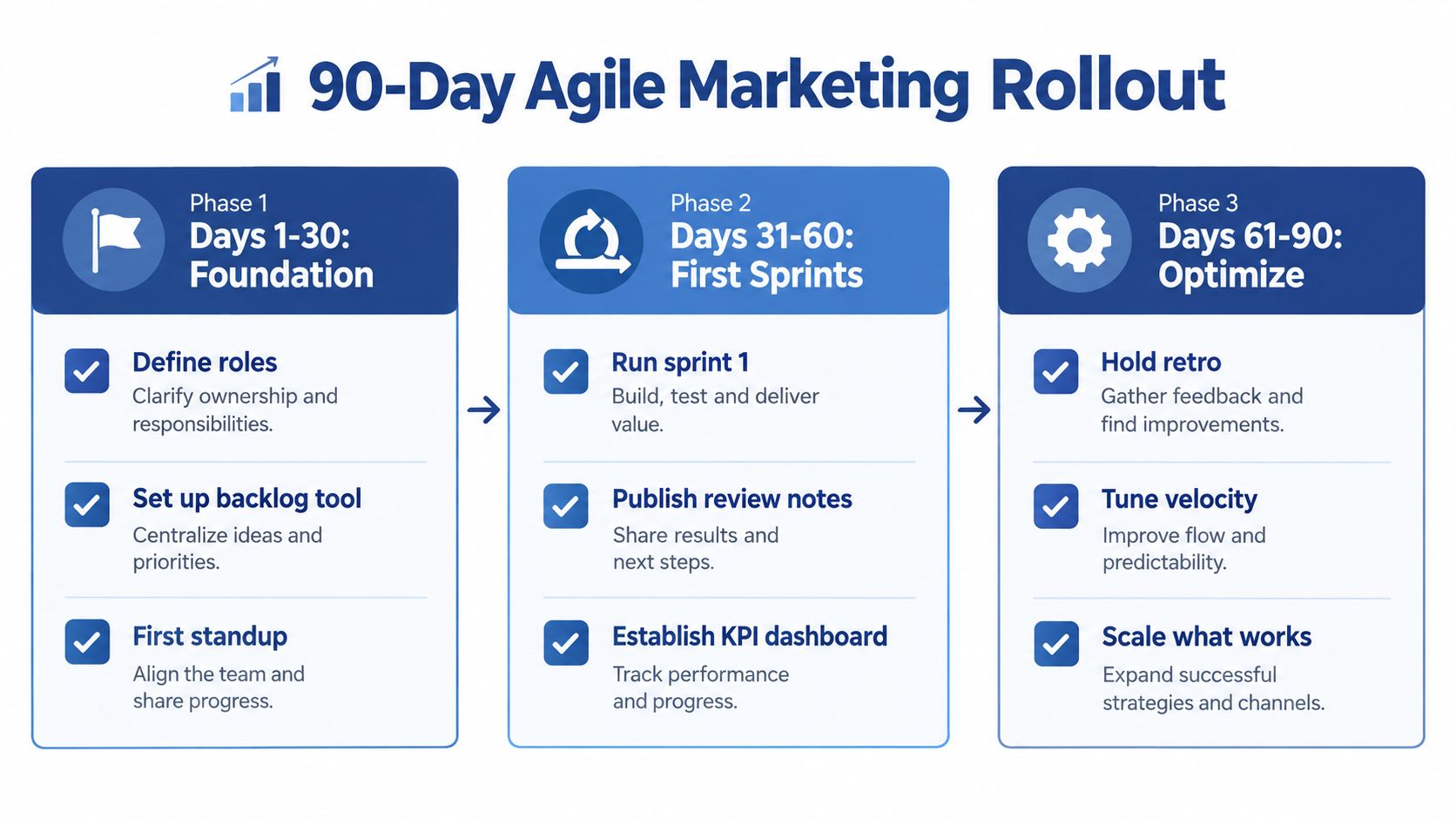
Days 1 to 30 build the foundation
Choose a campaign with a clear business purpose and accessible sales or engineering support. Avoid starting with the most politically complex initiative.
- Define roles: Name the backlog owner, delivery owners, technical reviewers, approvers, and data owner.
- Set up the backlog tool: Use a tool your team will maintain, such as Asana, Trello, Jira, or another shared workspace. Keep the fields limited to outcome, owner, priority, status, dependencies, and acceptance criteria.
- Create the first board: Include ready, in progress, review, blocked, and done.
- Write the definition of done: Include technical accuracy, approvals, tracking, publishing, and documentation where relevant.
- Start the first standup: Keep it focused on blockers and next actions, not executive reporting.
At the end of this phase, you should see where work waits. Don't hide those delays. They are diagnostic evidence about approvals, capacity, unclear briefs, and conflicting priorities.
Days 31 to 60 run the first sprints
Run a focused sprint with a single outcome. Hold planning, execute the agreed work, review the result with sales and relevant stakeholders, and publish review notes that record the evidence and decision.
Establish a KPI dashboard that separates outcomes, workflow health, and learning. If your CRM is inconsistent, fix ownership and lifecycle definitions alongside the campaign. Marketing automation can support controlled follow-up, but only when triggers, stages, owners, and handoffs reflect the actual sales process.
Your first sprint may expose more problems than it solves. That's useful. A blocked technical review or missing source document gives the team a concrete process issue to address instead of another abstract complaint about collaboration.
Days 61 to 90 optimize and scale
Hold a retrospective that includes the business owner, not only the delivery team. Ask:
- Which decision took too long, and who could have made it earlier?
- Which backlog item lacked enough information?
- Where did work wait for approval or technical input?
- Which KPI changed our next decision?
- What should we stop doing in the next sprint?
Tune the workflow based on those answers. Improve briefs, adjust review windows, clarify CRM ownership, reduce work in progress, or change the sprint scope. Don't scale ceremonies that haven't improved delivery.
By day 90, you should have a repeatable operating model for the pilot, evidence about its constraints, and a clear decision about expansion. Scale the parts that improve prioritization and coordination. Leave behind the rituals that create activity without better decisions.
Agile methodology for marketing works when it changes how your team chooses, delivers, measures, and improves work. It won't shorten an industrial sales cycle by itself, remove the need for strategy, or make attribution perfectly precise. It can give you a more honest system for learning early, protecting focus, and connecting marketing activity to commercial progress.
Machine Marketing helps manufacturers and industrial businesses diagnose marketing systems, connect strategy with execution, and build clearer workflows across SEO, content, CRM, automation, and lead generation. Visit Machine Marketing to discuss a practical Agile marketing pilot for your team.