
You're reviewing another SEO report, rankings look better, traffic is up, and your sales manager still can't identify a qualified request for quote from the work. Whether you hired an agency or assigned SEO internally, you're facing the same problem: activity without a defensible connection to sales. We recommend hiring your next manufacturer SEO agency around that connection, not around a more impressive dashboard.
Table of Contents
- Why Manufacturer SEO Hiring Is Different
- What a Manufacturing-Focused SEO Agency Actually Does
- The First Audit You Should Demand (and How to Score It)
- Ten Vetting Questions That Expose Weak Agencies
- Pricing Models and What Each One Rewards
- KPIs and Reporting That Actually Matter for Shops
- Red Flags and Quiet Deal Breakers
Why Manufacturer SEO Hiring Is Different
The moment to reconsider your SEO partner is when you ask which new opportunities came from search and nobody can answer. Don't immediately assume the answer is more content, more links, or a different reporting tool. Diagnose whether your partner understands what buyers need to evaluate your shop and how your team records that evaluation.
A qualified RFQ isn't just a completed form. You need an inquiry that matches your capabilities, materials, application requirements, commercial expectations, and service territory. A visitor researching machining for a school assignment and a procurement manager sourcing a production component shouldn't count as equivalent wins.
Hire for buyer understanding, not industrial vocabulary
Industrial buyer research commissioned by Google and conducted by Forrester Consulting surveyed 411 U.S. B2B decision-makers, finding that 62% expected more personalized online product-research experiences and 87% wanted recommendations based on their job role or organization's industry, according to the Forrester industrial buying study.
For your website, that means different buyers need different evidence:
- Engineers need material compatibility, process limits, inspection methods, and technically accurate specifications.
- Procurement managers need supplier qualification information, quote requirements, and delivery expectations.
- Business stakeholders need evidence that your shop can support the application without introducing unacceptable risk.
A specialist should translate those needs into an organized website, then help you connect buyer activity to your sales process. Knowing the phrase “CNC machining” isn't enough.
Hiring rule: Choose the agency that can explain how a buyer becomes a sales-accepted opportunity, not just how a keyword becomes a ranking.
You should also expect honest attribution. A buyer may discover you through search, return directly, and contact a sales representative later. We'd rather see an agency acknowledge that incomplete trail than claim every opportunity involving a website visit as SEO-generated revenue.
What a Manufacturing-Focused SEO Agency Actually Does
Ask what your team will receive during the first 90 days. A credible answer names implementation work, technical reviewers, approval responsibilities, and measurement milestones. A weak answer promises ongoing optimization without showing who will change your website.
Use this diagram to check whether the proposed scope covers the essential system.
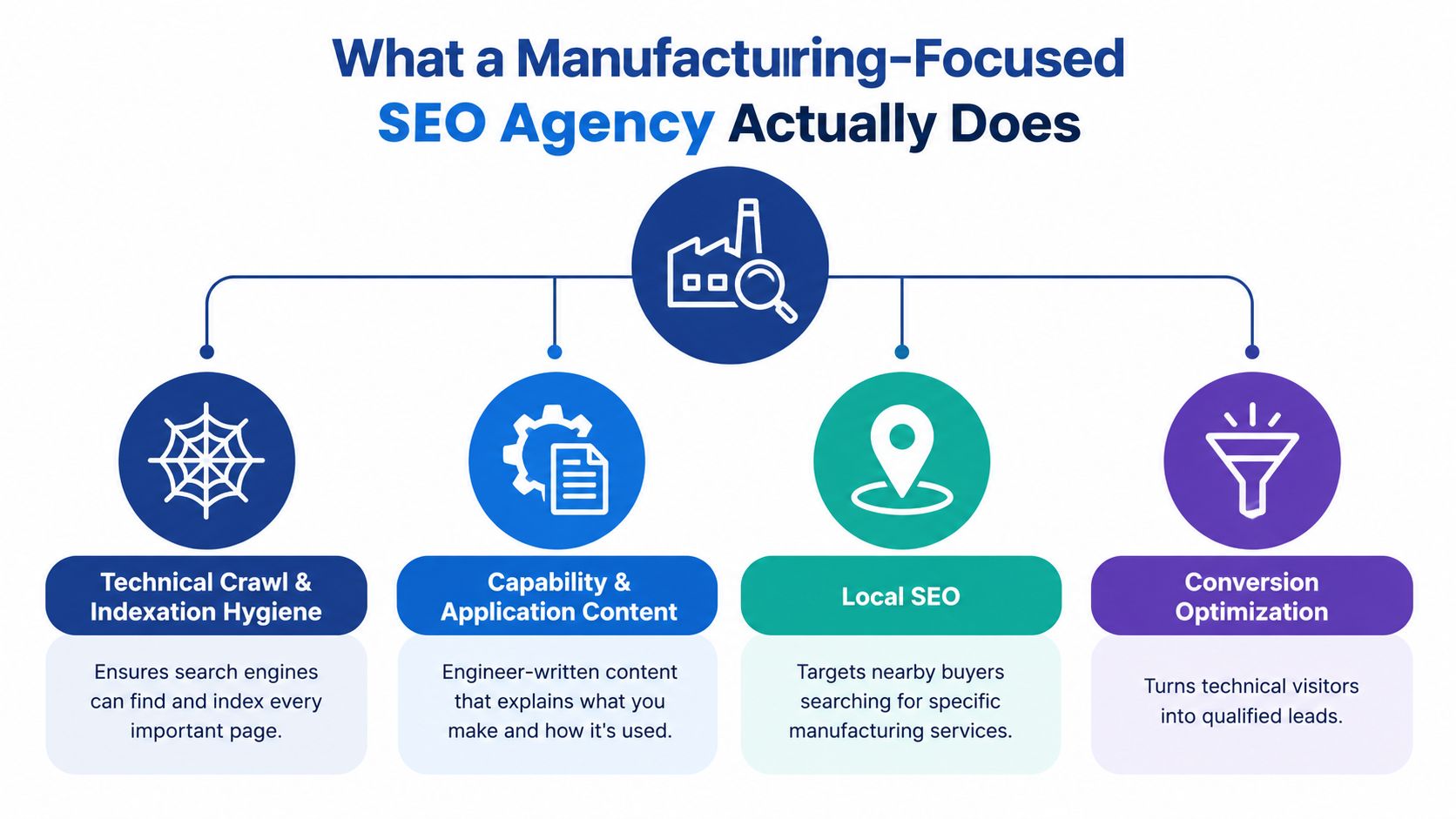
The work should connect across disciplines
Technical crawl and indexation hygiene means making important pages accessible to search engines and resolving conflicting instructions. You should know whether the agency implements repairs or merely sends recommendations to your developer.
Capability and application content requires access to your technical experts. Google's SEO starter guide prioritizes useful, original, organized, current content and recognizes the value of experienced sources. We recommend applying that guidance through engineer and production-manager interviews, not rewritten competitor pages.
For example, your CNC machining page should connect buyers to relevant materials, equipment, inspection capabilities, certifications, and application information. It shouldn't function as an isolated keyword landing page.
- Local SEO should reflect your actual facilities and service territory. Google describes local visibility through relevance, distance, and prominence, so profile accuracy and genuine geographic fit matter.
- Conversion optimization and CRM measurement should connect useful next steps, such as submitting a drawing, with records your sales team can qualify.
Build a controlled technical knowledge layer
Your agency should help you decide what belongs publicly on a page, what requires an approved download, and what stays confidential. Publish enough detail to establish fit without exposing proprietary process knowledge or customer information.
Use a technical content marketing workflow to organize interviews, technical review, and publication ownership. If AI visibility is also in scope, AnswerLion's services to improve AI assistant citations are another resource to evaluate, but ask for a concrete method and measurable deliverables rather than assuming citations will produce RFQs.
You're buying a connected system. Make sure someone owns the connections.
The First Audit You Should Demand (and How to Score It)
Demand an audit during the first 30 days that identifies business consequences, not just errors. A screenshot showing missing metadata doesn't tell you whether the affected page supports a profitable capability or an obsolete service.
The audit should connect each finding to a specific URL, proposed correction, implementation owner, and validation method. Use the following categories to organize the review.
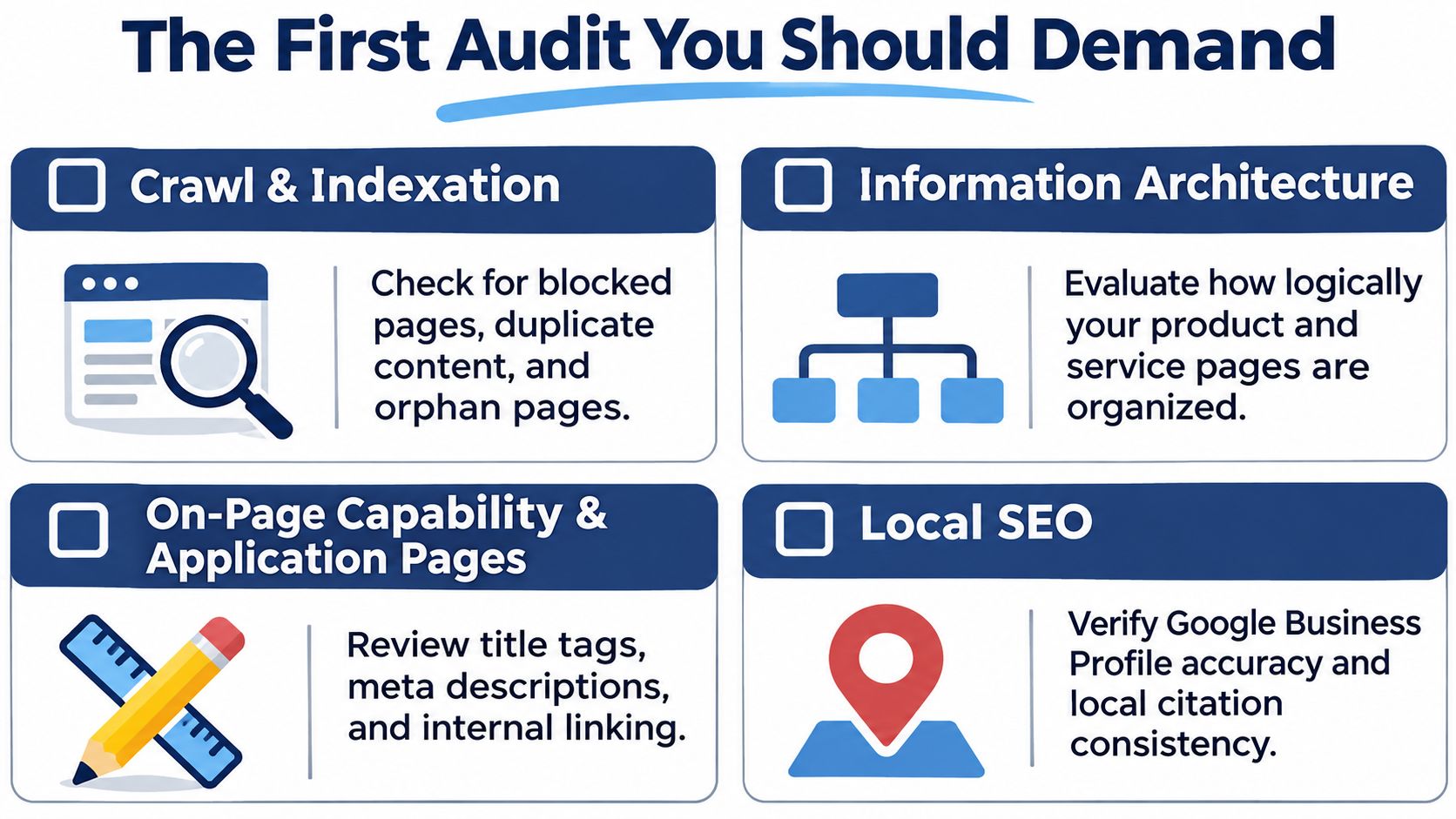
Require evidence before recommendations
Start with crawl and indexation. Following Google's crawling and indexing guidance, your agency should investigate blocked resources, orphan pages, duplicate URLs, incorrect canonical tags, accidental noindex directives, and non-crawlable internal links, then validate representative pages through URL Inspection.
A canonical URL is the preferred version of a page. Your agency should identify that version for each priority capability instead of leaving competing copies scattered across the site.
Next, examine the business-facing structure:
- Information architecture: Can buyers move from a capability to relevant materials, applications, quality evidence, and an inquiry path?
- On-page content: Do titles, headings, descriptions, and internal links accurately describe what your shop provides?
- Local footprint: Do business records match, and do location pages contain genuine local evidence?
- Content gaps: Which unanswered buyer questions prevent someone from evaluating fit?
- Backlink authority: Which referring websites are relevant, credible, and worth retaining or pursuing?
Use our technical SEO audit checklist as a working document for comparing findings, not as a substitute for diagnosis.
Score the quality of the diagnosis
We recommend this proposal-comparison rubric. These are evaluation scores, not industry performance benchmarks.
| Score | What the agency provides |
|---|---|
| 0 | Category omitted or unsupported |
| 1 | Generic tool output without interpretation |
| 2 | Page-specific evidence and a reasonable correction |
| 3 | Evidence, business priority, implementation owner, and validation plan |
Apply the rubric to every audit category. Don't let a polished presentation compensate for missing evidence on your most important pages.
A useful audit lets your developer act and your sales manager understand why the work matters.
Before approval, ask the agency to walk through a priority capability page. If the explanation stops at keyword placement, the diagnosis is incomplete.
Ten Vetting Questions That Expose Weak Agencies
Bring these questions to the sales call and record the answers. We recommend comparing the substance afterward, away from the salesperson's presentation and enthusiasm.
Questions about delivery
How many manufacturing clients have you served, and which resemble our business?
Relevance matters more than a large client count. A weak answer lists unrelated brands without showing industrial work.What changes in your first 90-day plan for a CNC shop versus a fabricator?
You're testing whether the agency recognizes different processes, applications, and buying questions. A weak answer offers the same keyword package.Who writes, reviews, and publishes our technical content?
You need clear accountability and technical approval. A weak answer relies on unnamed writers and asks you to catch every error afterward.Do you implement changes or only advise our team?
Recommendations don't help if nobody has capacity to execute them. A weak answer leaves development and publishing responsibilities undefined.What do you investigate when a priority page stalls?
Look for a diagnosis involving accessibility, intent, evidence, internal links, and competition. A weak answer automatically prescribes more blog posts.
Questions about accountability
How will you distinguish qualified inquiries from general traffic?
Your sales team needs agreed qualification criteria. A weak answer counts every submission as a lead.What does your link-building process involve?
Ask for target-selection criteria, outreach examples, and approval rights. A weak answer sells link volume without naming placement standards.Can we export reporting data and retain account access?
You need continuity if the relationship ends. A weak answer makes its proprietary dashboard your only record.How will you handle technical disagreements with our engineers?
You need a review and escalation process. A weak answer prioritizes search wording over manufacturing accuracy.What happens if the work doesn't attract suitable opportunities?
Look for a documented review of targeting, content, conversion paths, and qualification. A weak answer blames the sales cycle without changing the plan.
For another hiring resource, consider Fypion Marketing on choosing a partner alongside your own supplier-evaluation process. Don't replace evidence from the candidate agency with advice from any hiring guide.
Your strongest candidate won't necessarily answer instantly. They'll identify what they need to inspect before committing to a recommendation.
Pricing Models and What Each One Rewards
Choose the payment structure after defining the work and measurement rules. We don't recommend selecting an agency because its monthly price fits your budget while its responsibilities remain vague.
There isn't a substantiated universal price range to use for this decision. Request a scoped quote that identifies implementation, technical interviews, content review, reporting, software, and any separate development costs.
Manufacturer SEO Agency Pricing Models Compared
| Model | Typical Range | What It Covers | Alignment Risk |
|---|---|---|---|
| Monthly retainer | Scope-dependent; request an itemized monthly quote | Ongoing technical work, content, optimization, reporting | Agency can meet activity commitments without improving inquiry quality |
| Project or sprint | Deliverable-dependent; request a fixed-scope quote | Audit, migration repairs, capability-page rebuild, tracking setup | Work can end before you evaluate commercial outcomes |
| Performance or cost-per-lead | Qualification-dependent; negotiate acceptance and payment rules | Compensation tied to agreed lead outcomes | Agency may favor easy submissions over suitable RFQs |
| Hybrid | Base scope plus a negotiated performance component | Essential delivery with an outcome-based incentive | Disputes arise if attribution and qualification aren't explicit |
A retainer suits continuing work when you need regular access to technical, content, and measurement expertise. Require a prioritized backlog and evidence of completed changes, not just a recurring report.
A project suits a bounded problem. If your website needs a capability-page rebuild or a tracking repair, define acceptance criteria and a handover package. Don't expect ongoing iteration unless you've purchased it.
Match incentives to what you can verify
Performance pricing sounds aligned, but sparse inquiries make definitions especially important. If your CRM can't distinguish a new prospect from a repeat customer or an unsuitable request, paying per lead creates arguments rather than accountability.
- Define acceptance: Agree which industries, capabilities, territories, and commercial requirements qualify.
- Exclude clearly: Document spam, duplicates, existing customers, employment inquiries, and unrelated requests.
- Resolve ownership: Establish how sales accepts or rejects an inquiry and how the agency can review disputed records.
Contract principle: Don't pay an outcome bonus for an outcome you can't consistently identify.
We generally favor a scoped retainer or hybrid arrangement once your measurement process is dependable. No model automatically rewards vanity metrics or qualified pipeline. Your definitions, deliverables, and review rights determine the behavior you're paying for.
KPIs and Reporting That Actually Matter for Shops
A leadership report should answer whether you're becoming visible for the right work, whether buyers engage with useful evidence, and whether sales accepts the resulting opportunities. Rankings and sessions are diagnostic inputs, not the final business result.
A 2025 industrial-buyer benchmark reported that 85% of decision-makers used AI to research suppliers and 77% obtained pricing or lead-time information through self-service digital tools. Those behaviors reinforce why we recommend measuring research activity and assisted outcomes rather than relying entirely on the final recorded click.
This funnel provides an initial visibility-to-inquiry checkpoint. Your leadership dashboard should extend beyond it into opportunity and revenue records.
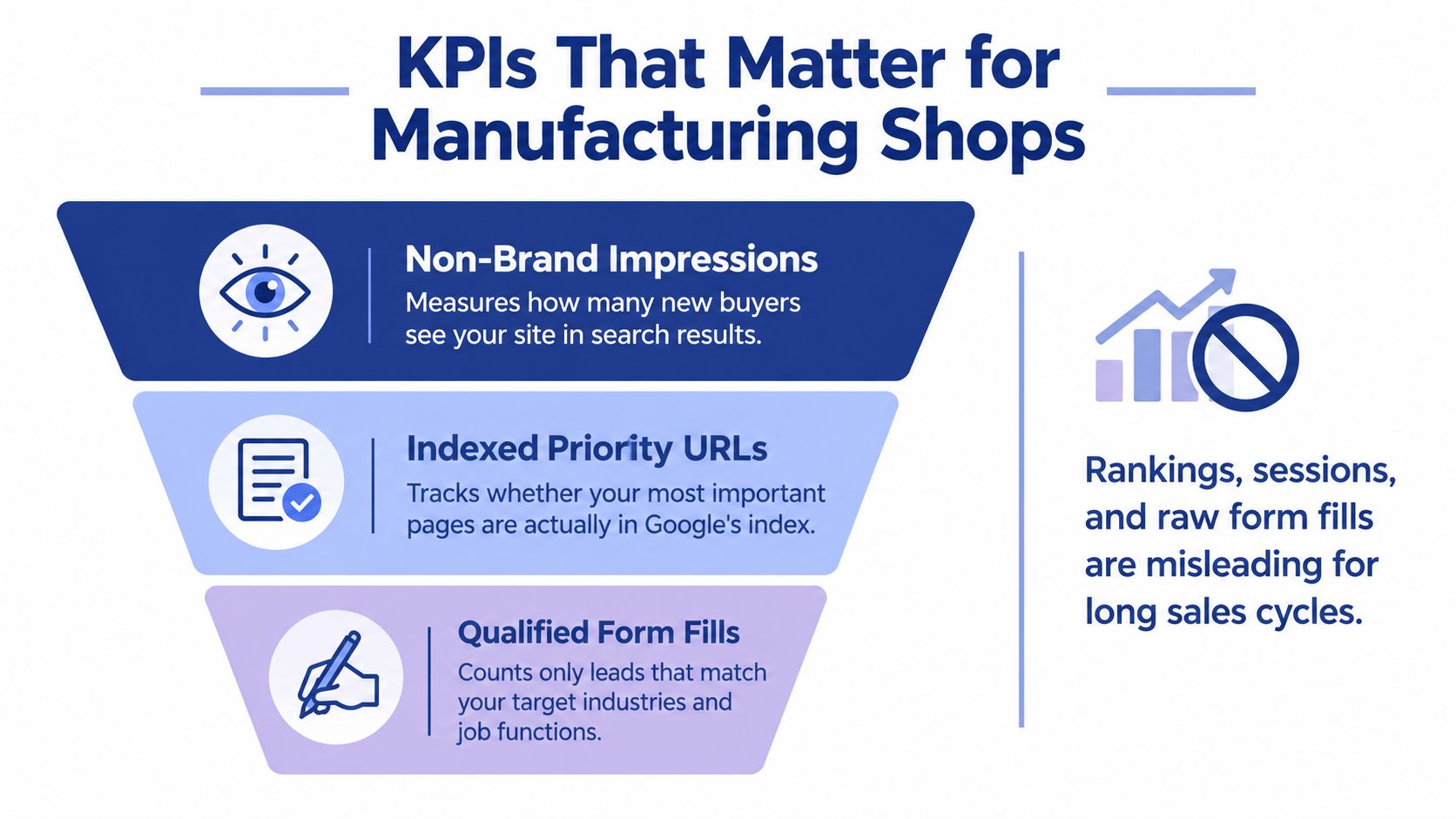
Build a dashboard your sales team can use
| Layer | Measure | Decision it supports |
|---|---|---|
| Discoverability | Indexed priority URLs and non-brand impressions | Are relevant buyers able to find important capabilities? |
| Technical engagement | Specification downloads and drawing-guide engagement | Are visitors investigating suitability? |
| Inquiry quality | Qualified organic RFQs and drawing submissions | Are inquiries aligned with your shop? |
| Sales acceptance | Opportunities accepted by sales | Does sales consider the demand worth pursuing? |
| Commercial outcome | Influenced pipeline and closed revenue by landing-page cohort | Which entry pages connect with valuable business? |
A landing-page cohort groups prospects by the page through which they first entered your tracked website journey. It helps you compare capability or application pages without treating all organic traffic as interchangeable.
Use manufacturing marketing KPIs to structure the leadership discussion, then agree on definitions with sales before publishing the dashboard.
Preserve the uncertainty instead of hiding it
Keep original source, first known landing page, relevant campaign information, inquiry type, and opportunity stage in your CRM. Ask sales to record referrals, distributor involvement, and existing relationships separately.
A credible monthly report includes completed work, changes in priority-page visibility, accepted and rejected inquiries, opportunity progression, and unresolved tracking gaps. A fluff report combines branded and non-brand demand, highlights favorable rankings, and omits sales disposition.
Don't claim precision your records can't support. Label opportunities as SEO-sourced, SEO-influenced, or unknown, using documented rules your team can explain.
Red Flags and Quiet Deal Breakers
A confident pitch isn't evidence of a reliable operating system. We recommend reviewing the proposal and contract as carefully as you'd review a supplier agreement for a critical production process.
Check ownership, responsibilities, and exit provisions before you approve the engagement.
Disqualify promises that remove accountability
Guaranteed rankings are a structural warning sign. Google explicitly states that nobody can guarantee a top ranking, and structured-data eligibility doesn't guarantee search placement, in its developer SEO guidance. An agency selling certainty about results it doesn't control is starting the relationship with the wrong standard.
No manufacturing case studies means you lack evidence of relevant delivery. Confidentiality can limit disclosure, but the agency should still offer anonymized work samples, a technical workflow, or references where permitted.
- Refusal to share a sample audit: You can't assess diagnostic quality before committing. Ask for a redacted example with findings, priorities, and implementation decisions.
- Templated proposals across unrelated industries: Your agency may be selling production capacity rather than understanding your capabilities and buyer requirements.
- Reports you can't export: You risk losing historical evidence and operational continuity when you leave.
- Lock-in contracts longer than 12 months: Treat this as a commercial review trigger, not an automatic rejection. Without performance reviews, termination rights, and a handover process, you carry too much risk.
- Outsourced writing without engineer interviews: Outsourcing itself isn't the problem. Publishing unverified technical statements is.
Also check who owns your website accounts, analytics access, content files, and reporting definitions. You shouldn't need permission from a departing agency to operate your own marketing system.
Before signing, bring these concerns into the final proposal discussion and document the answers.
Hand your chosen agency an onboarding sequence
Use this as a proposed operating schedule, not a ranking or revenue guarantee. Adjust implementation timing to your website complexity and your team's availability.
Days 0–30: Complete the diagnosis, establish baseline metrics, agree on qualified-RFQ criteria, and implement priority technical fixes. Set up CRM tagging and confirm account ownership, approval roles, and reporting access.
Days 31–60: Rewrite priority capability and application pages, align local business information, and turn initial engineer interviews into reviewed content. Give each deliverable a named approver and a clear publication decision.
Days 61–90: Review measurement quality, activate pipeline reporting, and hold a quarterly planning meeting. Compare inquiry fit with your intended work, resolve tracking gaps, and prioritize the next changes using evidence rather than a predetermined publishing quota.
The transformation you're buying is a clearer route from technical discovery to suitable sales conversations. Choose an agency that can diagnose, implement, and explain that route, then hold both teams accountable for maintaining it.
We offer manufacturing-focused marketing strategy, SEO, technical content, and CRM-connected measurement to help you evaluate the whole lead-generation system. Visit Machine Marketing to book a diagnostic and bring your current agency proposal, a sample report, and your priority capabilities for a practical second opinion.
