You've published one blog post a month for two years. The website looks active, but qualified RFQs haven't followed. That isn't a writing problem. It's a system problem.
A working B2B content marketing strategy connects what your team knows, what industrial buyers search for, and what your sales process needs next. We'll show you how to build that system around engineers, procurement managers, operations leaders, and the questions they ask before they ever contact a shop.
Table of Contents
- Why Most Manufacturer Content Marketing Misses Pipeline
- Mapping Industrial Audiences and Buyer Stages
- Choosing Content Pillars That Match Industrial Demand
- SEO for Industrial Keywords and Technical Search Intent
- Building a Repeatable Content Production Workflow
- Distribution, Repurposing, and Sales Enablement
- Your 30-Day Quick-Win Plan and Next Step
Why Most Manufacturer Content Marketing Misses Pipeline
A shop owner publishes “industry trends,” “the importance of quality,” and company updates for months. The site looks active, yet qualified RFQs remain scarce. The problem is not a lack of publishing. It is a content system disconnected from how industrial buyers investigate suppliers.
Start with the commercial question behind each topic. An article about a broad industry trend rarely helps a buyer decide whether your team can hold a tolerance, document quality, or meet production requirements. A design engineer, procurement manager, and plant owner may influence the same purchase, but each evaluates a different form of risk.
Topic selection is only one failure point. “Manufacturing decision-makers” gives a writer no usable direction and gives sales no clear asset to share. Define the role, problem, buying stage, and evidence that person needs before assigning a format.
Publication also gets mistaken for distribution. A post sitting on a blog is an asset waiting for a route to the buyer. Industrial prospects may find it through search, LinkedIn, email, a sales conversation, or a trade publication. Put each asset into the paths your buyers already use, then connect it to a follow-up action.
A content marketing from Sibley Digital overview explains the broader discipline. Industrial companies must adapt that model to technical buying behavior. Engineers search for specifications and process constraints. Procurement teams validate suppliers and compare commercial risk. Operations leaders look for reliability, capacity, and confidence that implementation will work. For context, review why manufacturers struggle with marketing to identify the operational gap behind inconsistent results.
Practical rule: Every asset needs a named audience, a buyer stage, a commercial question, and a next action.
Content now shapes vendor preference before a sales conversation begins. One cited buying study reported that 80% of B2B deals are won by the vendor the buyer favored before first contact according to the cited B2B buying benchmark. The same benchmark summary reports that 44% of respondents typically consume three to five pieces of content before engaging with a vendor, while 49% of B2B buyers rely more on content during research and purchase decisions.
Build content around specification questions, technical judgment, supplier-risk concerns, and sales conversations. Skip posts that merely announce activity. A functioning strategy helps the buyer assess fit before contact and gives your team useful evidence to move the opportunity ahead.
Mapping Industrial Audiences and Buyer Stages
Start with people, not formats. A buyer persona should describe the role, responsibility, pressure, objections, and information needs of a real person your sales team recognizes. Our guide to creating buyer personas can help you document that information without turning the exercise into a demographic worksheet.
Industrial buying usually involves several distinct content targets:
| Audience Segment | Dominant Search Intent | Key Questions | Best-Fit Content Formats |
|---|---|---|---|
| Design and process engineers | Technical feasibility and specification validation | Can this process hold the tolerance? Which material, finish, or geometry is appropriate? | Capability pages, technical guides, tolerance explainers, application notes |
| Procurement and supply chain managers | Supplier comparison and commercial risk | Can the shop meet lead-time, quality, documentation, and volume requirements? | Supplier comparison pages, certifications pages, case studies, RFQ guides |
| Operations leaders and plant owners | Reliability, capacity, and business impact | Will this supplier reduce disruption and support production priorities? | Customer proof, plant walkthroughs, implementation guides, executive summaries |
The buyer stage changes the job of the content. Awareness content helps someone define a problem. Comparison content helps them evaluate approaches or vendors. Decision content gives them enough evidence to request a quote, schedule a technical call, or involve another stakeholder.
A single article rarely performs all three jobs well. An engineer searching for a material alternative doesn't need the same opening, proof, or call to action as a procurement manager comparing certified fabricators.
Build the map from real conversations
Review sales calls, quote requests, technical emails, lost-deal notes, and questions your engineers answer repeatedly. Ask:
- What triggers the search? A failed supplier, a new design, a capacity constraint, or a quality issue?
- What creates hesitation? Tolerance capability, documentation, schedule, minimum order requirements, or communication?
- What proves competence? Inspection processes, material experience, certifications, equipment, or relevant applications?
Industry conversations can also reveal how manufacturers frame their expertise. The Uptool manufacturing talks guide offers useful context for identifying themes and conversations worth translating into content.
Choose one primary segment first. If your best opportunities come from design engineers, build around their technical questions before trying to speak equally to procurement and ownership. You can support the other roles later, but a focused system will outperform a broad content calendar with no clear reader.
Choosing Content Pillars That Match Industrial Demand
Content pillars are not broad categories such as “quality,” “innovation,” and “customer service.” Those labels are too vague to guide search research or production. A useful pillar is a repeatable area of expertise with identifiable buyer questions, commercial relevance, and enough depth to support multiple assets.
Begin with evidence from inside the business. Pull language from:
- Sales call transcripts and recordings, especially questions that delay an RFQ.
- RFPs and quote requests, including the exact terms buyers use for process, material, documentation, and delivery.
- Engineering forums and trade publications, where technical problems are discussed in the buyer's own vocabulary.
- Search results and keyword tools, used to validate whether the topic has discoverable demand in your niche.
Then organize that evidence into four practical pillars:
Capability and process expertise
Cover the processes you perform, including equipment, material ranges, tolerances, finishes, inspection, and production constraints. A capability page should help an engineer decide whether your shop belongs on the shortlist.
Applications and use cases
Explain where your capabilities solve a specific problem. Examples include low-volume production, complex geometries, difficult materials, replacement parts, or design-for-manufacturing decisions. Applications give searchers a reason to connect a process with their own project.
Standards, materials, and technical reference
This pillar answers questions about ISO, ASTM, ASME, material selection, surface treatment, inspection documentation, and tolerance planning. It can attract early research while showing that your team understands compliance and technical risk.
Customer proof and operational outcomes
Use approved customer stories, process explanations, and evidence of how your team handled a production challenge. Focus on the problem, the decision process, the work performed, and the operational consequence. Don't invent results or publish confidential details.
Technical content marketing for B2B provides a useful model for connecting proof, production, distribution, and measurement.
Reject any pillar that has no identifiable search demand, no sales relevance, or no internal subject-matter owner.
This rule prevents the most common strategic mistake, building an editorial category because it sounds good rather than because buyers need it. Your pillars should make it obvious what to publish, who should review it, where to distribute it, and which commercial action it should support.
SEO for Industrial Keywords and Technical Search Intent
Industrial SEO begins with the terms buyers enter when they need a supplier. Engineers search for part numbers, tolerances, materials, standards, processes, and capability combinations, not broad marketing topics. Build the content system around those research behaviors, then connect each page to a commercial action.
“5-axis CNC machining for Inconel” signals a specific capability need. “What is CNC machining” reflects early education. “ISO 9001 sheet metal fabricator near me” shows supplier selection, while “alternative to die casting for low volume” points to a process decision. Preserve these distinctions. A generic blog post rarely answers the buyer's real question or gives sales a useful follow-up.
Use three query layers:
- Specification and capability queries: Create dedicated service or capability pages for processes, materials, tolerances, finishes, certifications, and equipment.
- Long-tail problem queries: Publish technical explainers for questions such as “tolerances for medical device machining” or “alternative to die casting for low volume.”
- Commercial comparison queries: Help buyers compare processes, supplier options, lead-time considerations, documentation, and application fit.
Map every target query to a page format that answers the question and moves the reader toward the next decision.
| Query Type | Example | Page Format |
|---|---|---|
| Capability and specification | 5-axis CNC machining for Inconel | Capability or service page |
| Technical problem | Tolerances for medical device machining | Technical guide or application article |
| Process alternative | Alternative to die casting for low volume | Comparison article |
| Supplier evaluation | ISO 9001 sheet metal fabricator near me | Location or certification page |
| Commercial validation | CNC machining supplier for production parts | Case study or supplier evaluation page |
Long-form content earns its place when the subject involves technical trade-offs. One cited summary reports that content over 3,000 words receives three times more traffic, four times more shares, and 3.5 times more backlinks as reported by Contentifai. A separate claim in the same reference collection states that posts over 2,000 words rank 3.4 times higher for competitive keywords than posts under 800 words.
Treat those figures as guidance, not a publishing target. Length should follow the buyer's decision complexity. A commercially important technical page should define terms, explain process limits, set decision criteria, provide relevant examples, link to supporting capability pages, and make the RFQ path obvious.
Traffic alone is a weak success measure. An article that attracts students or casual readers but produces no commercial engagement is misaligned. Track whether visitors reach capability pages, download technical assets, submit RFQs, or engage with sales. Those actions show whether search content is operating as part of the revenue system rather than sitting apart as a publishing project.
Building a Repeatable Content Production Workflow
Manufacturers rarely lack expertise. They lack a reliable way to extract that expertise from the shop floor and turn it into approved content. The solution isn't a large editorial department. It's a lean workflow with clear ownership.
Assign three roles:
- Subject Matter Expert: An engineer, programmer, quality manager, or shop owner who supplies technical knowledge and verifies accuracy.
- Writer or Editor: An internal marketer or contractor who conducts the interview, structures the explanation, and removes jargon that doesn't help the buyer.
- Publisher: The person responsible for the CMS, SEO fields, forms, links, scheduling, email, and distribution.
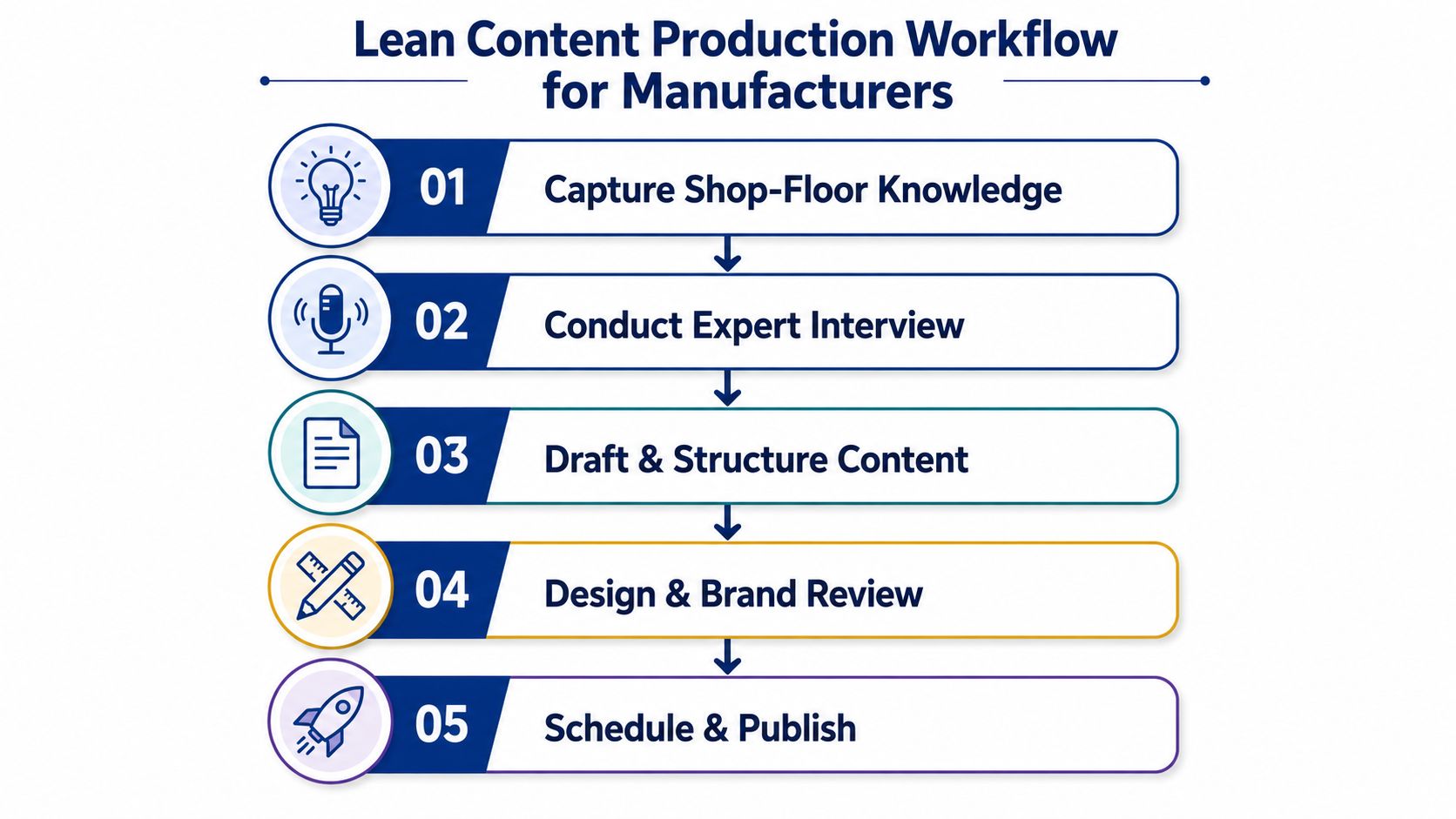
Use a practical cadence of one flagship asset per month plus four derivative pieces. The flagship might be a technical guide, capability page, application article, or case study. The derivatives can become LinkedIn posts, email sections, a sales one-pager, or a short video.
Use one approval path
The workflow should move in one direction:
- Brief: Define the audience, query, buyer stage, proof, CTA, and owner.
- SME interview: Hold a focused 30-minute conversation with the subject-matter expert.
- Draft and structure: Write for the buyer's question, not for internal terminology.
- Technical review: Have the engineer verify claims, specifications, and process language.
- Light copy edit: Fix clarity, headings, links, metadata, and calls to action.
- Publish and promote: Release the asset only when its distribution tasks are assigned.
A one-page approval sheet should show the owner, reviewer, due date, status, target page, CTA, and promotion checklist. If an asset sits in “technical review” for weeks, the problem isn't motivation. The approval path is incomplete.
For broader ideas on assigning ownership and sequencing production, review these expert workflow strategies and adapt them to your team size.
After the technical review is complete, use the video below as an example of how a focused content workflow can support production and communication without adding unnecessary meetings.
Don't wait for perfection. A technically accurate, useful asset published on schedule creates a stronger operating habit than an ambitious piece that remains trapped in review.
Distribution, Repurposing, and Sales Enablement
A blog post that only lives on your website is underused. Industrial buyers may find it through search, but your sales team, email list, LinkedIn network, trade contacts, and existing prospects can all extend its reach.
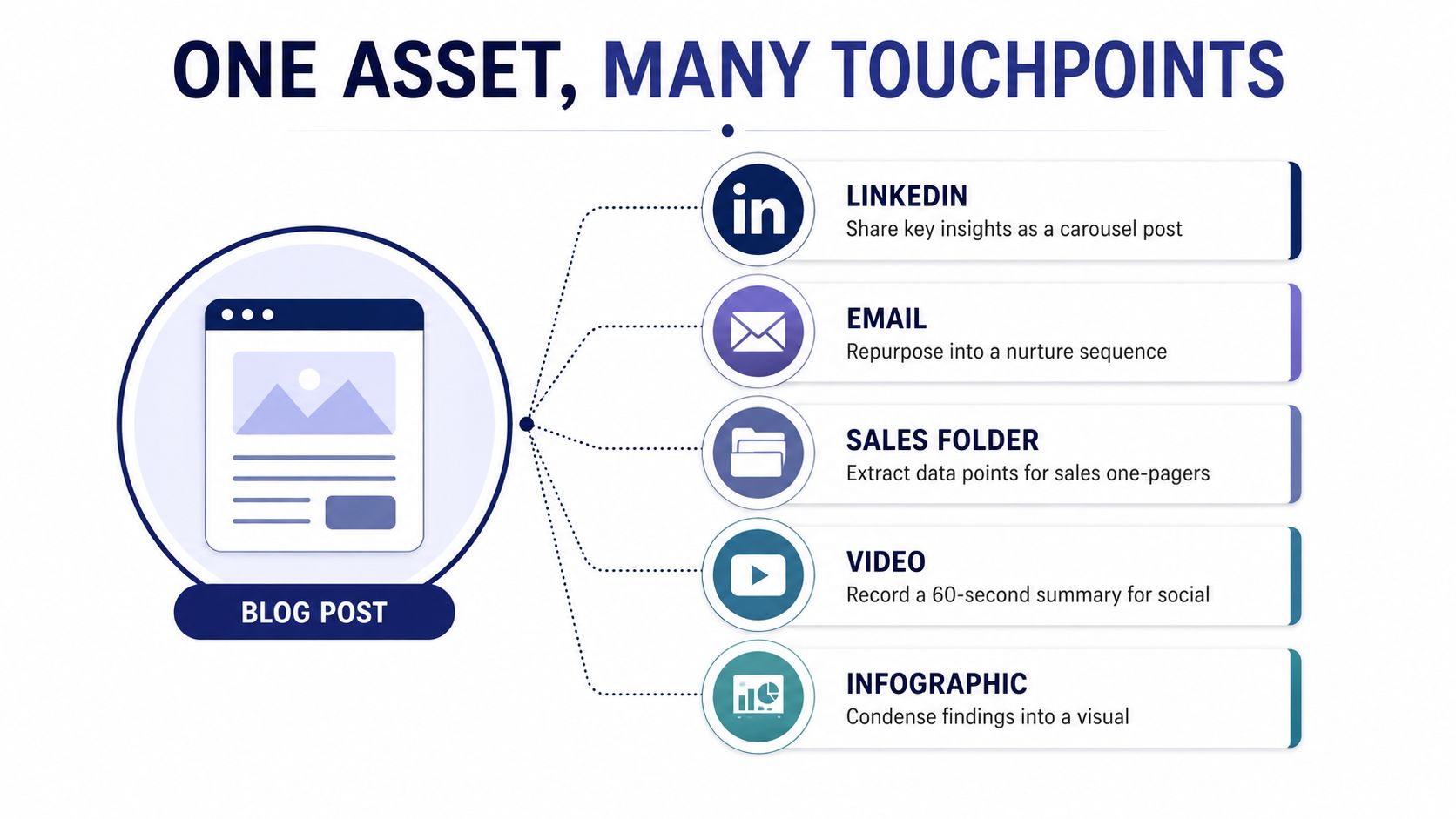
Start with one strong asset and assign every derivative before publication. For example, a 1,200-word capability guide can become:
- LinkedIn carousel: Turn the process, constraints, and decision criteria into a slide-based explanation.
- Three short-form posts: Publish one technical insight, one common mistake, and one buyer question.
- Two email snippets: Use one for awareness and one for a nurture follow-up.
- One-page PDF: Give sales a concise attachment for a quote or technical conversation.
- Short video: Have an engineer or owner summarize the key decision in a practical shop-floor setting.
Make distribution fit the industrial buying routine
LinkedIn works best when the content sounds like a knowledgeable person, not a brochure. Owners can share a lesson from a difficult production decision. Engineers can explain a tolerance trade-off. Sales representatives can address a question that repeatedly appears in RFQs.
Useful formats include:
- Owner-led thought posts: Explain how you evaluate supplier risk, capacity, quality, or customer fit.
- Plant walkthrough videos: Show inspection, programming, setup, material handling, or quality documentation.
- Customer wins: Share approved project lessons and tag customers only with permission.
- Technical excerpts: Pull a small section from a guide and point readers to the full asset.
Email should support the same system. Use a welcome sequence for new subscribers, a re-engagement sequence after thirty days of silence, and a sales handoff sequence that bundles the four pieces a contact has read. The handoff should tell sales what the person consumed and which question the content addressed.
Trade publications can help when your asset offers genuine technical value. Pitch an application explanation, process comparison, or original operational perspective, not a rewritten company announcement. The publication becomes a discovery channel, while your site holds the deeper guide and commercial next step.
Connect every action to the CRM
Don't let forms create anonymous activity. Add fields for:
- Lead source: The channel that first introduced the contact.
- Campaign: The specific promotion or initiative.
- Content tag: The pillar, asset, or topic associated with the conversion.
Set behavior triggers around meaningful activity, such as repeat visits to pricing or capability pages and multiple views of related pillar content. Route the lead to sales with context, including the pages visited, asset downloaded, role, company, and open question.
Scoring should combine company size, role, and behavior. A technical student downloading a guide isn't equivalent to a procurement manager from a target account returning to a capability page. The point isn't to create a complicated scoring model. It's to give sales a useful reason to act.
MarketingProfs identifies the most-used B2B performance metrics as conversions at 73%, email engagement at 71%, website traffic at 71%, website engagement at 69%, and social media analytics at 65% in its B2B benchmark report. For manufacturers, don't stop at those activity measures. Review organic traffic to commercial pages, marketing-qualified leads per asset, pipeline generated, and cost per lead by channel.
Reach, impressions, and follower counts can help diagnose distribution. They don't book machining, fabrication, or production work. Your CRM should show which content helped create a qualified conversation.
Your 30-Day Quick-Win Plan and Next Step
Don't start with a rebrand, a new platform, or a complete website rewrite. Use the site and tools you already have, then fix the connections between buyer questions, content, forms, and sales follow-up.
Week one
Pull the last 90 days of search queries, sales call recordings, and RFP language. Mine five recurring questions from customers and engineers. Write each question exactly as buyers ask it, then group it by role and buying stage.
Week two
Define four content pillars around those questions. Rewrite the homepage so it states who you serve, what you make or solve, and why a buyer should believe you. Manufacturer websites lose clarity when they speak in generalities, so lead with specific processes, applications, materials, and buyer problems.
Week three
Publish one technically rich piece for each pillar. Add a relevant downloadable specification guide, case study, checklist, or reference asset, then create one landing page per pillar with a single clear call to action.
Week four
Connect every form to the CRM and apply source, campaign, and pillar tags. Set up the welcome, re-engagement, and sales handoff sequences. Review traffic to commercial pages and MQLs per asset, then decide which topic deserves another asset.
The cited benchmark data supports a compounding approach. One source reports that companies publishing daily generate 13 times more monthly leads than teams publishing one or two posts per month, at 2.6 times the cost, while another benchmark says companies with 400 or more indexed blog posts generate 4.2 times more leads than companies with fewer than 100 as summarized by Marketful. Treat those figures as support for consistency and library depth, not as permission to publish low-value material.
For manufacturing specifically, a cited benchmark reports that 70% of manufacturing leads come through content downloads such as e-books and whitepapers, compared with 15% from webinars in the manufacturing marketing benchmark. Build discoverable pages for search, then offer substantive downloads for prospects who need deeper technical validation.
Pick one buyer segment, publish two pillar assets, and gate one useful offer before the month ends. Foundations beat volume, and one connected system beats three half-built campaigns.
Machine Marketing helps manufacturers and machine shops connect content strategy with industrial SEO, technical production, CRM tracking, email nurture, and sales enablement. Visit Machine Marketing to request a practical diagnosis of your current system and identify the next content assets worth building.