Innovation Isn't Magic. It's a System You Can Build.
If you're a manufacturer or engineer, you already know the problem. Good ideas aren't rare. What's rare is a repeatable way to move from idea to pilot, from pilot to customer adoption, and from adoption to profitable scale. Most innovation advice breaks down the minute it hits production scheduling, legacy equipment, procurement constraints, or a sales team that's still selling the old way.
That disconnect is expensive. According to the OECD's Measuring Innovation, only about 10% of innovation projects in developed economies achieve commercial success, while roughly 90% fail to generate profitable returns. We see that same pattern in industrial businesses. Teams confuse technical progress with market progress, then wonder why the launch stalls.
This list is built for that reality. It's not just a roundup of titles. It's a practical toolkit for manufacturers who need a better diagnosis, a better operating system, and clearer next steps. Each book solves a different failure mode, from protecting disruptive bets to validating demand before capex to getting a buying committee across the line.
If your team is also turning expertise into content, polished presentation matters too. Strong ideas travel further with sales-ready non-fiction book designs.
Table of Contents
- 1. The Innovator's Dilemma
- 2. Crossing the Chasm, 3rd Edition
- 3. The Lean Startup
- 4. Competing Against Luck
- 5. Loonshots
- 6. Working Backwards
- 7. Testing Business Ideas
- 7-Book Innovation Comparison
- Your Next Step Turn Insight Into Action
1. The Innovator's Dilemma
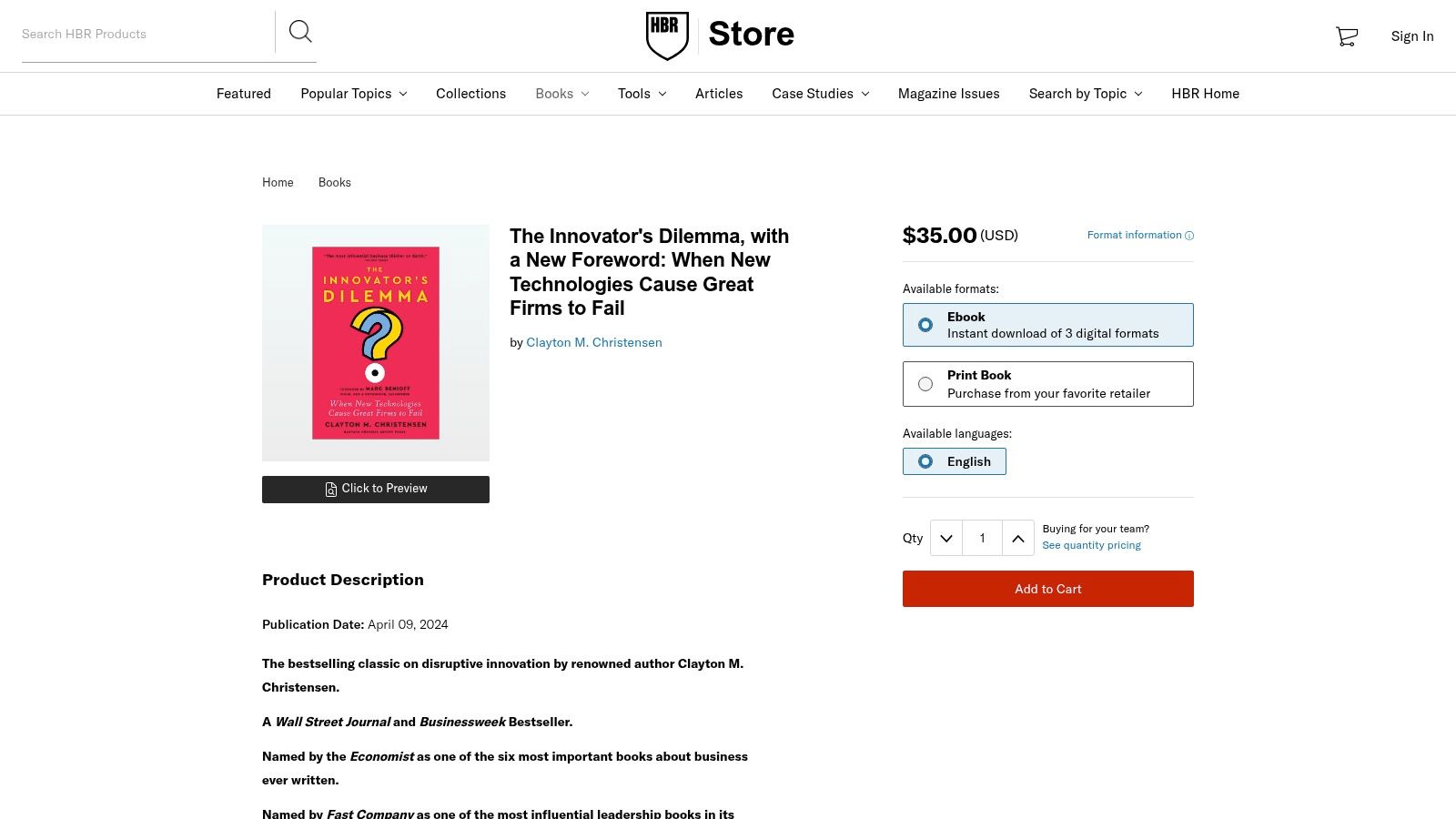
A common factory-floor problem looks like this. Your best customers keep asking for incremental improvements, tighter tolerances, better service response, or lower cost. Meanwhile, a smaller, less attractive market starts adopting something simpler, cheaper, or easier to deploy. Most established manufacturers keep feeding the core business until the new market becomes large enough to hurt them.
That's where The Innovator's Dilemma earns its place on any serious book on innovation list. Christensen gives you a strategic lens for deciding which opportunities belong inside the core and which need protection from the core.
Diagnosis
You're over-optimizing for current customers and current margins. That sounds rational, but it often causes leadership teams to reject early-stage offers that don't yet fit existing sales incentives, gross margin targets, or channel expectations.
In industrial companies, this shows up when a service model, retrofit offer, software layer, or lower-complexity machine gets dismissed because it doesn't look like the flagship line. The result isn't just missed revenue. It's a portfolio that can't adapt.
Solution
Christensen's distinction between sustaining and disruptive innovation helps you classify opportunities before politics takes over. That alone can improve decision quality. It gives leadership a shared language for capital allocation, team structure, and timing.
Use the book this way:
- Map the threat clearly: Separate improvements for existing buyers from offers aimed at new or overlooked buyers.
- Protect the new bet: If the new offer conflicts with the core profit model, give it a team, cadence, and success criteria of its own.
- Review incentives: If sales compensation, production scheduling, or quoting rules punish the new offer, the organization will kill it even if leadership says it matters.
Practical rule: If a new product line depends on the core business to tolerate lower margins, slower early growth, or a different sales motion, it usually needs structural protection.
The trade-off is simple. This book is outstanding for strategic diagnosis, but it won't tell your team exactly how to run weekly experiments. You'll still need a process for market validation and execution. That's why it pairs well with practical work on business model innovation for industrial firms after leadership sets direction.
You can find the book through the Harvard Business Review store listing for The Innovator's Dilemma.
2. Crossing the Chasm, 3rd Edition
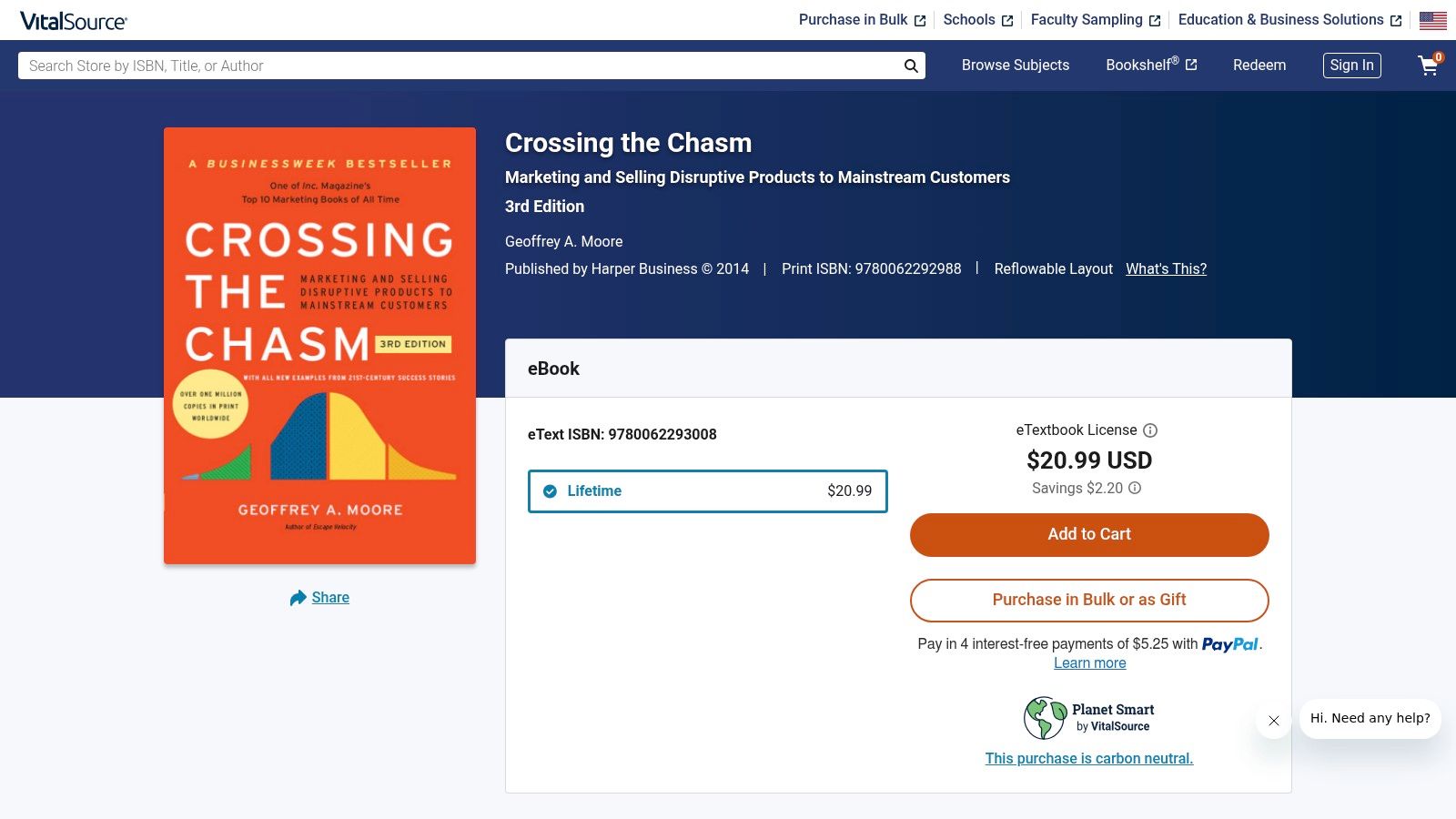
Some products don't fail because the technology is weak. They fail because the company sells a technically advanced offer the same way it sells an established product. That's a predictable mistake in industrial software, controls, sensors, automation platforms, and connected equipment.
Crossing the Chasm is the best pick when the product works, early adopters are interested, and mainstream buyers still won't commit.
Diagnosis
Your team has early enthusiasm but no reliable path into pragmatic accounts. Engineers love the feature set. A few forward-leaning customers say yes. Then the pipeline stalls because the broader market wants proof, integration support, references, and reduced buying risk.
That friction matters in B2B. Innovation adoption and diffusion depend on six interdependent factors: network effects, switching costs, market timing, perceived innovation attributes, pricing strategies, and buyer behavior, as outlined in this analysis of innovation diffusion dynamics. In manufacturing, perceived reliability and compatibility often matter more than raw performance.
Solution
Moore's beachhead strategy is built for that moment. Pick a narrow segment that has an urgent problem, build the whole product around that use case, and win enough reference customers that pragmatic buyers stop seeing the offer as experimental.
What works in practice:
- Choose one segment first: Don't launch to “all manufacturers.” Target one buyer type with one pressing operational problem.
- Define the whole product: Include training, implementation support, integration guidance, and proof points. The product is more than the hardware or software.
- Build references intentionally: Pragmatic buyers want evidence from companies that look like them.
A hard truth. This book is less useful for minor line extensions or service businesses that don't face a category-adoption problem. But for companies trying to move from curiosity to mainstream demand, it's one of the clearest operating guides available.
Mainstream buyers rarely reward novelty by itself. They reward reduced risk.
You can access the publisher page for Crossing the Chasm, 3rd Edition on VitalSource.
3. The Lean Startup
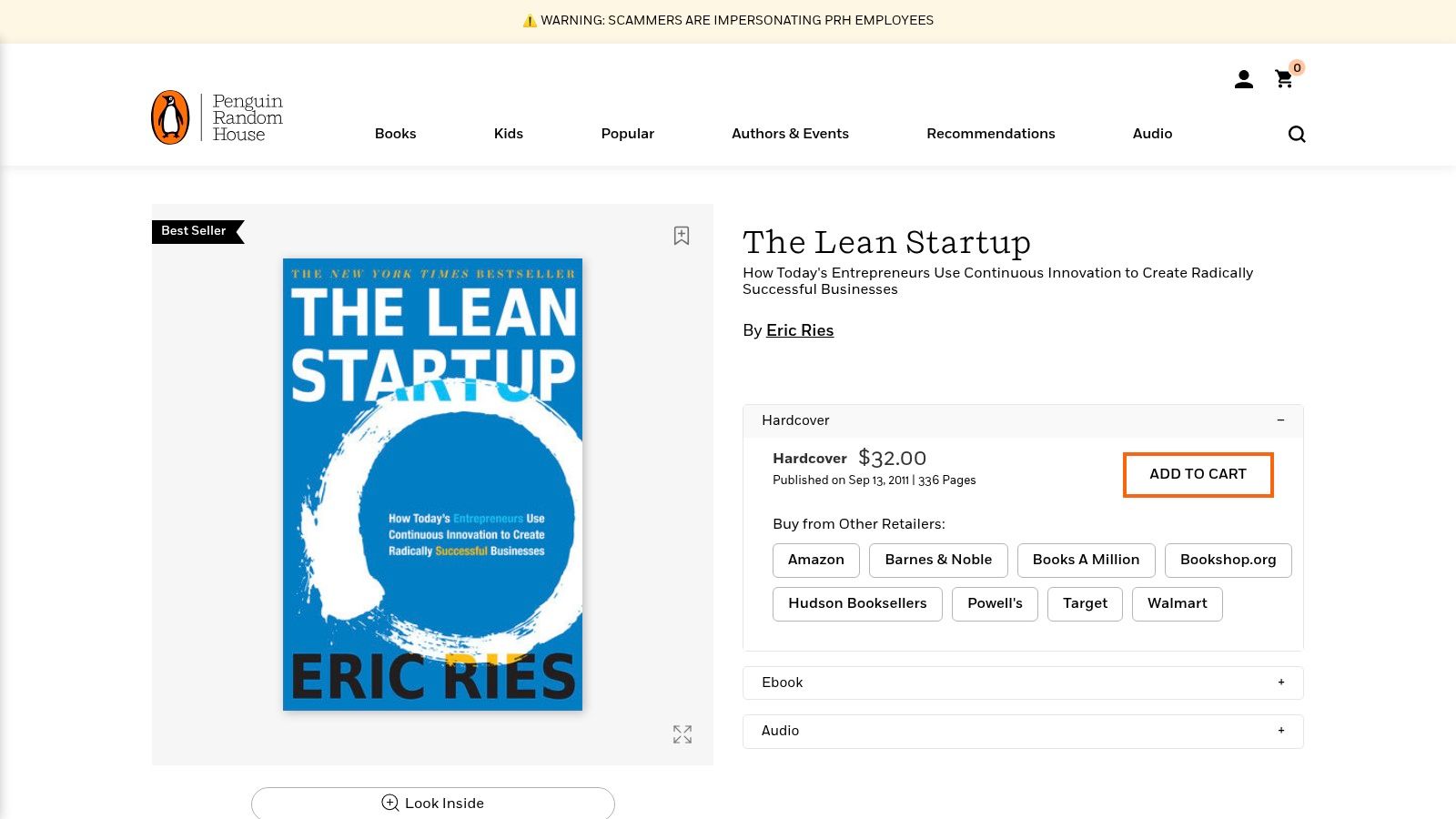
If your team tends to overbuild before learning, start here. The Lean Startup is the most tactical book on innovation in this list for reducing waste before a big launch.
Manufacturers often assume Lean Startup is only for software. That's a mistake. The principles work well for pilot cells, retrofit programs, service offers, pricing tests, distributor enablement, and phased capex decisions.
Diagnosis
You're making large bets on untested assumptions. The engineering team assumes the feature set matters. Sales assumes buyers care. Leadership assumes the market is ready. Then the company commits time, tooling, and launch effort before any of those assumptions are tested.
The better path is disciplined experimentation. Historical analysis summarized by ITONICS states that structured innovation frameworks such as Design Thinking, Lean Startup, and Outcome-Driven Innovation have increased commercial success rates by approximately 25% to 30% in companies that implement them systematically, compared with ad hoc processes.
Solution
Ries gives you an operating loop. Build, measure, learn. In industrial settings, that can mean a stripped-down pilot, a limited release to one customer segment, or a manual service version before investing in automation.
Use it with rigor:
- State the assumption first: Write down what must be true for the idea to work.
- Design the smallest useful test: Don't build the full system if a narrower pilot can answer the question.
- Track learning metrics: Separate activity from evidence. Shipping a prototype isn't proof of demand.
- Decide fast: Pivot when evidence contradicts the plan. Persevere when the signal is real.
This is also where modern marketing execution matters. If your experiment never reaches the right buyers, you won't learn much. That's one reason we connect product testing with innovation in marketing for B2B teams, especially when engineers and commercial teams need the same feedback loop.
The limitation is cultural. Teams have to accept that early versions may be incomplete and that some ideas deserve to die early. If your organization treats every test like a final exam, this method will feel uncomfortable. That discomfort is usually a sign that it's needed.
You can get the official book details from Penguin Random House's page for The Lean Startup.
4. Competing Against Luck
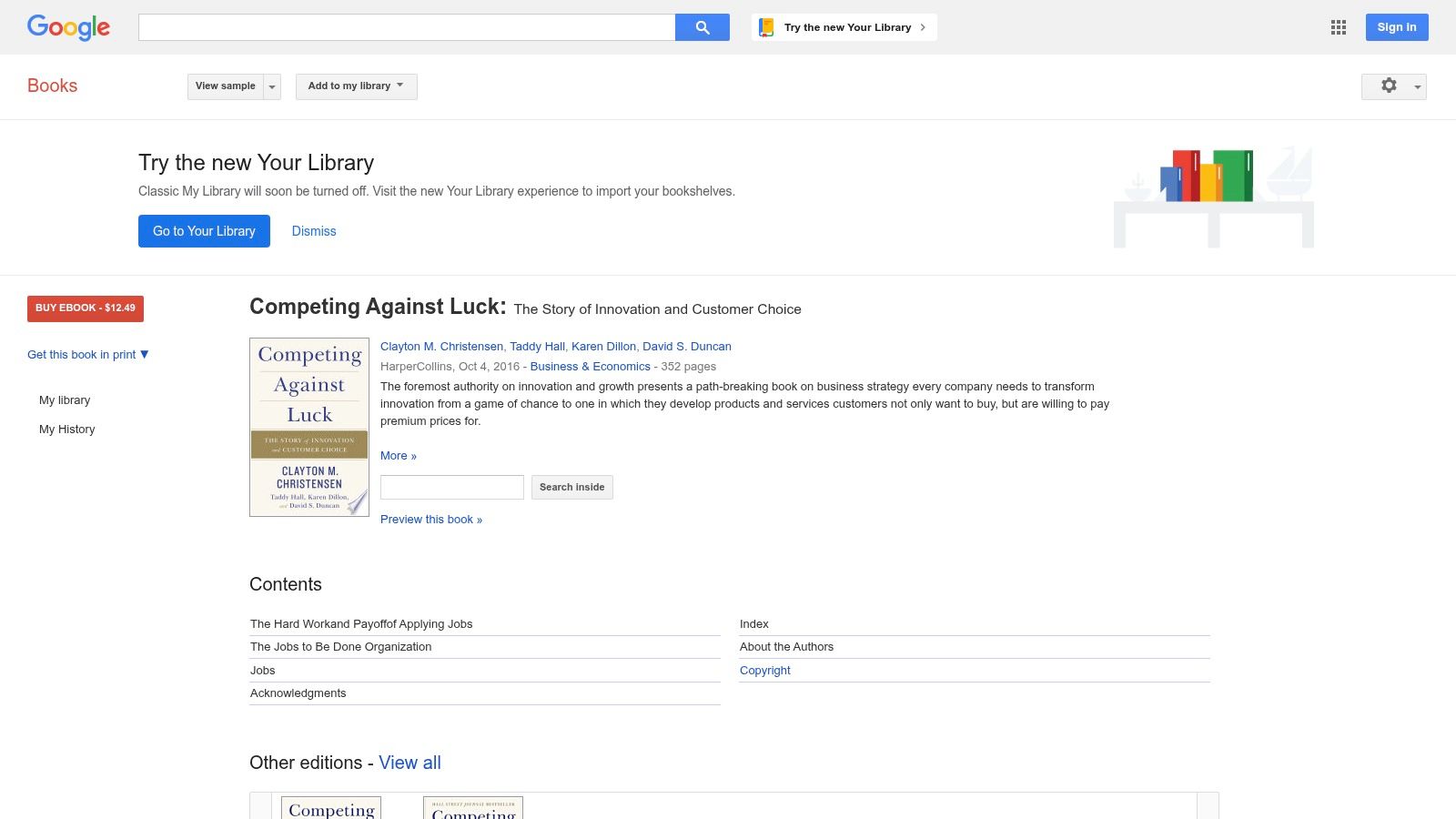
A product can be technically excellent and still get ignored because the messaging is built around specs, not the customer's actual struggle. That happens constantly in manufacturing.
Competing Against Luck fixes that by applying Jobs-to-Be-Done thinking. It helps you understand what a customer is really “hiring” your product or service to accomplish.
Diagnosis
Your team is selling features when buyers are trying to make progress. They aren't buying spindle speed, tolerance bands, remote monitoring, or a maintenance package in isolation. They're trying to reduce downtime, avoid line risk, simplify compliance, speed onboarding, or make a plant manager look competent in front of leadership.
When companies miss that job, launches drift. Existing innovation books often ignore the gap between strategy and industrial execution, especially in businesses where legacy tools, CRM data, automation, and engineer-focused content all need to work together, as noted in Viima's discussion of the Four Lenses of Innovation.
Solution
Jobs-to-Be-Done gives commercial and engineering teams a shared way to define value. Instead of asking, “What features should we add?” ask, “What progress is the customer trying to make, and what gets in the way?”
Try this sequence with your team:
- Interview recent buyers: Focus on the timeline of the purchase, not broad satisfaction questions.
- Look for switching moments: What triggered the search, what alternatives were considered, and what anxieties slowed the decision?
- Rewrite positioning: Lead with the job, then support it with technical proof.
A strong use case for this book is repositioning mature lines. Many industrial companies already have capable products. They just frame them around internal engineering pride instead of external business outcomes.
This book is less prescriptive than The Lean Startup on experiment design. You'll need discipline in how you collect and synthesize interviews. But if your team keeps building things customers “should” want, this is the correction.
You can review the book on Google Books for Competing Against Luck.
5. Loonshots
Some companies don't have an idea problem. They have an immune system problem. The organization rejects fragile ideas before those ideas have time to mature.
That's why Loonshots stands out. Bahcall spends less time on brainstorms and more time on structure, incentives, and the conditions that let unconventional ideas survive.
Diagnosis
Your core business is too efficient for exploration. Production meetings dominate. Quarterly targets dominate. The people evaluating new ideas are rewarded for protecting utilization, margin, and predictability. In that environment, the safest answer always wins.
This is especially common in midsize industrial firms. Leadership says it wants innovation, but every mechanism in the business is tuned for exploitation, not exploration.
Solution
Bahcall's value is organizational design. He gives leaders a framework for separating franchise work from experimental work without turning them into enemies. That's useful when you're balancing current throughput with future bets such as service platforms, connected products, or a move into a less familiar market.
Use the book to pressure-test these areas:
- Team separation: Does the experimental initiative have enough independence to avoid being buried by core priorities?
- Incentive alignment: Are managers punished when early-stage projects look inefficient?
- Executive translation: Can leadership explain why the core and the experimental track need different metrics and cadences?
Field note: If every project must clear the same ROI logic at the same maturity level, the newest ideas won't survive long enough to become credible.
This book won't replace your process for validation. It also won't teach the day-to-day mechanics of running pilots. What it does better than most books is give leaders language for redesigning the system around innovation, not just talking about innovation.
That makes it a smart companion to strategic thinking around Blue Ocean Strategy in practical terms, especially when your team needs permission to pursue a market space the core business doesn't yet understand.
You can visit the publisher page for Loonshots at Macmillan.
6. Working Backwards
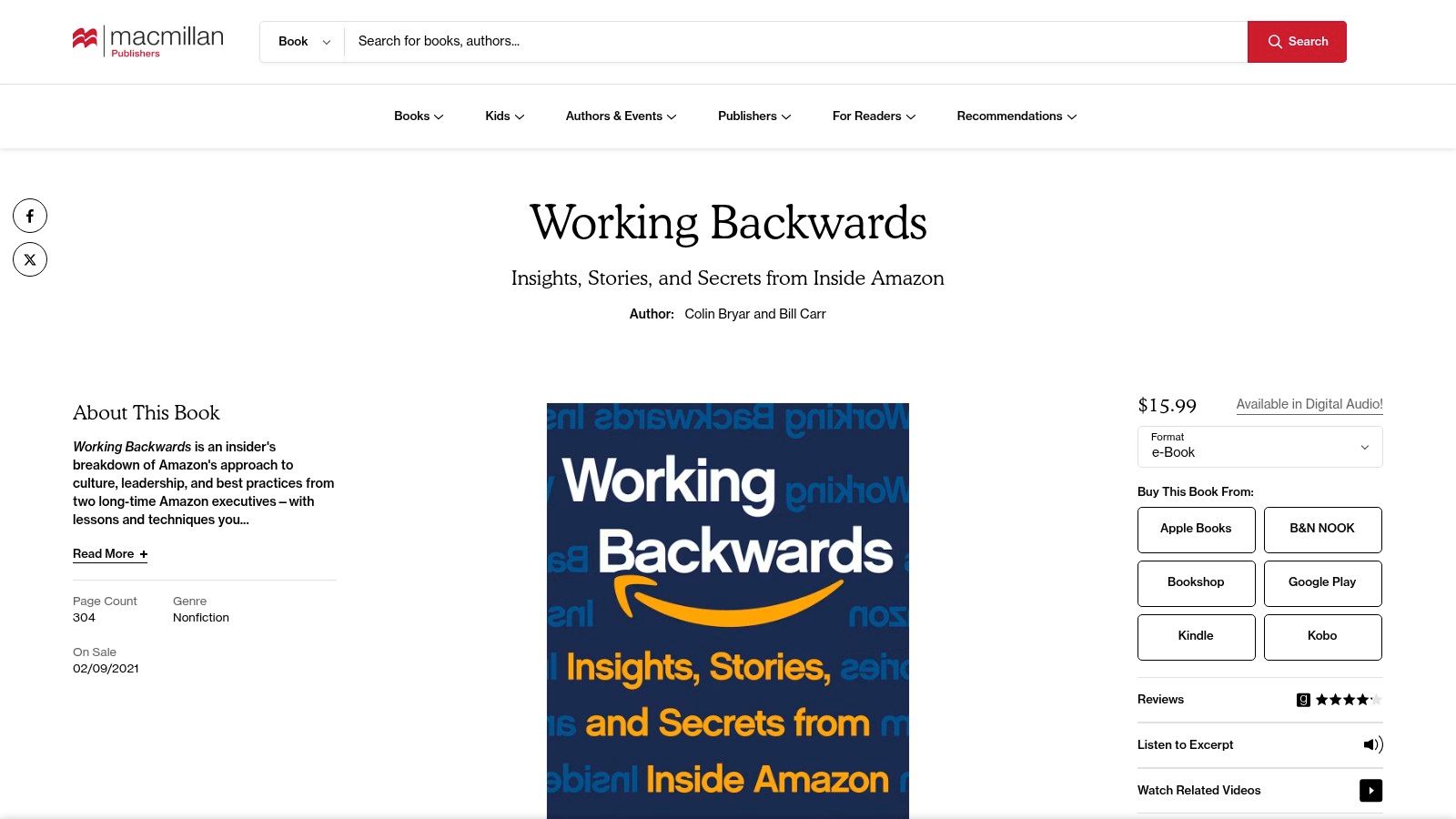
A lot of innovation programs fail in the handoff. Someone has an idea. Leadership likes it. Then requirements stay fuzzy, priorities drift, and execution gets trapped in recurring meetings with no real mechanism for decision-making.
Working Backwards is one of the best books for turning innovation from a slogan into an operating cadence.
Diagnosis
Your team has enthusiasm but no mechanism. There's no structured way to define the customer problem, document the intended outcome, identify assumptions, and keep a cross-functional initiative moving without endless interpretation.
That gap matters because buyers need confidence before they adopt something new. Marketing research notes that sharing information about product development progress increases adoption of the current version of a Continuous Innovation Product by reducing uncertainty and perceived switching costs, as described in this marketing research text on innovation and diffusion.
Solution
The PR/FAQ method is the standout tool here. Write the future press release and frequently asked questions before building the product. For manufacturers, that forces clarity around customer value, implementation realities, objections, and what the launch means in plain English.
Three ways to apply it:
- Write the promise first: If the press release is vague, the product concept is vague.
- Use FAQs to expose friction: Installation, lead time, support burden, training, compatibility, and payback concerns should show up before engineering starts building.
- Run narrative reviews: Replace slide-heavy updates with written narratives that force clearer thinking.
This book is demanding. Writing well takes discipline, and implementing it often meets with initial resistance. But once the habit sticks, requirements improve, review meetings improve, and cross-functional confusion drops.
Write the launch document before the launch work. That simple sequence change prevents a lot of expensive ambiguity.
For operations-minded teams, this is one of the strongest books on innovation because it doesn't stop at inspiration. It gives you mechanisms.
You can find the official listing on Macmillan's page for Working Backwards.
7. Testing Business Ideas
When a team agrees that it should “test more,” the next problem appears fast. Test what, exactly? In what order? With what evidence threshold? Testing Business Ideas solves that practical gap better than almost any other title.
This is the field manual in the stack. If The Lean Startup gives you the philosophy, this book gives you the workbench.
Diagnosis
You know a big launch is risky, but your team still defaults to one giant bet. That happens because no one has a shared library of smaller experiments, no one tracks assumptions consistently, and no one knows what counts as enough evidence to proceed.
The execution backdrop matters. In a 2025 report, B2B organic lead volumes increased 36.4% from January to September, SQL conversion rates rose from 5.2% to 9.2%, and cost-per-lead declined from $215 to $165. For industrial teams, that reinforces a practical point. Better testing and better buyer acquisition systems work together. You need both signal and reach.
Solution
Bland and Osterwalder provide a library of experiments that manufacturers can use without pretending every business is a software startup. You can test demand for a service contract, a pricing model, a distributor play, a retrofit package, or a niche market offer before committing fully.
A useful reading order for this whole list is:
- Start with The Innovator's Dilemma if leadership is unclear on where to place bets.
- Read Competing Against Luck if your team doesn't understand buyer motivation.
- Move to The Lean Startup to install learning loops.
- Use Testing Business Ideas to build actual test plans.
- Add Crossing the Chasm when the issue is mainstream adoption.
- Use Loonshots and Working Backwards to strengthen structure and execution.
This book's downside is the same as its strength. It encourages lots of small tests, and some teams find that frustrating because they want certainty before action. Certainty usually arrives too late. What you want is enough evidence to make the next decision with less waste.
You can review the publisher page for Testing Business Ideas from Wiley.
7-Book Innovation Comparison
| Title | Implementation Complexity 🔄 | Resource Requirements ⚡ | Expected Outcomes 📊⭐ | Ideal Use Cases 💡 | Key Advantages ⭐ |
|---|---|---|---|---|---|
| The Innovator's Dilemma (Clayton M. Christensen) | Medium, strategic coordination across units; portfolio rules | High, capital allocation, multiple business units or carve‑outs | ⭐⭐⭐⭐, clearer portfolio choices; reduced risk of missing disruption | Manufacturers deciding on cannibalization, timing of new product lines | Strategic lens for sustaining vs disruptive; practical allocation guardrails |
| Crossing the Chasm, 3rd Ed. (Geoffrey A. Moore) | Medium, market segmentation and whole‑product work | Medium, reference customers, channel partnerships, sales focus | ⭐⭐⭐⭐, repeatable GTM path into mainstream pragmatists | High‑tech/industrial products moving from early adopters to mainstream | Actionable beachhead/positioning playbook for complex B2B buys |
| The Lean Startup (Eric Ries) | Low–Medium, build‑measure‑learn cycles and MVPs | Low–Medium, cross‑functional teams, fast feedback loops, cultural buy‑in | ⭐⭐⭐⭐, faster validated learning; reduced waste and failed capex | Engineering teams running pilots, prototypes, phased investments | Tactical MVPs, innovation accounting, pivot/persevere framework |
| Competing Against Luck (Christensen et al.) | Medium, disciplined qualitative JTBD research | Medium, skilled interviewers, customer observation, analysis | ⭐⭐⭐, improved product‑market fit; predictable growth drivers | Repositioning mature products and aligning engineering to customer value | JTBD causal theory; uncovers non‑obvious purchase drivers |
| Loonshots (Safi Bahcall) | Medium, org design and incentive restructuring | Medium–High, leadership alignment, structural changes, time | ⭐⭐⭐, protects radical ideas; balances exploration vs exploitation | Midsize firms protecting early‑stage platform or service experiments | Practical frameworks for org levers and incentive alignment |
| Working Backwards (Colin Bryar, Bill Carr) | High, disciplined narrative writing and operating cadences | High, writing/review discipline, coaching, sustained cadence | ⭐⭐⭐⭐, repeatable management routines; de‑risked large bets | Organizations scaling customer‑obsessed innovation and long‑term bets | Concrete tools (PR/FAQ, weekly reviews, hiring bar) to operationalize innovation |
| Testing Business Ideas (Bland & Osterwalder) | Low–Medium, follow visual templates and experiment library | Low–Medium, consistent test execution, tracking evidence | ⭐⭐⭐⭐, rapid validation; lower capex risk before scale | Pilots for services, pricing, channels, and non‑software experiments | Large library of actionable experiments and assumption‑mapping templates |
Your Next Step Turn Insight Into Action
A book on innovation only matters if it changes what your team does next month. Reading without implementation becomes another form of procrastination, especially in manufacturing where urgency is always pulling attention back to today's orders, today's quality issue, or today's customer fire.
The practical move is to match the book to the bottleneck. If leadership can't separate core improvements from future bets, start with The Innovator's Dilemma. If the market doesn't seem to care about a technically strong offer, start with Competing Against Luck. If your team builds too much before learning, start with The Lean Startup or Testing Business Ideas. If good ideas keep dying in meetings, use Loonshots. If execution feels vague and cross-functional work keeps drifting, use Working Backwards.
There's another reason to be disciplined here. For B2B companies, SEO delivers a 2.6% conversion rate, outperforming PPC at 1.5%, paid social at 0.9%, and trade shows at 0.7%. That matters because innovation doesn't end with the product or service design. You still need a reliable system to bring validated offers to market and convert interest into qualified opportunities.
The same applies to channel selection and buying committee reach. LinkedIn is used by 97% of the B2B market that uses social media for lead generation, and 41.7% of respondents use it daily. For industrial firms selling into multi-stakeholder buying groups, that makes consistent thought leadership and targeted outreach part of the innovation system, not a separate marketing afterthought.
AI can help on the commercial side too. Companies using AI for lead generation report a 50% increase in sales-ready leads, up to 60% lower customer acquisition costs, and 64% of businesses using AI chatbots report an increase in qualified leads. Used well, those tools don't replace strategy. They help teams capture and qualify demand more efficiently once the offer is validated.
So here's the assignment. Pick one book from this list based on your biggest current constraint. Read it with the people who own the outcome. Then implement one concrete artifact within the next 30 days: one PR/FAQ, one JTBD interview sequence, one pilot design, one assumption map, or one protected innovation lane.
If your team is also documenting what it learns, sharper communication helps. A useful companion resource is this guide on how to write nonfiction.
Innovation is a muscle. It gets stronger when you use it on real business problems, in a repeatable system, with evidence instead of optimism.
If you want help diagnosing where your innovation system is breaking down, from positioning and validation to industrial SEO, CRM, automation, and lead generation, talk with Machine Marketing. We help manufacturers connect the tools and teams they already have into a system that drives growth.