Most advice about Facebook Ads for B2B starts in the wrong place. It treats Meta like a cheap form-fill machine, then blames the platform when leads don't turn into pipeline.
That's the wrong diagnosis. For industrial companies, Facebook usually works better as a demand-creation and retargeting layer, then as a source of CRM signals that train Meta toward better buyers over time. The win isn't more form fills, it's better feedback from your CRM so the algorithm learns which leads become SQLs and which ones close.
Table of Contents
- Why Facebook Ads Deserve a Place in Your B2B Strategy
- Choosing the Right Campaign Objectives and Structure
- Building Audiences That Reach Engineers and Decision-Makers
- Creative and Offers That Convert Technical Buyers
- Tracking and Attribution Beyond the Facebook Pixel
- Testing Framework and Budget Allocation for B2B Campaigns
- Follow-Up Automation and Putting the System Together
Why Facebook Ads Deserve a Place in Your B2B Strategy
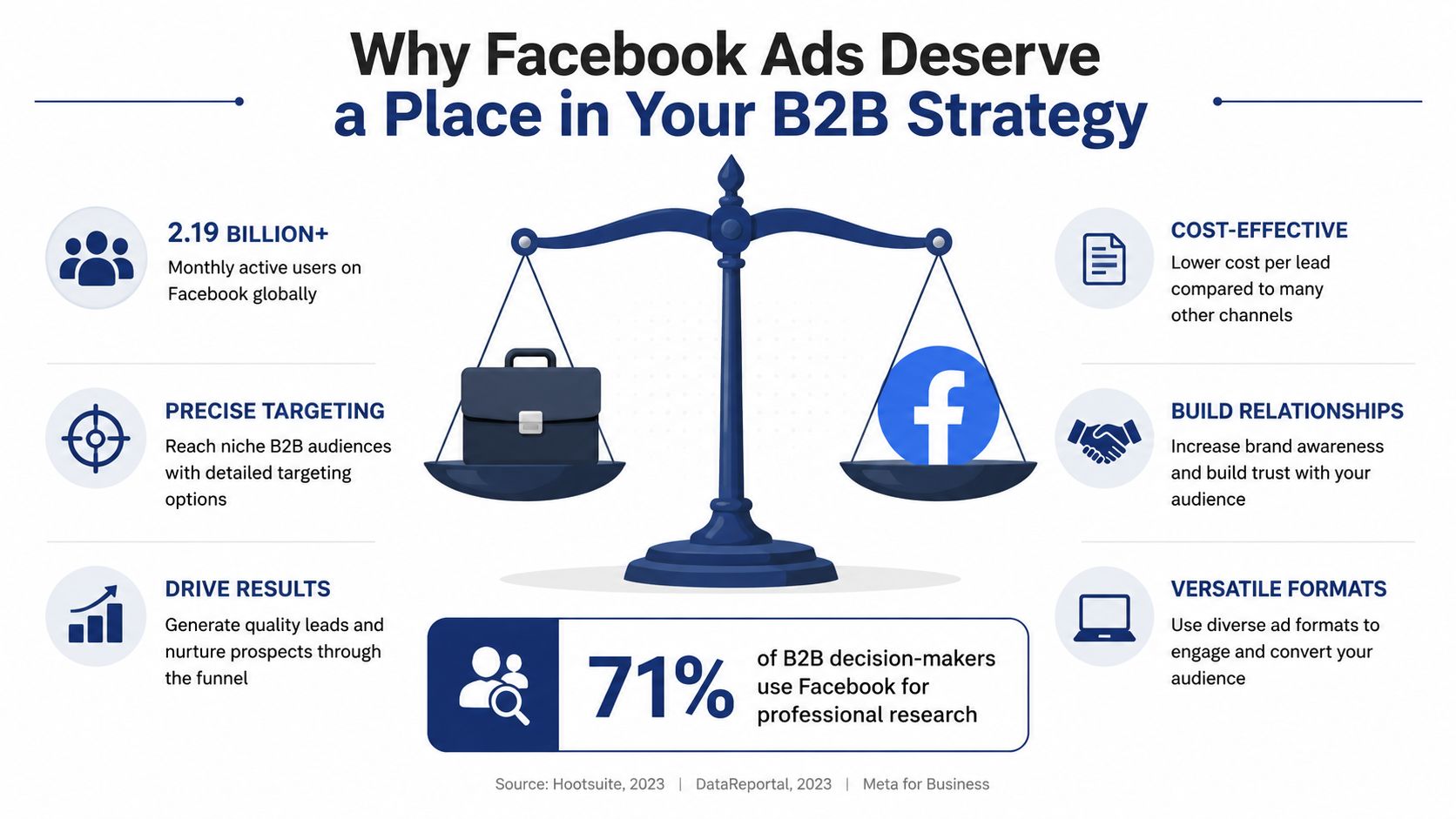
Facebook still gets dismissed by industrial teams because it doesn't look like a buying platform. That misses how buyers behave. Decision-makers spend 74% more time on the platform than other users, and 48.5% use Facebook for B2B research, according to the benchmark data summarized in Dreamdata's B2B Facebook Ads benchmarks.
That matters because B2B buying rarely starts with a demo request. It starts with repeated exposure, a problem to solve, and a search for vendors once the team is already aware of the category. Facebook fits that earlier stage well, especially when you want to stay in front of plant managers, operations leaders, and procurement teams between sales conversations.
Practical rule: use Facebook to create familiarity before you ask for commitment.
Where Facebook fits in the media mix
For B2B, Facebook is usually not the place to hunt for direct traffic volume. Dreamdata reports that B2B advertisers allocate about 11% of total ad spend to Facebook, while the platform accounts for only 0.8% of B2B website traffic Dreamdata benchmark page. That gap tells you what the channel is doing. It's paying for reach, repeated exposure, and remarketing, not just clicks.
That's why Facebook often complements LinkedIn and Google Ads instead of competing with them. LinkedIn can be stronger for precise professional targeting, and Google can be better for intent capture. Facebook gives you a broader, often cheaper way to keep the conversation alive after someone has heard of you.
For industrial and commercial advertisers, the cost side also matters. The same benchmark set cites a Facebook CPC around €1.80 and a cost-per-lead near $16.95 in the industrial/commercial sector Dreamdata benchmark page. That doesn't mean every campaign will match those figures, but it does show why Facebook remains attractive for upper-funnel and retargeting work.
What to expect from the channel
If you expect Facebook to behave like search, you'll be disappointed. If you use it to build audiences, warm up buyers, and feed remarketing, it can make the rest of your system perform better. That's the honest trade-off.
A good way to judge fit is to ask three questions:
- Do your buyers research over time? Facebook helps most when the buying cycle isn't instant.
- Do you have a CRM and follow-up process? Without that, the leads are just noise.
- Do you need more awareness before demand appears? Facebook is built for that job.
If you're building a broader industrial demand system, use Facebook as the layer that keeps your name in front of the market while other channels capture demand later. That's the right expectation, and it's the one that saves budgets.
Choosing the Right Campaign Objectives and Structure
The biggest mistake I see in Facebook Ads for B2B is choosing the wrong objective, then blaming the ads when the structure was broken from the start. Meta's delivery system optimizes around the objective you pick, so the setup has to match the sales motion, not the vanity metric.
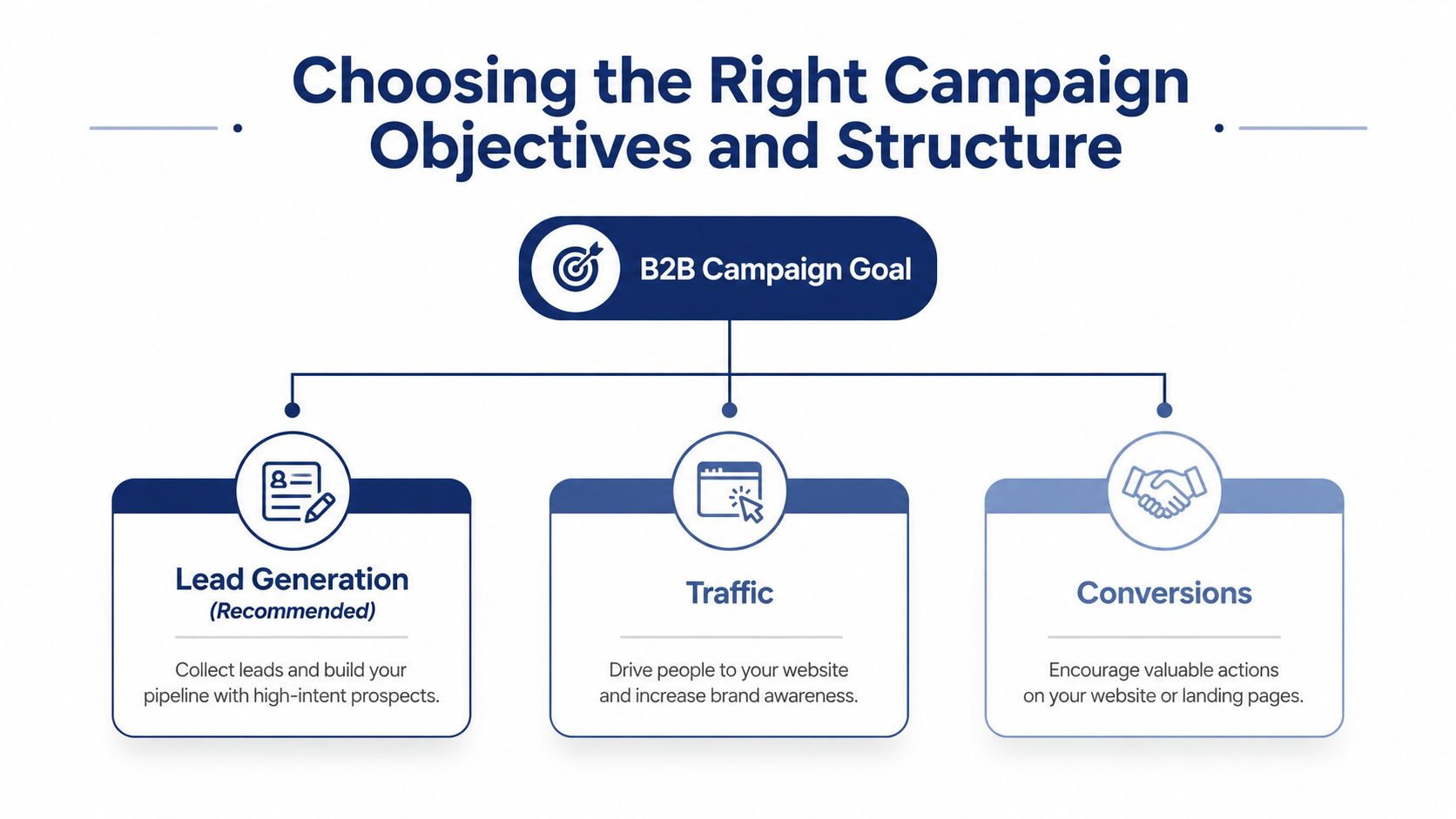
For most industrial companies, Lead Generation is the most practical starting point. That recommendation lines up with practitioner guidance from Cometly's B2B ads on Facebook guide, which emphasizes a clean campaign structure and enough learning time for the system to stabilize. Awareness campaigns still matter, but mainly when you need to build a retargeting pool before expecting leads.
How to structure the account
Use one objective per campaign. Keep each audience segment in its own ad set. Run multiple creative variations inside each ad set so Meta has something to compare.
That structure does two important things. It reduces audience overlap, and it gives the platform cleaner signals. If you cram every audience into one campaign, you make it harder to see what's working.
A simple setup for a CNC machine shop launching a new service line might look like this:
- Campaign 1, Lead Generation: one service line, one offer, one conversion goal.
- Ad set 1: plant managers.
- Ad set 2: operations leaders.
- Ad set 3: retargeting visitors who already viewed the service page.
A manufacturer promoting a diagnostic assessment tool can use the same pattern, but with a softer offer at the top and a stronger follow-up sequence behind it. That keeps cold traffic from being forced into a hard ask too early.
Learning phase discipline
Give the campaign at least seven days before making a judgment, because the system needs time to learn from delivery patterns Cometly. If you start editing too quickly, you interrupt the optimization process and create false signals.
Don't optimize a campaign every day just because you're nervous. Give the system room to settle, then read the data.
The practical takeaway is simple. Use Lead Generation when the offer is clear and the lead can be handled in CRM. Use Awareness when you need to fill the top of the funnel. Use Conversions only when your tracking and downstream qualification are already solid enough to trust.
Building Audiences That Reach Engineers and Decision-Makers
Targeting is where many industrial campaigns waste money. The instinct is to get overly narrow, then stack job titles and interests until the audience is tiny and unstable. On Facebook, that often hurts performance more than it helps.
A stronger approach starts with your own data. Upload CRM contacts, customer lists, and email lists to create Custom Audiences, then build lookalikes from your highest-value segments. The source material behind this guidance, plus the audience-building logic used in industrial campaigns, is consistent with the workflow in buyer persona development.
Use data layers instead of guesswork
For a machine tool distributor, the core audience stack might include existing customers, website visitors to product pages, and a lookalike based on quoted accounts. For a custom fabricator, the stack could center on CRM contacts, procurement teams, and visitors who spent time on capability pages.
Broad interest targeting can also outperform narrow job-title filters on Facebook, especially in B2B manufacturing. Interests like industrial machinery or B2B purchasing often give Meta more room to find the right people than a hyper-specific title stack that's too small to learn from.
Exclusions matter as much as targeting
A lot of wasted spend comes from showing prospecting ads to people who already bought, already quoted, or already filled the funnel. Use exclusions for current customers, recent converters, and low-quality traffic that doesn't match your sales motion.
A practical segmentation model looks like this:
- Top layer: CRM contacts and customer data.
- Middle layer: lookalike audiences from qualified leads or closed-won accounts.
- Bottom layer: interest and behavior targeting tied to industrial buying.
Retargeting by engagement depth
Not every visitor deserves the same follow-up. Someone who watched a full video or visited a service page is warmer than someone who bounced in ten seconds. Build separate retargeting layers for those behaviors and give each layer a different message.
One more useful resource is a strong internal content map. If your team still needs clarity on how to define segments before ad setup, the article at https://machine-marketing.com/how-to-create-buyer-personas/ is worth aligning with your CRM structure.
Creative and Offers That Convert Technical Buyers
Cold audiences in industrial markets rarely respond to a hard-sell demo request. Engineers, plant managers, and procurement teams usually want the problem framed first, then they decide whether the offer deserves attention. Practical tools beat aggressive pitches because they lower the trust barrier.
A diagnostic often works better than a direct sales ask. ROI calculators, benchmark reports, template packs, quizzes, and problem-solving guides give technical buyers something useful without asking for too much too soon. That also fits the educational first, retarget later motion discussed in B2B content strategy for engineers.
What the creative should sound like
The copy should sound like someone who knows the plant floor, not like a brand deck. Short sentences work. Clear nouns work. Jargon does not.
A few ad angles tend to beat generic company messaging:
- Problem-first framing: name the operational pain before naming the solution.
- Specific utility: offer a calculator, checklist, or assessment.
- Proof without hype: show a process, not a slogan.
If you want a practical baseline for ad formatting and testing, Facebook Ads best practices from UFO Performance Marketing is a useful reference for creative discipline and channel setup.
Formats that usually make sense
Short video walkthroughs work well because they make a technical process easier to grasp. Carousel ads can show a before-and-after workflow or a sequence of steps. Single-image ads can work if the message is concrete and the visual is clean.
Here's the full-funnel logic I'd use:
- Cold audience: educational content, diagnostic tools, and practical guides.
- Warm retargeting: case studies, process explanations, proof points.
- Hot audience: demo requests or consultations, but only after familiarity is built.
The biggest creative mistake is asking for the sale before the buyer understands the problem. Facebook can support direct response, but only after the audience has enough context to trust the offer. If you want the algorithm to find buyers who matter, the creative has to support the downstream signal chain, not just fill the top of the funnel with cheap leads. That means aligning the offer with CRM tracking so you can teach Meta which ads produce SQLs and closed-won revenue, not just form fills.
Tracking and Attribution Beyond the Facebook Pixel
Most B2B Facebook programs break at the handoff to sales. The ads can be fine, the audience can be solid, and the offer can be useful, but if measurement stops at the form fill, Meta learns to optimize for volume instead of revenue quality. That is how teams end up celebrating cheap leads that never become pipeline.
The better workflow starts with the pixel and then extends into Conversions API, UTMs, and CRM feedback. The operating model laid out in Facebook ads for B2B marketing is straightforward. Capture every lead with UTMs, push source fields into your CRM, then let your sales stages tell you which ad set and creative produced SQLs and closed-won deals. If you want a practical way to connect spend to revenue, the framework in how to measure marketing ROI helps keep the reporting tied to outcomes instead of vanity metrics.
Build the feedback loop
Once you know which leads matter, send those high-value outcomes back into Meta as a Custom Audience or, better, as offline conversion events. That is the piece many B2B guides skip. They stop at lead capture, but the stronger system uses downstream outcomes to train future delivery. For industrial suppliers, machine shops, and other long-sales-cycle businesses, that matters because a form fill from an intern is not the same signal as a plant manager who turns into a quoted opportunity.
For teams on GoHighLevel or a similar CRM, the setup usually looks like this:
- Capture the source data on every lead, including campaign, ad set, ad name, and landing page URL.
- Tag the lead in the CRM with those fields the moment the form submits.
- Track the outcome in sales stages, not just form status. A lead should move from new, to contacted, to SQL, to opportunity, to closed-won.
- Feed back SQL and closed-won records through offline conversions or the Conversions API so Meta sees the revenue path, not only the first click.
- Retarget engaged contacts with the next relevant offer, such as a quote request, specification sheet, or demo.
A practical Conversions API setup is usually simple on the surface and messy in the details. In Meta Events Manager, you connect the CRM or server-side gateway, map the event name to the outcome you want to optimize for, and pass identifiers such as email, phone, external ID, and event time. In the CRM, create an automation that fires when a deal changes to SQL or closed-won, then send that record back as an offline event with the original campaign source attached. If your team uses Zapier, Make, or native webhooks, the same logic applies. The point is to stop rewarding Meta for lead forms alone and start rewarding it for qualified stages.
The same idea applies whether your CRM is GoHighLevel, Salesforce, or something else. The stack matters less than clean source tracking, consistent stage tagging, and a reliable path from sales records back into ad delivery.
What to measure instead of just clicks
The diagnostic questions are simple:
- Which audience created the best SQLs?
- Which creative brought in the highest-intent leads?
- Which campaign produced the cleanest handoff to sales?
If your team needs a broader way to tie spend to revenue, the brand value measurement guide is useful context for thinking about measurement beyond surface-level engagement.
Measure the path to revenue, not just the first form submission.
That mindset turns Facebook into a pipeline learning system instead of a lead dump.
Testing Framework and Budget Allocation for B2B Campaigns
Testing on Facebook works best when you isolate one variable at a time. If you test audience, offer, and creative all at once, the data gets muddy fast. B2B budgets are usually too valuable to waste on random experimentation.
Use a simple structure. Keep the audience stable, test the creative first, and only then test a new offer or a new segment. That gives you cleaner readouts and fewer false positives.
What the benchmarks suggest
Recent benchmark data gives you a rough reference point, not a guarantee. Powered by Search reported a 2026 B2B SaaS average CTR of 1.51%, average CPC of $0.83, average CPA of $19.68, and ROAS of 1.24 Powered by Search benchmark summary. Meta-adjacent benchmark summaries also place all-industry Facebook CTR around 1.44% to 1.49% and median CPC around $0.54 to $0.55 Powered by Search benchmark summary.
For lead generation, GTM 8020 reports a median of 39 leads for B2B companies, with top performers reaching 191 leads Powered by Search benchmark summary. Those numbers are useful because they keep expectations grounded. Facebook can produce meaningful B2B output, but results still vary by industry and offer.
| Metric | B2B SaaS Average | All-Industry Median | Industrial/Commercial |
|---|---|---|---|
| CTR | 1.51% | 1.44% to 1.49% | Not provided |
| CPC | $0.83 | $0.54 to $0.55 | €1.80 |
| CPA or CPL | $19.68 CPA | Not provided | $16.95 CPL |
The industrial/commercial CPC and CPL figures come from the Dreamdata-related reporting summarized by GTM 8020 and the Dreamdata benchmark page itself. Use them as directional context, not a promise.
How to scale or stop
Scale when the campaign produces qualified conversations, not just cheap clicks. Kill or pause when the audience is stale, the creative is exhausted, or the lead quality never reaches sales.
A useful rule for B2B is to review performance through three lenses:
- CPC: tells you whether the ad is earning attention efficiently.
- CPL: tells you whether the offer is resonating.
- Cost per SQL: tells you whether the campaign is generating real business value.
If you need a broader framework for tying marketing spend to revenue, the brand value measurement guide from SleekPost fits well alongside this testing process. Use it to keep the discussion anchored in business outcomes, not platform vanity.
Follow-Up Automation and Putting the System Together
A lead that waits two days for follow-up is already going cold. That's true on Facebook, and it's even more damaging in industrial sales where buyers expect responsiveness and clarity. The ads are only the front end of the system.
The workflow should be different for each lead type. A form-fill lead needs immediate SMS and email follow-up. A content-download lead needs nurture. An engaged retargeting prospect needs a timely reminder tied to the next logical offer.
Build the response chain
The automation logic is simple, but the execution has to be tight. If you use GoHighLevel or a similar platform, build separate paths for high-intent and low-intent contacts, then connect each path to the source data you captured in the CRM.
A clean sequence usually includes:
- Immediate confirmation: let the lead know the request was received.
- Sales notification: alert the right rep fast.
- Nurture branch: send useful follow-up for softer leads.
- Retargeting trigger: move engaged non-converters into a new ad set.
For a practical reference on automation sequencing and workflow logic, Andy's automation guide is a solid companion read.
Diagnose the handoff
Most campaign problems are handoff problems. Marketing generates the lead, sales responds slowly, and nobody owns the gap. That's why the system has to be diagnosed as one chain instead of separate departments.
Use this checklist:
- Source tags: are leads tied to campaign, ad set, and creative?
- Speed to lead: are form submissions answered fast enough?
- Sales routing: does the right rep get the right lead?
- Nurture logic: do softer leads keep receiving relevant content?
- CRM feedback: are SQLs and closed-won deals fed back into Meta?
If those pieces are connected, Facebook becomes more than a lead source. It becomes part of a closed loop that keeps improving with every deal you win.
If you want a sharper diagnosis of your own Facebook setup, Machine Marketing can help you audit the CRM handoff, rebuild the offer path, and turn ad spend into a system your sales team can use. Visit Machine Marketing to see how we approach B2B growth for manufacturers, machine shops, and industrial teams.