If your quoting team is waiting for inbound RFPs, a few repeat customers, and the next trade show to fill the pipeline, you don't have a lead-generation system. You have a collection of hopeful events. Finding potential clients consistently requires a designed process that identifies the right accounts, detects buying signals, reaches the right people, routes responses quickly, and shows you what to improve.
For manufacturers, this matters because industrial purchases involve multiple stakeholders and long evaluation periods. One 2025 industry summary reports that 84% of companies involve more than one person in purchase decisions, 20% of deals take over a year, and buyers often wait until roughly two-thirds through their buying journey before engaging sellers. The vendor already considered before contact wins roughly 80% of the time, according to the same B2B lead generation statistics summary. Your job is to become visible before the buyer has written the shortlist.
Table of Contents
- Why Most Manufacturers Struggle to Find Potential Clients
- Defining Your Ideal Customer Profile for Industrial Sales
- Mapping the Channels That Actually Produce Buyers
- Building Prospect Lists From Live Signals
- Designing Outreach Sequences That Earn Replies
- Qualifying Leads and Routing Them Into Your CRM
- Measuring, Iterating, and Closing the Loop
Why Most Manufacturers Struggle to Find Potential Clients
Most manufacturers don't have a sales effort problem. They have a system-design problem. The company may have capable salespeople, strong engineering knowledge, and satisfied customers, but the pipeline still depends on whoever happens to call, submit an RFP, attend a show, or remember the business during a sourcing project.
That approach creates revenue volatility. A large account goes quiet, a trade show underperforms, or an estimator gets overloaded, and suddenly everyone asks sales to “find more leads” without changing the operating system behind the request. We see the same pattern across manufacturers that have tools and teams in place but lack a coordinated method for turning market attention into qualified opportunities. Our diagnosis often starts with the reasons manufacturers struggle with marketing.
Four failure modes to diagnose
No documented ICP: Sales pursues any company that appears vaguely relevant. Without an ideal customer profile, your team can't distinguish a high-fit aerospace supplier from a low-margin account that consumes quoting time.
Channel dependence: The business relies on one or two sources, commonly referrals, Google, trade shows, or outbound calls. That makes pipeline performance vulnerable to seasonal gaps and changing buyer behavior.
No live-signal prospecting: A static list tells you who exists. It doesn't tell you who is expanding a plant, hiring engineering staff, changing procurement leadership, or preparing to source new capacity.
Measurement gaps: Teams count inquiries but don't consistently track source, fit, response time, next action, opportunity creation, and revenue by segment. As a result, stale contacts and weak channels remain hidden.
A 2026 benchmark summary reports that only 27% of marketing-generated leads ever get contacted by sales, while 79% never convert to sales, with weak nurturing and follow-up identified as major causes. The same source reports that the average B2B company generates about 1,877 leads per month, while data decay creates pipeline risk within 12 months for 68% of companies. Those figures point to a practical conclusion. More traffic won't fix a broken handoff or an unmaintained database. Review the B2B lead generation benchmark data when setting your internal baseline.
Practical rule: Treat client acquisition like an engineering system. Define the inputs, control the process, inspect the outputs, and correct the failure points.
The repeatable sequence is straightforward: define, map, build, reach out, qualify, measure. Each stage prevents a specific failure. A sharp ICP improves targeting. A balanced channel mix creates visibility. Live signals improve timing. Sequences create persistence. CRM routing protects response speed. Measurement tells you where the system is leaking.
Defining Your Ideal Customer Profile for Industrial Sales
Your ICP isn't a wish list of companies you'd like to sell. It's a filter that tells your team where to spend scarce sales capacity and where to stop. A useful profile combines three inputs: firmographics, technographics, and buying signals.
Firmographics describe the account itself, such as industry classification, employee or revenue band, facility count, geography, ownership, and production model. Technographics show how the company operates, including its ERP, MES, CAD environment, machine fleet, quality certifications, and manufacturing processes. Buying signals indicate whether the account has a reason to act now.
Build the filter before choosing the channel
Start with the commercial pattern behind your best-fit work. Ask which industries value your capabilities, which jobs produce acceptable margins, which geographic areas you can serve reliably, and which requirements create a defensible advantage. Then add operational clues that sales can verify.
| Attribute Type | Qualifying Criteria | Example |
|---|---|---|
| Firmographic | Industry, employee range, geography, facility profile | Aerospace and medical device OEMs in the Midwest, with 50 to 500 employees |
| Technographic | Equipment, software, certifications, production needs | CNC production environment, CAD-based engineering workflow, relevant quality systems |
| Buying signal | Trigger indicating an active or emerging need | Recent FDA or AS9100 audit activity and active engineering hiring |
| Negative ICP | Conditions that make pursuit uneconomic | Low-volume buyers outside your service area, poor technical fit, or chronic price-only bidding |
For a precision CNC manufacturer, a workable ICP might target aerospace and medical device OEMs in the Midwest with 50 to 500 employees, recent FDA or AS9100 audits, and active engineering hiring. The profile is specific enough to guide a list build and broad enough to support a real market.
Don't confuse the ICP with a buyer persona. The ICP describes the account. The persona describes the people inside it, such as the sourcing manager, operations leader, quality director, or manufacturing engineer. A practical guide to mapping ICP and buyer personas can help you connect account selection with role-level messaging. You can also use this buyer persona creation process to document objections, priorities, technical questions, and approval responsibilities.
Add disqualifiers
Your negative ICP is as important as your target profile. Write down the industries, job sizes, locations, buying behaviors, and buyer roles your team should disqualify. This protects estimators and salespeople from spending hours on opportunities that were never commercially viable.
Review the profile with sales, operations, and finance. If production says a certain job type creates scheduling problems, it belongs in the disqualifier list. If finance says a segment consistently produces weak margins, don't keep targeting it because its logos look impressive.
Mapping the Channels That Actually Produce Buyers
Manufacturers need a channel mix that matches their capacity. The right question isn't “Which channel is popular?” It's “Which two channels can we run consistently with the people and proof we have?”
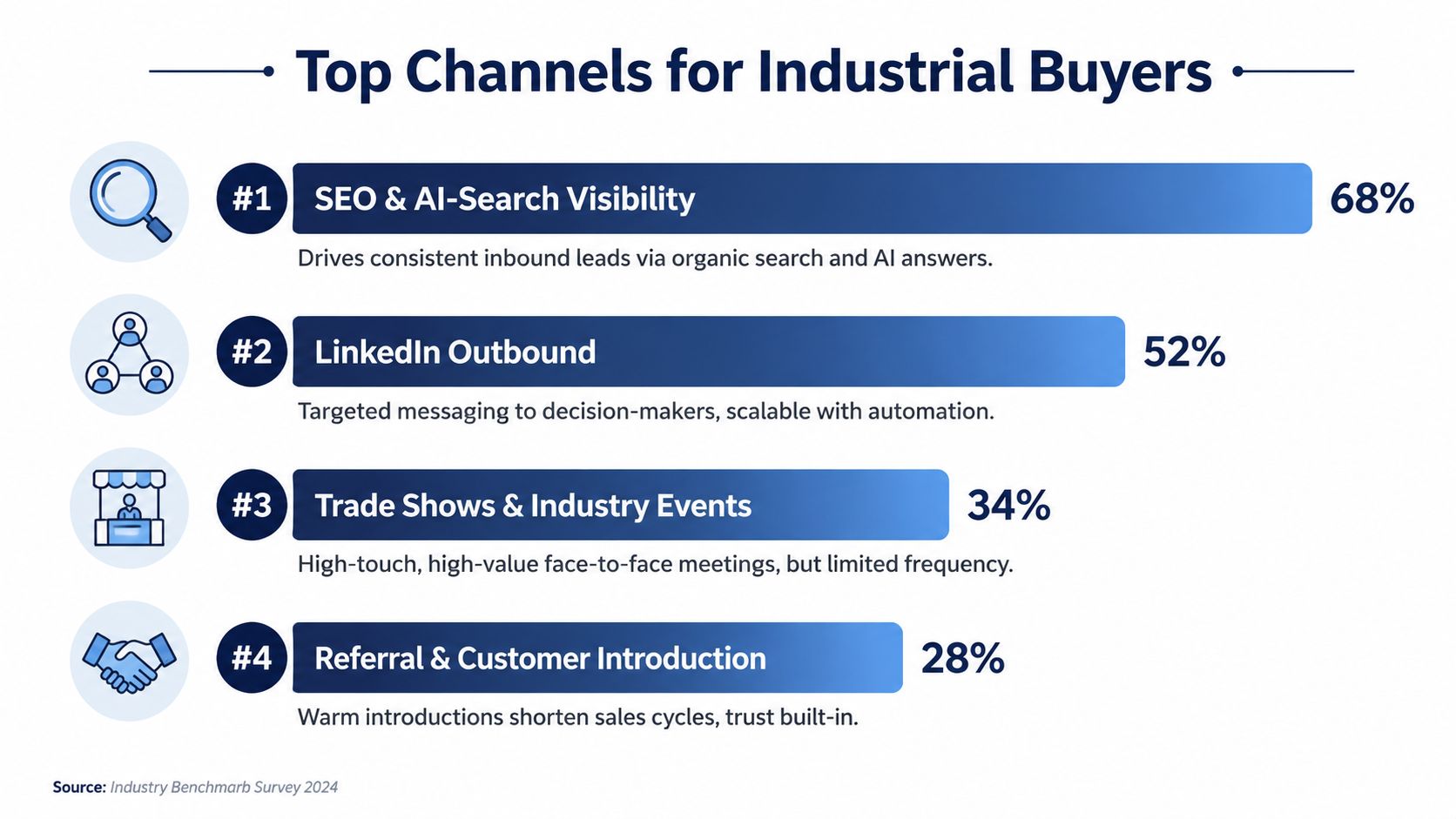
Search visibility deserves the first position because buyers use websites to validate technical capability before speaking with sales. That now includes AI-assisted discovery. Recent B2B buyer research reports that GenAI has overtaken traditional search for a quarter of buyers, nearly two-thirds use GenAI as much as or more than search, and 90% research before first contact. The same research reports that 67% prefer a rep-free buying experience. Read the 2025 buyer intelligence research for the broader shift toward Google, AI tools, social media, and peer recommendations.
Rank channels by operating reality
SEO and AI-search visibility: High compounding value, slower to build, and strong for manufacturers with technical expertise worth documenting. Create pages around materials, tolerances, industries, processes, certifications, and common sourcing problems. AI systems need clear, structured evidence of capability, not vague “quality manufacturing” language.
LinkedIn outbound: Practical for reaching operations, engineering, sourcing, and executive contacts when your ICP is narrow. It requires research and disciplined follow-up, but a small team can manage it with a defined account list and useful messages.
Trade shows and industry events: High-touch and potentially valuable for complex industrial sales. The limitation is frequency. Treat the event as the beginning of a sequence, not the entire campaign. Scan contacts, record the conversation context, and follow up while the problem is still recognizable.
Referrals and customer introductions: Trust arrives with the introduction, but referrals don't happen reliably by accident. Ask satisfied customers, suppliers, and complementary service providers for specific introductions tied to a defined capability.
Local and regional search: Important for machine shops, field service providers, and manufacturers where geography affects freight, response time, or site access. Keep your service areas, capabilities, and contact path clear.
Account-based direct outreach: Best when you can name the target accounts and likely business trigger. It takes more preparation than broad prospecting, but it gives a small sales team control over who enters the pipeline.
Use two primary channels. For many manufacturers, that means search visibility plus LinkedIn outbound, or referrals plus account-based outreach. Layer trade shows seasonally. Use paid campaigns only after the offer, landing page, and follow-up process can convert attention into a real conversation. The next challenge is building the account list from current signals rather than buying a stale spreadsheet.
Building Prospect Lists From Live Signals
A purchased list usually answers the least useful question: who might exist? A live-signal list answers the commercial question: who has a reason to consider a supplier now?
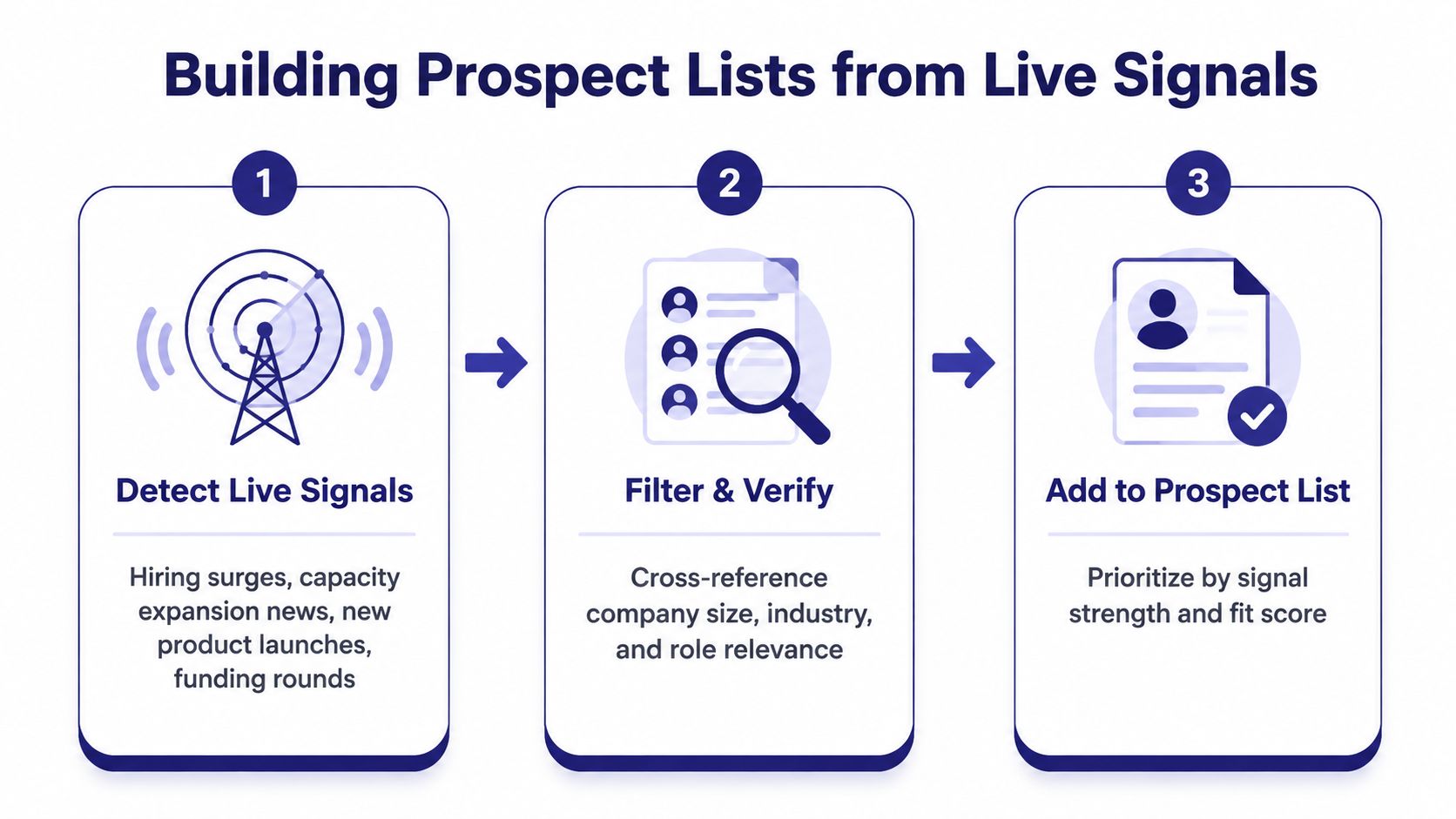
Look for evidence that capacity, compliance, leadership, product demand, or sourcing requirements are changing. Useful signals include hiring surges, new facility permits, capital expenditure announcements, procurement or operations leadership changes, RFP postings, patent filings, and supplier mentions that reveal competitor-customer movement.
Use a repeatable list-building workflow
Begin with a hypothesis list of 50 target accounts, then verify fit before assigning sales activity. Use LinkedIn Sales Navigator for job changes and account research, Google News alerts for named companies, import and export records where relevant, SEC filings for public manufacturers, and trade publication coverage for plant, product, and leadership news.
A useful workflow looks like this:
- Detect: Record the company, signal, source, date, affected function, and likely business implication.
- Filter: Check industry, size, geography, process fit, certifications, and the buyer roles identified in your ICP.
- Verify: Confirm the signal through a second source or direct company evidence. Don't turn one unverified mention into an aggressive pitch.
- Prioritize: Rank accounts by fit, signal strength, contactability, and urgency.
- Assign: Put each account and next action into the CRM before outreach starts.
This is the operating difference between a static database and intent data. Intent isn't permission to assume a prospect is ready to buy. It's a reason to investigate and make a more relevant approach.
Don't ignore smaller industrial firms
SMB prospecting tools often miss smaller machine shops and manufacturers because those companies leave fewer digital signals. Recent coverage recommends refreshing SMB prospect lists every 90 days and layering multiple data sources because coverage gaps can exceed 30% in target-company samples. See the analysis of prospecting tools for small businesses for the data-quality issue.
Supplement commercial databases with chamber directories, industry association rosters, local manufacturing groups, and trade show attendee lists. For example, a plant expansion permit can become a qualified 15-account list by identifying nearby suppliers, filtering for relevant production capabilities, verifying engineering or procurement contacts, and prioritizing accounts with current hiring or sourcing activity. The permit is the starting signal. Fit and verification determine whether the account earns outreach.
Designing Outreach Sequences That Earn Replies
A plant expansion, engineering hire, or new program announcement gives a CNC shop a reason to contact an aerospace Tier 2 supplier. The sequence should connect that verified signal to a problem your company can solve, then make the next step easy to accept or decline. Relevance earns the reply. Repetition does not.
Cold outbound benchmarks show average cold-calling success of only 2.3% to 2.7%, while top performers reach about 6% to 10% or more in booking success, according to Cognism's cold-calling statistics. Use the figures to set operating expectations. Segment accounts, maintain enough volume, and follow up consistently. Do not turn volume into indiscriminate blasting.
A separate analysis of more than 20 million cold emails found that sequences with 4 to 7 messages achieved about a 27% reply rate, compared with about 9% for sequences containing only 1 to 3 messages. The same sales follow-up analysis found that at least one follow-up raised average reply rate from about 9% to 13%. Treat these numbers as directional benchmarks, not promises for an industrial market.
Give every touch a job
The first email might say:
“I noticed your team is adding engineering capacity around aerospace production. We help Tier 2 suppliers reduce outside-machining bottlenecks when internal capacity is tight. Would it be useful to compare your overflow requirements with our current capabilities?”
A LinkedIn connection note should reference the same business context without copying the email. A later message can offer a relevant capability, ask a diagnostic question, or close with a simple choice. If the contact engages but stalls, pause the standard sequence and respond to the specific question they raised.
| Touch # | Day | Channel | Purpose | Sample Reply Benchmark |
|---|---|---|---|---|
| 1 | 1 | Name the signal and relevant problem | Directional benchmark, not a guarantee | |
| 2 | 3 | Create recognition and add context | Directional benchmark, not a guarantee | |
| 3 | 5 | Share a useful capability or diagnostic question | Directional benchmark, not a guarantee | |
| 4 | 8 | Phone | Test relevance and offer a short conversation | Directional benchmark, not a guarantee |
| 5 | 11 | Confirm priority without repeating the pitch | Directional benchmark, not a guarantee | |
| 6 | 14 | Close the loop with a low-friction choice | Directional benchmark, not a guarantee |
Multi-channel campaigns combining email, phone, and LinkedIn have produced 37% more conversions than single-channel outreach in one benchmark. Another benchmark found that 58% of sequence replies came from the first email and 42% from follow-ups. A separate analysis reports that 44% of salespeople stop after one follow-up, even though sequences often need 6 to 10 touches to create momentum. Set those touches in the CRM, assign an owner, and stop the sequence when a prospect replies, opts out, or no longer matches the buying situation.
Keep the copy short. State why you chose the account, name the operational outcome, provide relevant proof when available, and ask a low-friction question. Review practical templates from Outsoci, then rewrite each example around your own signal, capability, and qualification goal.
Qualifying Leads and Routing Them Into Your CRM
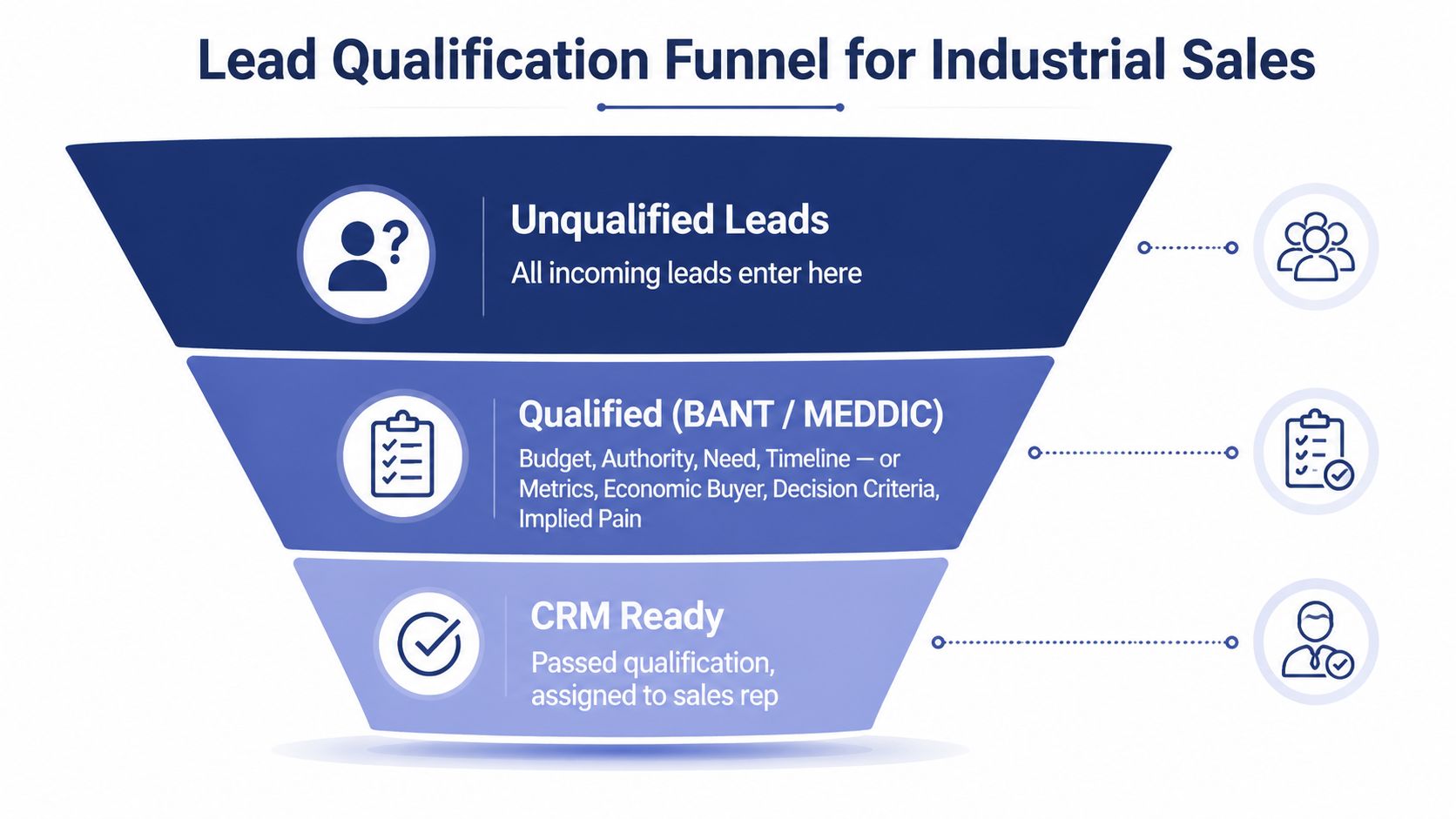
An unqualified lead isn't a pipeline asset. It's an untested assumption that can consume quoting, engineering, and sales time. Your team needs a lightweight qualification process that captures commercial reality without forcing every industrial opportunity into a rigid software-sales script.
Use BANT when budget, authority, need, and timing are reasonably visible. Use MEDDIC when the sale involves complex component requirements, multiple stakeholders, technical decision criteria, an economic buyer, and measurable operational pain. Don't ask every question in the first conversation. Use the framework to identify what you still need to learn.
Score for fit, intent, and recency
A useful industrial score combines:
- Account fit: Does the company match your ICP, geography, industry, process, and size criteria?
- Role relevance: Is the contact involved in sourcing, engineering, quality, operations, or executive approval?
- Demonstrated intent: Has the person requested pricing, returned to a capability page, downloaded technical material, or replied to outreach?
- Signal recency: Is the trigger current enough to influence a project or capacity decision?
- Commercial viability: Can you serve the job profitably with available equipment, certifications, and production capacity?
Speed matters after fit is established. One 2026 benchmark reports that responding to a new lead within 5 minutes can make a company up to 21 times more likely to qualify it than waiting 30 minutes. Configure instant CRM notifications, automatic owner assignment, and a clear next-action task rather than relying on someone to check a shared inbox.
Make the handoff visible
Your routing logic should cover every entry point:
- Form fill: Capture company, role, need, timeline, and source. Score against the ICP, assign an owner, and create a same-day task.
- Cold reply: Attach the conversation to the account, record the signal that prompted outreach, and schedule the next action based on the response.
- Trade-show scan: Add event, booth conversation, capability interest, and follow-up permission. Route technical questions to the appropriate sales or engineering owner.
Marketing and sales need a service-level agreement that defines what counts as a qualified lead, how quickly the owner responds, and what happens if the lead stalls. If no response arrives after the first task, create an escalation. If the opportunity isn't ready, place it into a reason-coded nurture path instead of letting it disappear.
Measuring, Iterating, and Closing the Loop
Your dashboard should explain pipeline behavior, not decorate a meeting. Tie every metric to one of the four system blocks: ICP, channels, sequences, or CRM.
Track pipeline value by channel, cost per qualified opportunity, speed-to-lead, sequence reply and meeting rates, and win rate by ICP segment. Add the reason an opportunity was lost, the time between stages, and the source context that influenced the first conversation. These details help you distinguish weak demand from weak follow-up.
Run a practical 90-day review
At the end of the quarter, pull the account, activity, opportunity, and revenue data together. Compare results with the benchmark ranges already discussed, then make decisions rather than reporting activity.
| KPI | Realistic Target | What to Adjust if Off |
|---|---|---|
| Pipeline value by channel | A growing share from two repeatable channels | Reallocate effort toward channels producing qualified opportunities |
| Cost per qualified opportunity | Clear enough to compare channels | Tighten targeting, offer, landing page, or qualification |
| Speed-to-lead | Consistent response within the defined SLA | Fix routing, alerts, ownership, or coverage gaps |
| Sequence reply rate | Improving relevance across tested segments | Rewrite the signal, proof, subject line, or call to action |
| Meeting rate | Qualified conversations from replies | Improve qualification and reduce friction in the ask |
| Win rate by ICP segment | Stronger performance in selected segments | Drop weak-fit slices and refine the negative ICP |
Don't rely on last-touch attribution. A trade show may create recognition, LinkedIn may maintain visibility, and a technical search may confirm capability before the buyer submits a form. If your CRM credits only the final click, you'll underfund the earlier interactions that made the conversation possible.
Lead volume creates another trap. A full database means little if contacts are stale, unqualified, or never routed. Review channel quality, account fit, response speed, and revenue together.
Use this loop every quarter: Measure, diagnose, adjust channel mix, refresh ICP, rerun sequences, re-measure. The transformation comes from feedback discipline. You don't need more activity until you know which part of the system is underperforming.
Machine Marketing helps manufacturers connect market research, industrial SEO, content, outreach, CRM setup, and automation into a practical client-acquisition system. Visit Machine Marketing to request a diagnosis of your ICP, channels, prospect lists, and follow-up process, then choose the next improvement to implement this quarter.