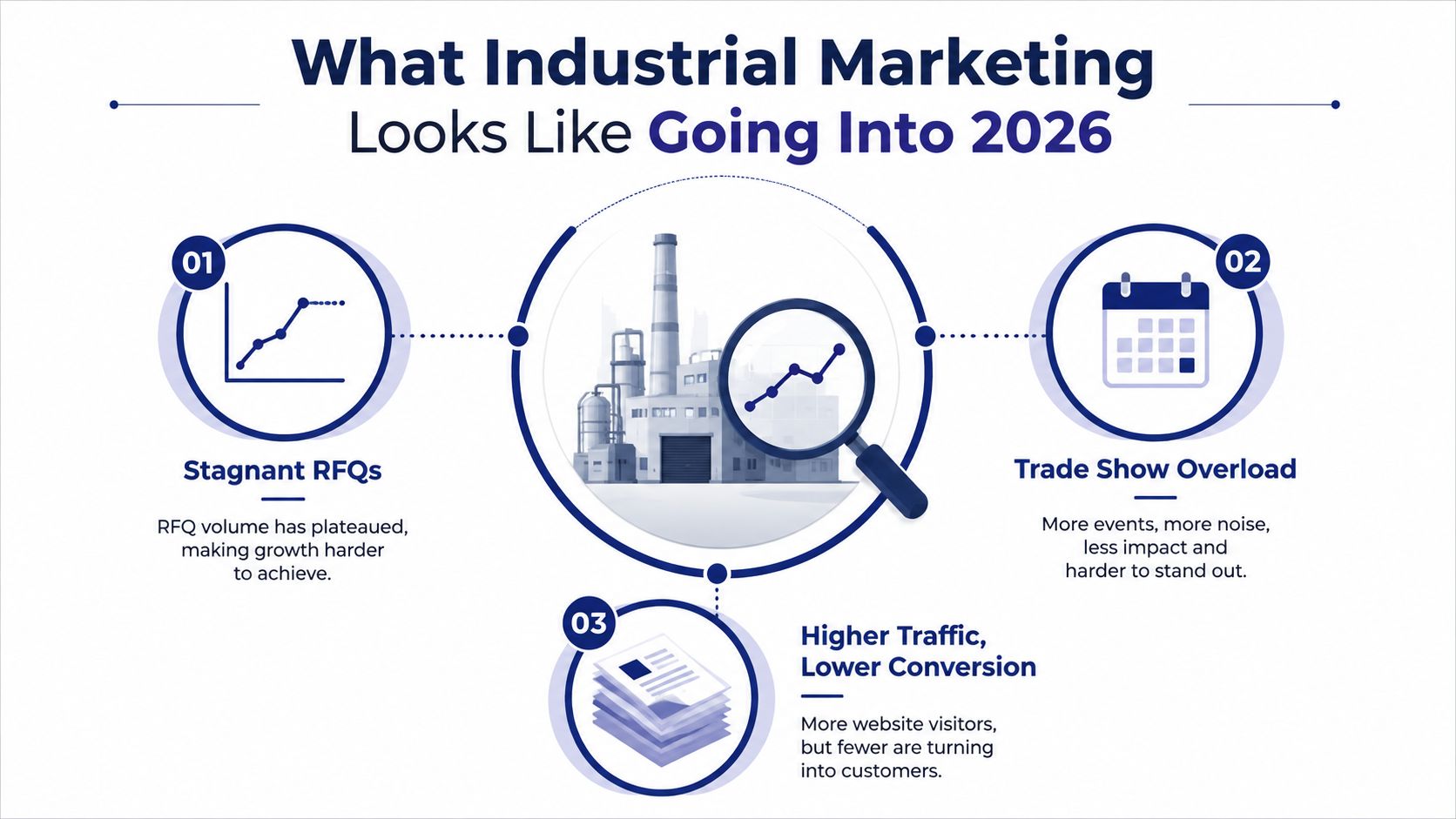
A plant manager at a 90-person CNC shop can watch website traffic rise, add another trade show, and still see qualified RFQs stay flat. That isn't a traffic problem. It's a reallocation problem inside the revenue system.
Manufacturing marketing budgets averaged 6.7% of revenue in 2024 and rose to 9.5% in 2025, compared with a 7.8% cross-industry average in Gartner's 2026 CMO Spend Survey reporting. Digital channels now represent about 61% of total marketing budgets, according to Gartner-referenced manufacturing marketing data. The money is moving, but many firms are still operating the old way, with disconnected CRM records, slow quoting, thin technical content, and sales follow-up that depends on memory.
The industrial marketing trends that matter for 2026 won't come from collecting more channels. They'll come from connecting the systems you already have, helping buyers self-educate, and removing friction between research, RFQ submission, qualification, and close.
Table of Contents
- What Industrial Marketing Looks Like Going Into 2026
- The Five Forces Reshaping Industrial Marketing
- Where Industrial Marketing Budgets Are Moving
- Building the Industrial Revenue System Behind the Trends
- How Machine Shops and Manufacturers Are Applying These Trends
- A Practical Toolkit for Small and Mid-Size Industrial Firms
- Industrial Marketing Myths Worth Retiring
- Your Next Step and a Direct Call to Action
What Industrial Marketing Looks Like Going Into 2026
The plant manager in that CNC shop doesn't need another vanity dashboard. He needs to know why more visitors aren't producing more qualified opportunities. Is the website attracting the wrong applications? Are technical buyers unable to confirm fit? Does an RFQ sit in a shared inbox until the estimator has time? Does marketing know which accounts sales is actively pursuing?
Those questions change the diagnosis. Industrial buyers increasingly research independently, compare suppliers before contacting them, and expect a website to answer practical questions about capability, risk, lead time, and total cost of ownership. A 2026 manufacturing buying-journey study reports that 81% of buyers had already built a shortlist before contacting a vendor, 48% had used AI to research suppliers in the prior 90 days, and 83% still considered the website the central reference tool throughout the purchase process.
The 2026 diagnosis
We see five connected forces changing the operating model:
- Buyers self-serve more of the decision. Your website and technical library now perform part of the pre-sales job.
- Budgets are shifting toward trackable digital execution. The question isn't whether to add digital. It's where existing spend should move.
- CRM and automation integration determines follow-up quality. A tool stack that can't share reliable data creates expensive gaps.
- Self-serve quoting is becoming a buying-enablement issue. Standard parts and repeatable configurations shouldn't always require a sales conversation.
- AI is useful as an assistant, not a substitute for industrial judgment. It can enrich accounts, summarize research, and support routing, but it can't repair poor data or unclear positioning.
We'll examine the macro forces, budget allocation, the revenue system behind them, two practical field vignettes, and a 90-day plan for small and midsize manufacturers. The standard is simple: every recommendation should improve pipeline quality, response speed, buyer confidence, or measurement.
Working rule: Don't ask which trend your competitors are discussing. Ask where a buyer, estimator, salesperson, or CRM record is creating avoidable friction.
The Five Forces Reshaping Industrial Marketing
Industrial marketing is being reshaped by buyer behavior and operating discipline. For small and midsize firms, the 2026 advantage will come from reallocating effort into cleaner CRM-to-automation integration, stronger buying-enablement content, and self-serve quoting workflows, not from chasing every new channel.
Five forces driving industrial marketing in 2026
| Force | Supporting data | Implication for industrial firms |
|---|---|---|
| Digital self-directed research and account-focused buying | 92% of industrial B2B buyers consume 3–5 pieces of content before contacting sales, 82% use search engines for research, and 71% of industrial companies had adopted account-based marketing by 2024, according to industrial marketing research | Build technical pages, application notes, comparison content, and shared account definitions before adding another campaign |
| AI-assisted supplier research | 48% of industrial buyers used AI to research suppliers in the prior 90 days, according to the manufacturing buying-journey study | Structure product information so buyers and AI tools can interpret specifications, applications, and fit |
| Digital budget expansion | Digital represented about 61% of total marketing budgets in Gartner-referenced manufacturing reporting, documented by Lead Forensics | Fund measurable assets and workflows before adding disconnected channels |
| Integration pressure | 71% of manufacturers had a CRM, 52% had marketing automation, but only 48% had integrated systems, according to the 2025 manufacturing benchmark | Fix field definitions, routing, and lifecycle ownership before purchasing more software |
| Self-serve commercial support | Buyers increasingly need fast answers about configuration, availability, service, and fit | Give standard parts and repeatable configurations a quoting path that does not require a sales call |
The technical-content arms race is not a contest to publish more blog posts. Engineers need evidence they can forward internally, including tolerances, materials, certifications, operating conditions, CAD resources, maintenance implications, and application boundaries. A generic capability page rarely carries the same weight as a page that helps a design engineer reject poor-fit suppliers quickly.
Trade shows still support high-intent relationship acceleration. They should not carry discovery, education, qualification, and follow-up alone. The industrial buyer-experience research from Accenture identified more than 1,600 customer pain points across the B2B buying process. Buyers encounter friction throughout the journey, not only at the first click.
Connected product models also change the commercial conversation. The discussion around PaaS and circular commerce helps manufacturers address use, support, lifecycle value, and procurement risk alongside the initial product sale.
The practical lesson is blunt. A smaller firm can beat a larger one by publishing better proof, responding faster, and keeping account data clean. Scale does not compensate for a broken handoff.
Use an intent-data framework for industrial marketing to distinguish a named account showing meaningful research behavior from an anonymous visitor who is not ready for sales. Apply that signal to routing and prioritization, then verify it against real engagement. Do not create another score nobody trusts.
Where Industrial Marketing Budgets Are Moving
The budget question is not whether to add SEO, LinkedIn, trade shows, or paid search. It is which existing spend should move into assets and workflows that keep producing value after a campaign ends. For most small and midsize manufacturers, the 2026 advantage will come from better allocation, not another channel.
Manufacturing marketing budgets rose from 6.7% of revenue in 2024 to 9.5% in 2025, while digital represented about 61% of total budgets, according to Gartner-referenced manufacturing budget reporting. A separate benchmark places digital at 41% of marketing budgets, up from 26% in 2021. The figures use different survey bases, but point in the same direction: digital work is taking a larger share of industrial marketing investment, as reported in the 2025 manufacturing digital-transformation benchmark.
That shift does not justify spending more on every digital tactic. It requires a sharper operating purpose. Search, technical content, email nurture, account-based campaigns, CRM automation, and self-serve quoting can continue working after launch. A booth, sponsorship, paid placement, or sales trip has a shorter operating window and depends on disciplined follow-up to create measurable pipeline.
A more useful allocation table
There are no verified average cost-per-qualified-lead figures by channel in the brief, so the table below is an allocation tool, not a fabricated benchmark.
| Channel | Avg cost per qualified lead | Recommended 2026 budget share |
|---|---|---|
| Paid search | Establish from your CRM by campaign and opportunity quality | Fund where high-intent queries produce qualified RFQs |
| SEO and technical content | Establish from production cost, assisted pipeline, and opportunity quality | Increase when content supports engineering validation and repeat discovery |
| LinkedIn ABM | Establish by target-account engagement and sourced opportunity | Use for priority accounts with a defined sales motion |
| Email nurture | Establish from engaged accounts, RFQs, and influenced opportunities | Build around applications, buying stages, and existing database quality |
| Trade shows | Calculate fully loaded event cost against sourced and influenced pipeline | Keep for high-intent relationship acceleration, not broad awareness alone |
| Field sales support | Calculate loaded labor and travel against sourced opportunities | Protect where technical selling and account development require human contact |
| CRM, automation, and quoting workflows | Calculate implementation and maintenance cost against response speed and conversion | Treat as infrastructure when handoffs are creating leakage |
A fixed annual budget does not require sacrificing useful reach. Move money from poorly measured awareness into CRM cleanup, technical content, and self-serve quoting. Fund content that helps an engineer confirm fit, workflows that route an RFQ to the right estimator, and quoting tools that let qualified buyers answer routine questions without waiting for a sales response.
The priority is integration. A strong campaign still underperforms when the CRM loses source data, automation cannot trigger the next action, or a quote request sits in a shared inbox. Audit those handoffs before adding another channel.
A manufacturer should be able to answer:
- Which campaigns sourced opportunities?
- Which assets influenced an active buying committee?
- Which RFQs arrived through self-serve tools?
- How quickly did the right estimator receive each inquiry?
- Which channels produced poor-fit work?
If answering requires manual spreadsheet work, the budget problem is also an operating problem. Fix measurement and handoffs first, then increase spend where the improved system can capture and advance demand.
Building the Industrial Revenue System Behind the Trends
A manufacturer can buy a new ad platform and an AI assistant while the CRM remains half-empty and quote requests wait in a shared inbox. That isn't transformation. It's a collection of disconnected intentions.
A functioning industrial revenue system has four layers. Each layer has a different job, and the handoffs matter more than the individual software brand.
Four connected layers
CRM as the source of truth. Start with account, contact, application, industry, capability, buying stage, RFQ status, estimated value, and ownership fields. If sales, marketing, estimating, and service use different definitions for the same account, every downstream report will be suspect.
Marketing automation as an operating trigger. Automation should create tasks and decisions, not only send emails. A return visitor to a technical page might enter an application-specific nurture sequence. A known target account with repeated engagement might trigger a sales review. A qualified RFQ should create an owner, deadline, and escalation path.
AI-assisted research as preparation. AI can help enrich account records, summarize public supplier information, classify applications, and draft outreach for review. It shouldn't invent technical claims, approve fit, or send unverified engineering advice.
Self-serve quoting as buyer enablement. If a standard part can be configured safely, let a qualified buyer explore price, lead time, materials, and constraints without waiting for a sales call. Keep complex, custom, regulated, or high-risk work with sales and estimating.
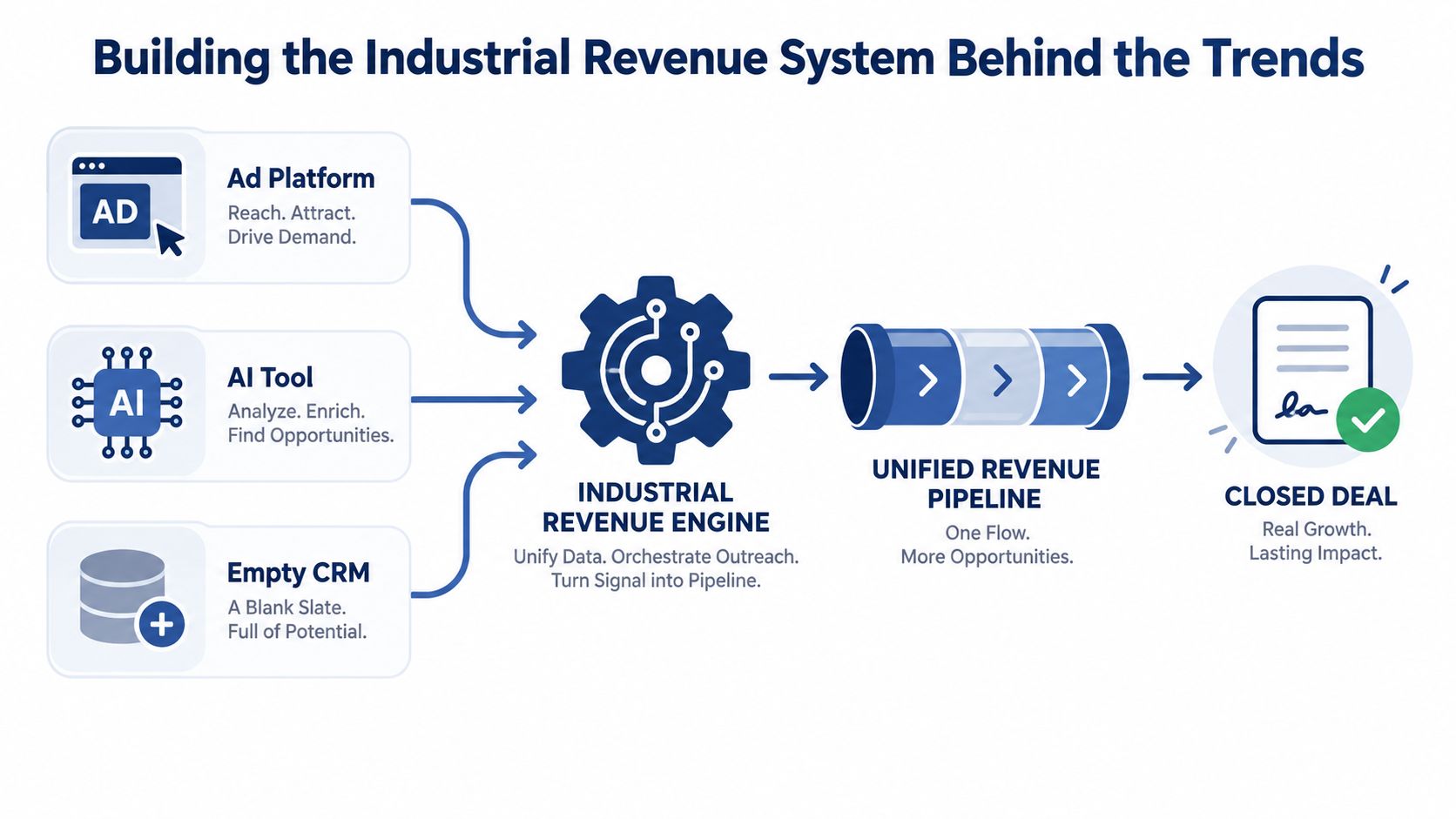
How the handoff should work
Consider a hypothetical $40M CNC shop. It could connect HubSpot or Salesforce to a quoting engine, use AI to organize 3,000 target accounts into 200 priority fits, and route inbound RFQs to the appropriate estimator in under two hours. Those figures describe a blueprint, not a verified case study or expected result. The value comes from defining the workflow before selecting the tools.
The integration needs explicit rules:
- Capture the source. Store campaign, landing page, referral, account, application, and RFQ details.
- Validate the fit. Use capability, material, volume, tolerance, geography, and timing fields.
- Assign ownership. Route by technical fit and territory, not by whoever notices the notification.
- Start the clock. Record submission time, acknowledgment time, estimator assignment, and quote delivery.
- Close the loop. Return win, loss, reason, margin, and next-step data to marketing and sales reporting.
Data rule: If a field changes how you route, score, quote, or report an opportunity, make it required and define its acceptable values.
The digital marketing guidance for industrial companies is most useful when it connects channel execution to this operating system. Don't ask whether a platform has AI. Ask whether it passes clean data to the next person who must act.
How Machine Shops and Manufacturers Are Applying These Trends
The following snapshots are editorial scenarios built from the operating patterns described in the plan, not independently verified case studies. Treat them as diagnostic models. The point isn't to promise the same results. It's to show what a connected reallocation looks like in practice.
A 60-person aerospace machine shop had quote turnaround stuck at six days. The team paired a configurator with an automated RFQ acknowledgment, changed CRM fields for material, tolerance, certification, production volume, and required date, and routed complete inquiries to an estimator. The scenario moves turnaround to 36 hours and win rate from 14% to 22%, without adding headcount.
That workflow changes the buyer experience before a salesperson gets involved. The acknowledgment confirms receipt, identifies missing information, sets expectations, and gives estimating a structured record instead of a forwarded email. Sales still handles complex applications, but the system stops making every buyer wait for a manual first response.
A 200-employee industrial pump manufacturer took a different path. It dropped two trade shows and redirected 60% of its budget into buying-committee content, including engineer PDFs, ROI calculators, and maintenance video libraries. The scenario attributes a specific $3.1M deal to pipeline influenced by a long-form technical guide, while sales forwarded the guide during evaluation.
The important move wasn't canceling events. It was redefining their role. The manufacturer stopped using trade shows as a substitute for technical education and began measuring which content helped engineering, operations, procurement, and finance continue the conversation internally.
Before and after snapshots
| Metric | Machine shop, 60 staff | Pump manufacturer, 200 staff |
|---|---|---|
| Primary leak | Slow RFQ response | Weak buying-committee enablement |
| System change | Configurator, acknowledgment, estimator routing | Technical library, calculators, maintenance videos |
| CRM changes | Application, tolerance, certification, volume, due date | Account role, content engagement, opportunity influence |
| Sales enablement | Structured RFQ record and response sequence | Long-form guide and engineer-forwardable assets |
| Reallocation lesson | Reduce manual quoting friction | Reduce event dependence for education |
| Scenario result | Turnaround from six days to 36 hours, win rate from 14% to 22% | $3.1M deal influenced by a technical guide |
Both firms stopped treating activity as proof of progress. The shop stopped accepting slow response as normal. The pump manufacturer stopped assuming attendance represented buying intent. That is the trend worth copying: move resources toward the point where the buyer loses confidence.
A Practical Toolkit for Small and Mid-Size Industrial Firms
You don't need an enterprise stack to create operating discipline. You need a short list of metrics, clear ownership, and a sequence that fixes the biggest leak before adding software.
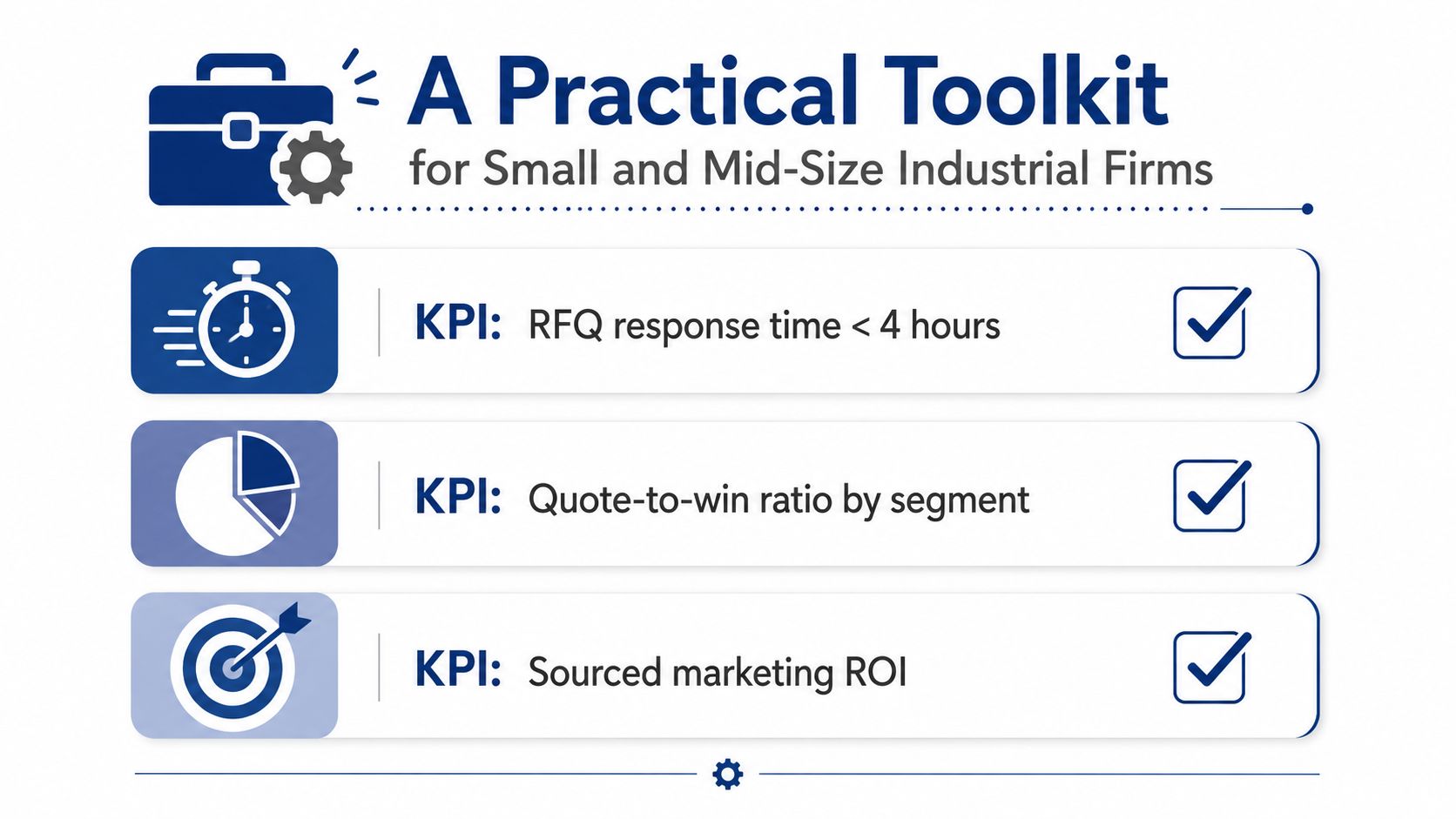
Track the metrics that connect marketing activity to commercial movement:
- RFQ response time: Measure submission to acknowledgment, assignment, and quote delivery. Set an internal target of under four hours if your operation can support it, and record exceptions rather than hiding them.
- Quote-to-win ratio by segment: Break it down by application, industry, part type, source, and estimator. An overall average can hide poor-fit campaigns and strong niches.
- Sourced versus influenced pipeline: Sourced pipeline shows where opportunities originated. Influenced pipeline shows which assets and interactions helped active opportunities advance.
- Customer-acquisition-cost payback period: Compare acquisition cost with gross-margin contribution and repeat-purchase behavior. Don't call a channel efficient because it generated inexpensive inquiries.
Match the system to the business
A 25-person shop can often start with HubSpot Pro, a quoting configurator, Google Ads, and one carefully selected trade show. The constraint isn't tool volume. It's whether the team records source, fit, ownership, response time, and outcome consistently.
A 150-person manufacturer may justify Salesforce, 6sense or ZoomInfo, Marketo or HubSpot Enterprise, and intent-data overlays. Those tools only help if the company has defined account tiers, lifecycle stages, sales acceptance rules, and a process for correcting bad records.
For account-based campaigns, a practical GTM framework for ABM campaigns can help align target selection, messaging, sales activity, and measurement before launch.
Your 90-day implementation plan
Weeks 1–4, diagnose the leak. Audit duplicate accounts, missing owners, stale stages, inconsistent industry fields, unassigned RFQs, and opportunities without source data. Interview sales and estimating. Document the current path from inquiry to quote, including every manual handoff.
Weeks 5–8, build buyer enablement. Publish two assets for real buying committees, such as an application guide and a total-cost-of-ownership worksheet. Add one automated RFQ acknowledgment and make the message useful, with confirmation, required information, and a clear next step.
Weeks 9–12, launch and instrument. Choose one demand channel, connect campaign data to opportunity records, define a sales response agreement, and review results weekly. The marketing systems guidance for small manufacturers can provide a useful reference point as you decide what to simplify, connect, or replace.
Score your maturity.
- Level one: Leads arrive through scattered channels, and follow-up depends on individuals.
- Level two: A CRM exists, but fields, ownership, and lifecycle definitions vary.
- Level three: Marketing automation, CRM, quoting, and sales tasks share defined data.
- Level four: The team measures response, fit, pipeline source, influence, win rate, and payback by segment.
Buy software to move up a level. Don't buy it to decorate the current one.
Industrial Marketing Myths Worth Retiring
Myth one, more content solves lead problems. If your team believes this, check whether sales can find and forward the right asset, whether pages answer application questions, and whether content engagement changes routing. Manufacturing marketers use content marketing widely, but only 30% said their organizations were effective, and only 21% had a documented content strategy, according to the manufacturing content marketing findings. The replacement habit is to create fewer, more useful assets tied to applications, stages, and sales conversations.
Myth two, SEO is set and forget. A page that once ranked can become technically outdated, commercially vague, or weaker than a competitor's application content. Review search intent, capability proof, internal links, conversions, and sales usefulness on a regular operating cadence.
Myth three, trade shows are dead. The better diagnosis is that their role is narrowing. A trade show can accelerate trust with a high-intent account, but it shouldn't be your only discovery, education, or follow-up system.
Myth four, AI replaces salespeople. AI can support research, classification, drafting, and workflow assistance. Industrial salespeople still interpret requirements, manage risk, coordinate stakeholders, and earn confidence when a project is technically or commercially complex.
Marketing also can't sit outside the CRM. If campaign activity, RFQ details, sales acceptance, quote status, and loss reasons don't connect, you can't distinguish a channel problem from a qualification problem or a closing problem.
The right filter for the next conference pitch or software demo is simple: does this improve the revenue system, or does it merely add activity?
Your Next Step and a Direct Call to Action
Before budgeting another dollar, answer one question:
Where in our revenue system is the leak, capture, qualification, or close?
If the leak is capture, spend the first 30 days fixing CRM hygiene, source tracking, account ownership, and RFQ intake. If the leak is qualification, rebuild the content engine around applications, technical fit, proof, and buying-committee questions. If the leak is close, create a sales-marketing service-level agreement covering response time, accepted opportunities, quote status, follow-up, and loss reasons.
Don't launch all three programs at once. Pick the failure point that blocks the most valuable opportunities, assign one owner, and measure the handoff before and after the fix.
The strongest industrial marketing trends for 2026 point to one conclusion. Growth will come less from novelty and more from integration, especially between CRM, automation, technical content, quoting, and sales execution.
Book a 30-minute revenue-system audit, download your internal prioritization worksheet, or bring your sales and estimating leaders into one working session. In the next piece, we'll examine how manufacturers can turn technical proof into content that sales teams use.
Machine Marketing helps manufacturers and machine shops connect websites, SEO, content, email campaigns, CRM, automation, and lead-generation workflows into a practical growth system. Visit Machine Marketing to request a revenue-system diagnosis and identify the leak before you spend more on channels.