If you're running a manufacturing business with strong capabilities but uneven inbound demand, the problem usually isn't your product. It's the system around it. We see this pattern constantly. A shop has solid equipment, experienced people, and a real differentiator, but lead flow still depends on trade shows, referrals, or whether the sales team had time to chase follow-ups that week.
That creates a pipeline you can't plan around. Some months are packed. Others go quiet. A proper manufacturing lead generation system fixes that by treating demand creation like any other operational process. You define inputs, build the workflow, instrument the handoffs, and improve it over time.
Table of Contents
- From Inconsistent Inquiries to a Predictable Pipeline
- The Blueprint Defining Your Target and Calculating Goals
- Engineering Your Message and Core Offer
- Choosing Your High-Priority Lead Generation Channels
- Building Your Lead Capture and Nurture Machine
- A Campaign in Action A Real-World Example
- Measuring Success and Your 30-60-90-Day Plan
From Inconsistent Inquiries to a Predictable Pipeline
Most manufacturers don't have a lead problem first. They have a process problem first.
The usual symptoms are easy to spot. Inquiries come in waves. Sales blames marketing for lead quality. Marketing blames sales for weak follow-up. The CRM turns into a contact graveyard. Meanwhile, the company keeps spending money on activity instead of building a repeatable system.
That's risky in a market where digital execution matters more every year. The global lead generation industry is projected to reach approximately $295 billion by 2027, LinkedIn accounts for 80% of all B2B leads generated through social media, and AI can boost lead generation results by about 50% for companies using it to analyze data and automate tasks, according to industry benchmarks on lead generation trends.
The system view
A reliable manufacturing lead generation program has four parts:
- Target definition so you know which accounts deserve attention.
- Message-market fit so your outreach speaks to operational pain, not brochure language.
- Channel selection so you show up where buyers already look.
- Capture and follow-up infrastructure so interest turns into tracked opportunities.
If one part is weak, the whole machine underperforms. Good SEO won't save weak positioning. Strong ads won't fix a bad offer. A polished website won't help if form fills sit untouched in an inbox.
Practical rule: Don't ask whether marketing is “working.” Ask where the system breaks between first touch and sales conversation.
What a predictable pipeline actually requires
Manufacturing buyers don't buy like impulse consumers. They research, compare, loop in engineering, purchasing, operations, and leadership, then move when timing, confidence, and internal approval line up. That means your job isn't to chase random leads. It's to build a process that keeps the right accounts moving.
That process usually includes:
- A central CRM that captures every inquiry, source, and follow-up status. If your current setup is fragmented, this guide on CRM for lead generation is a useful place to tighten the foundation.
- Consistent outbound and inbound coordination so your email, LinkedIn, content, and sales outreach reinforce each other.
- A response workflow that triggers immediate action when a prospect raises a hand.
- A measurement layer that shows which campaigns create qualified conversations, not just traffic.
AI can help, but only after the basics are in place. If you're evaluating tools, a grounded overview of what to look for in a best AI lead generation solution can help you separate useful automation from shiny distractions.
The key trade-off is simple. You can run isolated tactics, or you can build a manufacturing lead generation system. Tactics create bursts. Systems create planning confidence.
The Blueprint Defining Your Target and Calculating Goals
The strongest campaigns usually start with work that feels unglamorous. Before you write a page, launch an ad, or ask sales to do more outreach, you need a precise definition of who you're trying to reach and how many opportunities the business needs.
The foundation is the Target Market Profile. According to Athena SWC, the most effective manufacturing lead generation process begins there because it's the critical element. From that point, you can compute the required number of prospects based on desired revenue growth, sales cycle steps, and conversion rates at each stage, as outlined in their manufacturing lead generation methodology.
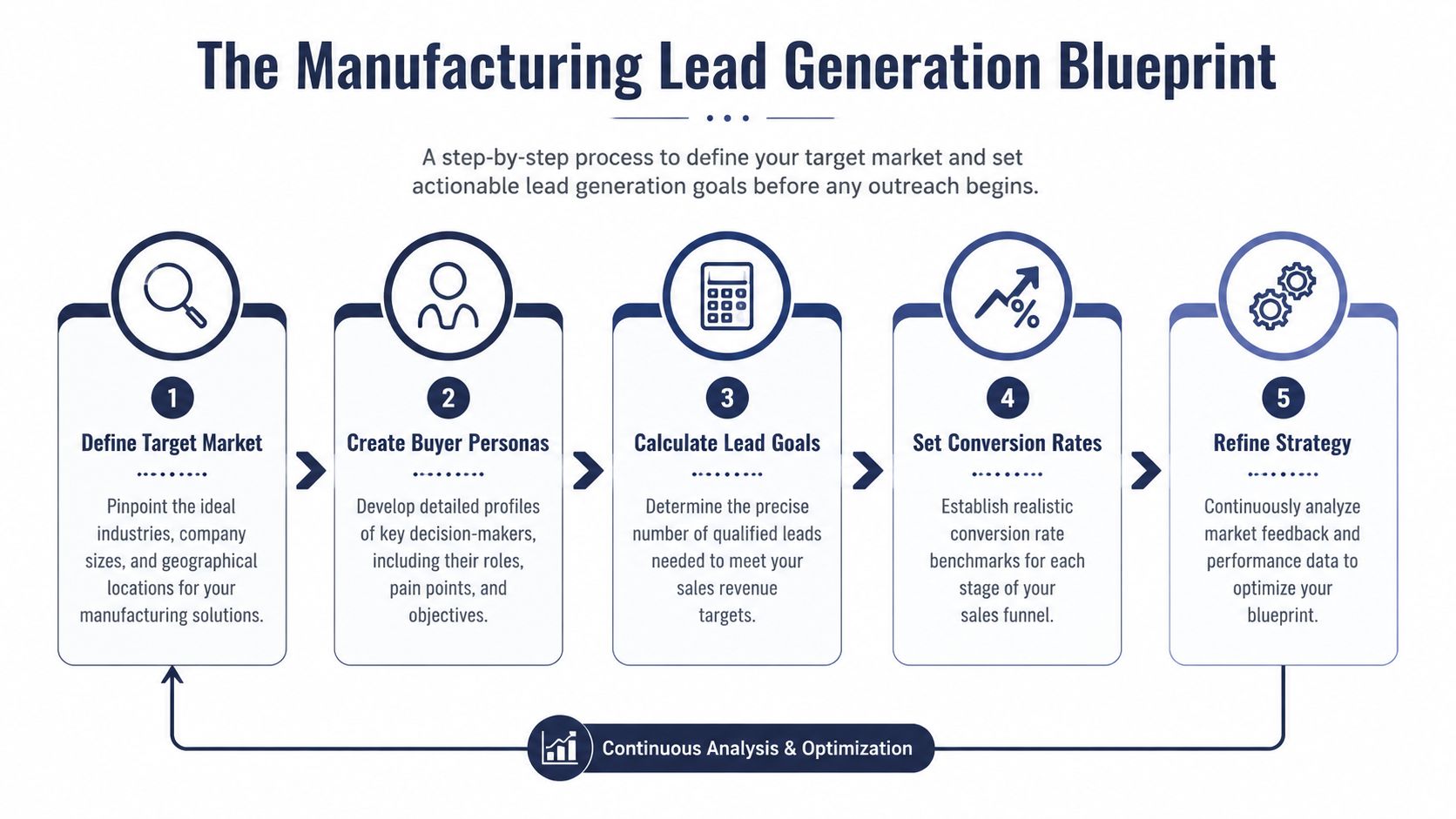
Start with the target market profile
A vague target hurts everything downstream. “Industrial companies” is not a target. “Mid-market aerospace suppliers in the Midwest with tight-tolerance machining needs and an engineering-led buying process” is getting closer.
Your profile should define:
- Industry fit such as aerospace, medical, food processing, energy, or general industrial.
- Account attributes including size, plant count, geography, internal complexity, and whether they buy custom or repeat work.
- Buying roles like engineers, plant managers, operations leaders, quality managers, and procurement.
- Trigger conditions such as expansion, supplier dissatisfaction, new compliance demands, or rising scrap and downtime.
If your team hasn't formalized buyer roles, use a structured process for creating buyer personas so messaging and outreach don't default to guesswork.
Work backward from revenue
Often, manufacturers get stuck. They set a revenue goal, then jump straight into tactics. The better approach is to build the math first.
A simple planning model looks like this:
| Input | Question to answer |
|---|---|
| Revenue target | How much new revenue are you trying to create? |
| Average deal value | What does a typical closed opportunity contribute? |
| Opportunity rate | How many qualified leads usually become true pipeline? |
| Close rate | How many real opportunities become customers? |
| Sales cycle stages | Where do deals stall or disappear? |
Once those inputs are on paper, you can estimate how many target accounts and engaged leads you need at the top of the funnel. The exact formula will vary by business, but the principle doesn't. Start with the revenue number, divide by average deal value, then adjust upward based on your actual conversion behavior.
If you don't know your conversion rates, don't pretend you do. Use your last year of quotes, opportunities, and wins to build a baseline.
A few practical checks help keep the plan realistic:
- Separate new business from existing account growth. They behave differently.
- Use stage definitions that sales accepts. “Lead” means nothing if everyone interprets it differently.
- Review by segment. Aerospace may convert differently than food equipment or contract manufacturing.
- Update the model regularly. Your target list should change as markets, capacity, and margins change.
At this stage, manufacturing lead generation stops being abstract. Once the blueprint is defined, your team can make decisions based on throughput and fit, not gut feel.
Engineering Your Message and Core Offer
A tight target profile doesn't help if your message still sounds like a capabilities brochure.
Most manufacturing websites say roughly the same thing. Quality. Precision. Service. Innovation. Years of experience. Those words aren't wrong. They're just too broad to move a buyer who's already comparing several vendors with similar claims.
Translate technical capability into business value
The message has to connect your capabilities to the buyer's operating reality. Engineers, operations leaders, and sourcing teams care about different things, but they all respond when you clearly tie your offer to a problem they need solved.
A useful framework is problem, solution, transformation.
- Problem: What friction is the account dealing with right now?
- Solution: What specific capability, process, or approach do you provide?
- Transformation: What changes for the buyer if the project goes well?
Here's the difference in practice:
| Weak message | Stronger message |
|---|---|
| We provide precision CNC machining services. | We help aerospace and defense teams source tight-tolerance machined parts without late-stage surprises in quality documentation or delivery. |
| We offer custom automation systems. | We design automation systems that reduce manual bottlenecks on production lines where throughput has stalled. |
| We are a trusted fabrication partner. | We support OEMs that need a fabrication partner capable of handling revision-heavy work without communication breakdowns. |
The stronger version is narrower. That's the point. Broad messaging attracts curiosity. Specific messaging attracts qualified conversations.
Build offers that earn the next conversation
Your core offer shouldn't always be “contact us.” For many buyers, that's too big a step too early.
A better approach is to give prospects something useful that matches their stage in the buying process. In manufacturing, that often means:
- Technical guides that help evaluate materials, tolerances, design constraints, or supplier selection.
- Application notes that show how a process performs in a real use case.
- Capability sheets tied to a clear buying situation, not just a general overview.
- ROI or feasibility conversations for buyers who are close to an active project.
- Case-study style proof that shows how your team solved a defined production problem.
A good offer reduces decision friction. It gives the buyer a low-risk way to say, “This is relevant. Show me more.”
A few trade-offs matter here.
If you gate everything, you may suppress engagement from cautious engineers who just want to assess fit first. If you gate nothing, your sales team may lose visibility into who's leaning in. The right answer depends on your market, but the rule is consistent. Gate the assets that indicate meaningful buying intent. Leave some educational content open so trust can build before the form fill.
Message engineering takes discipline. It forces you to stop talking about what your company does in general and start talking about what the buyer needs right now. That shift is where better lead quality usually begins.
Choosing Your High-Priority Lead Generation Channels
Channel choice is where many manufacturers lose efficiency. They try to “be active” everywhere, then wonder why nothing compounds.
The better move is narrower. Focus on the channels that match industrial buying behavior and support a full system, not random activity. A 2022 survey found that 98% of manufacturers generate leads through digital channels. Within that mix, 69% use organic search, 69% use social media, 43% use PPC, and 85% use content marketing to generate sales-qualified leads, according to manufacturing marketing benchmark data.
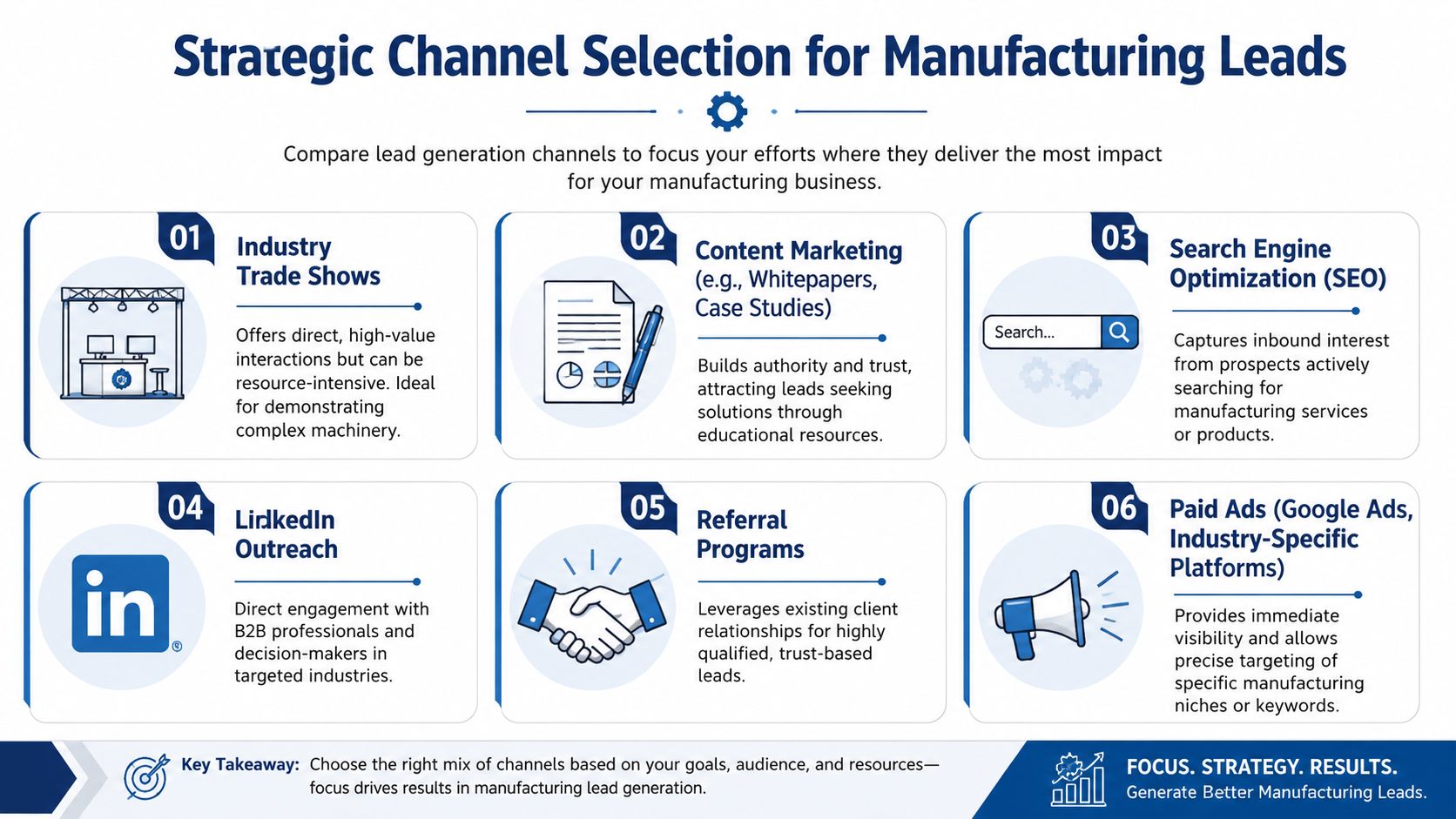
What the channel mix should actually do
For most manufacturers, three channels deserve priority because they serve different jobs.
SEO captures existing demand. It puts your company in front of buyers who are already looking for a process, supplier, material capability, or manufacturing solution. This is your long-game channel. It works best when service pages, industry pages, and technical content map cleanly to actual search intent.
LinkedIn supports visibility and targeted outreach. It's where your sales and marketing teams can stay present with engineers, plant leaders, and procurement contacts over time. It's especially useful when your audience is narrow and your deals require repeated exposure before a conversation starts.
Email handles structured follow-up. Once someone downloads a guide, requests a quote, meets your team, or engages with outreach, email keeps the relationship moving without forcing the sales team to manually chase every touch.
Here's a practical breakdown:
| Channel | Best use | Common mistake |
|---|---|---|
| SEO | Capture active demand | Publishing broad articles with no commercial intent |
| Build familiarity and start targeted conversations | Posting company news no buyer cares about | |
| Nurture and reactivate leads | Sending generic newsletters to everyone |
Where manufacturers usually waste effort
Not every channel deserves equal attention.
Trade shows can still help, especially for complex products that benefit from live demos and face-to-face trust building. But they shouldn't carry the whole program. Broad organic social outside of LinkedIn often becomes a time sink. Paid campaigns can work, but only when landing pages, offers, and negative keyword controls are in place.
That's the key trade-off. Channels don't fail because they're bad. They fail because businesses ask them to do jobs they weren't built to do.
A practical channel stack for manufacturing lead generation usually looks like this:
- SEO for discovery
- LinkedIn for account targeting and credibility
- Email for nurture and follow-up
- Selective PPC for high-intent searches
- Trade shows as support, not the operating system
Choose channels by buyer behavior, not by what feels modern or what a competitor is posting.
If your internal team is small, start with fewer channels and execute them properly. Three coordinated channels beat six neglected ones every time.
Building Your Lead Capture and Nurture Machine
Traffic and outreach mean very little if the handoff is sloppy. Consequently, many manufacturing lead generation efforts fail. The site attracts interest, someone fills out a form, and then the lead either sits too long, goes to the wrong person, or enters a CRM with no structured follow-up.
That's expensive because industrial buying takes time. Manufacturing leads require an average of 62 personalized touchpoints to engage and maintain interest before purchase, according to Belkins' analysis of manufacturing lead generation. Single-touch campaigns don't match that reality.
A visual model helps here.
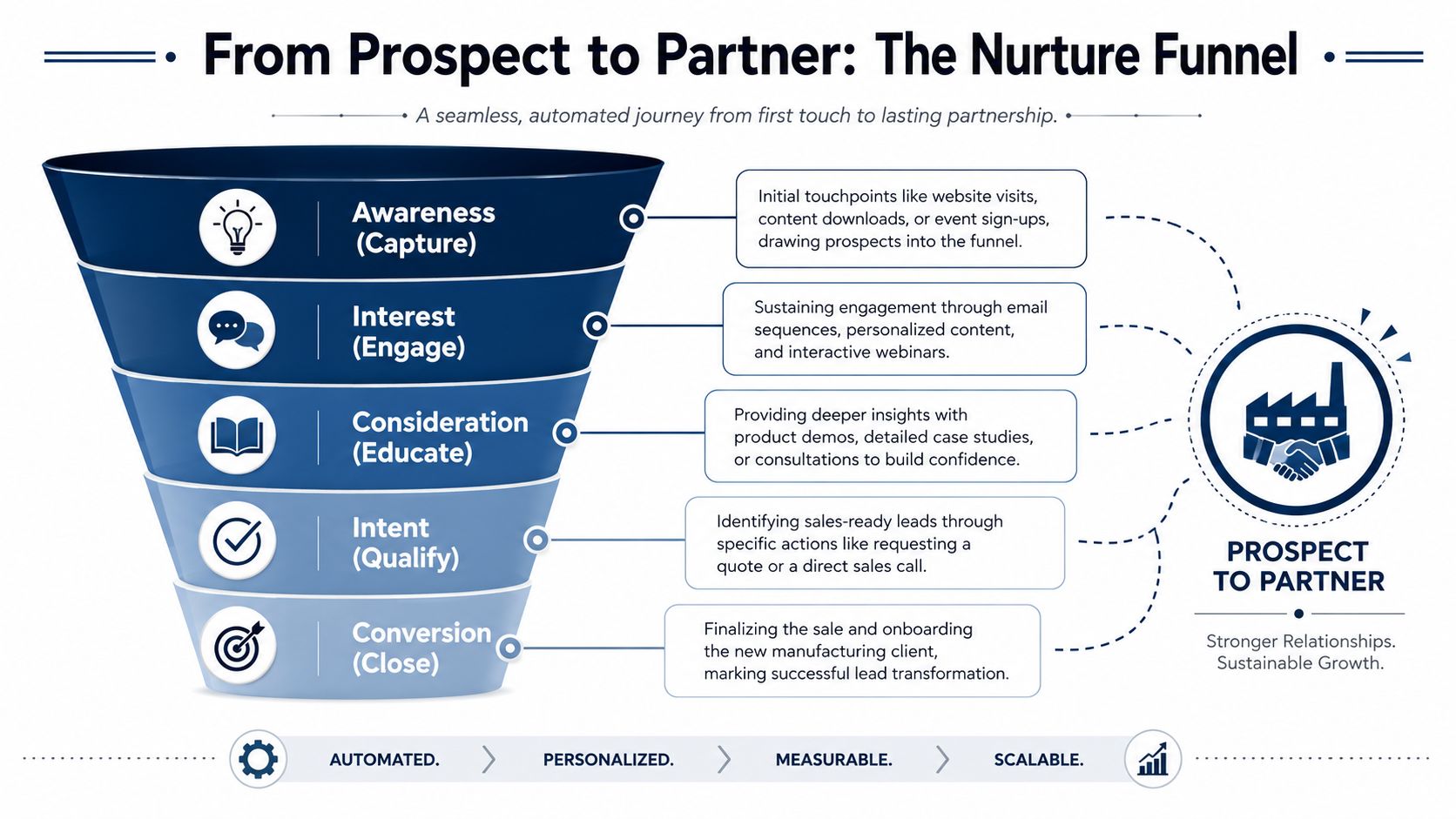
Design the handoff before you launch campaigns
Your capture system should answer five questions immediately after a prospect acts:
- Who is this account?
- What did they do?
- How urgent is the signal?
- Who owns follow-up?
- What happens next if sales doesn't engage right away?
That means your website, forms, CRM, and automation platform need to work together.
A basic but effective architecture often includes:
- Focused landing pages tied to one offer and one audience
- Short forms for early-stage assets, longer forms only when buying intent is higher
- CRM fields for source, industry, role, product interest, and status
- Automated workflows that trigger confirmation, routing, and nurture
- Sales alerts when high-intent actions occur, such as RFQ submissions or consultation requests
If you're building this stack for the first time, a practical guide to marketing automation for manufacturers can help you define the workflow before you overcomplicate the tools.
What your nurture machine needs to do
A good nurture sequence doesn't just “stay in touch.” It advances confidence.
Use this progression:
- Immediate response: confirm the request, deliver the asset, and set expectations.
- Follow-up education: send material related to the original interest, not a generic company intro.
- Proof: show relevant applications, process detail, or problem-solving examples.
- Sales invitation: offer a technical call, quote discussion, or capability review when engagement suggests readiness.
Later in the sequence, video can help simplify complex explanations or create a stronger human handoff.
The CRM matters here, but the logic matters more. HubSpot, GoHighLevel, and similar systems can all support this if the pipeline stages, ownership rules, and triggers are defined well.
If you're layering AI into the workflow, focus on practical use cases such as lead routing, summary generation, segmentation support, and prioritization. A solid overview of an end-to-end AI lead generation strategy is useful if you want automation without removing human judgment from technical sales.
Fast follow-up wins attention. Relevant follow-up earns trust.
The machine should make sure no inquiry disappears, no good lead waits too long, and no sales rep has to guess what happened before they picked up the phone.
A Campaign in Action A Real-World Example
Here's what the system looks like when the pieces work together.
Take a custom CNC machine shop that wants more aerospace work. The team has strong process control, deep experience with tight tolerances, and a good story to tell, but their outreach has been inconsistent. They decide to build one focused campaign around a single topic instead of promoting the whole company at once.
The offer and the post
The campaign starts with a technical asset. Not a generic brochure. A concise case-study style document called:
How We Solved a Tight-Tolerance Machining Challenge for an Aerospace Component
The asset is built for a specific reader: a manufacturing engineer or sourcing contact dealing with precision requirements, inspection concerns, and supplier risk.
The LinkedIn post promoting it might read like this:
Tight tolerance work doesn't fail at the machine first. It usually fails earlier, in quoting assumptions, print interpretation, or inspection planning.
We put together a short breakdown of how a shop can approach a demanding aerospace machining job without creating downstream quality surprises. If that's relevant to your team, download the guide.
Notice what it doesn't say. It doesn't lead with “we're proud to announce.” It doesn't list equipment. It starts with the buyer's problem.
Sales uses the same asset differently. Instead of blasting a cold pitch, reps send targeted outreach to a hand-built list of accounts that match the target profile. The message is short. It references the role, the likely challenge, and the asset.
The landing page and follow-up sequence
The landing page is simple:
- A headline tied to the problem
- Three bullets on what the reader will learn
- A short form asking for name, company, work email, and role
- A secondary path for buyers who are already active, such as “Request a technical review”
Once the form is submitted, the sequence starts.
Email one delivers the guide and acknowledges the likely use case.
Email two shares a short note about common issues in revision-heavy or high-spec parts, with a link to a related article or capability page.
Email three offers proof. That could be a process explanation, inspection workflow, or a practical note on how the shop handles quoting and feasibility review.
Email four invites the lead to a technical consultation with a clear reason to take the call. For example: review part complexity, discuss manufacturability concerns, or assess supplier fit.
Here's the important part. Sales doesn't wait until the end of the sequence if the account shows stronger intent sooner. If the lead returns to the site, clicks high-intent pages, or replies with project details, a rep steps in.
That's what a functioning manufacturing lead generation campaign does. It doesn't rely on one touch, one page, or one person. It creates coordinated movement from awareness to conversation.
Measuring Success and Your 30-60-90-Day Plan
If you only measure closed deals, you'll misread the health of the system. Manufacturing sales cycles typically span 6 to 12 months, so leads generated now often won't close for a while. That's why teams need to track pipeline velocity and engagement over time instead of expecting immediate ROI, as discussed in this B2B marketing thread on manufacturing sales cycles.
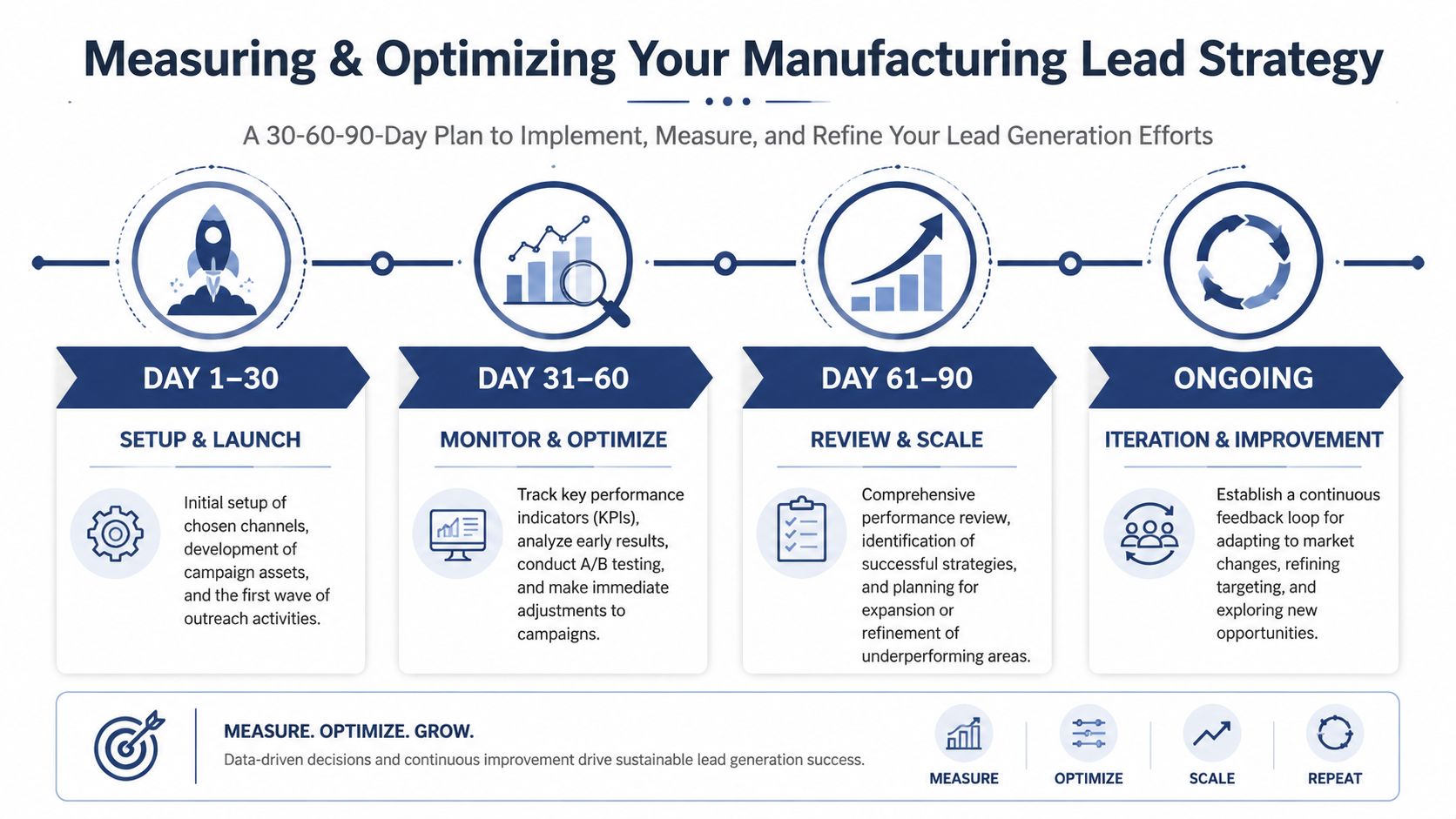
Track the system, not just the last click
Start with the metrics that show whether the machine is functioning.
| KPI | Why it matters |
|---|---|
| Qualified leads by source | Shows which channels produce real buying potential |
| Lead-to-opportunity rate | Reveals lead quality and handoff effectiveness |
| Opportunity-to-close rate | Tests sales fit, targeting accuracy, and offer quality |
| Time to first response | Exposes operational drag after form submissions or RFQs |
| Pipeline velocity | Helps you see movement before revenue lands |
| Cost per qualified lead | Keeps spending grounded in lead quality, not vanity volume |
You should also review qualitative signals:
- Sales feedback: Are reps getting better conversations or just more names?
- Content resonance: Which offers get discussed on calls?
- Account engagement: Are multiple stakeholders from the same company interacting?
- Channel fit: Which channels bring technical buyers versus low-fit inquiries?
The real question isn't “How many leads did we get?” It's “Did the right accounts move closer to a sales conversation?”
Your 30-60-90-day rollout
A disciplined rollout beats an all-at-once launch.
Days 1 to 30
- Define your target market profile
- Clarify buyer roles and pain points
- Audit your current site, forms, CRM, and follow-up process
- Choose one primary offer and one primary audience
- Write your core messaging for that segment
Days 31 to 60
- Build the landing page and thank-you flow
- Configure CRM fields, ownership rules, and status definitions
- Create your first email nurture sequence
- Tighten one LinkedIn outreach workflow and one inbound path
- Set up reporting for source, stage progression, and response times
Days 61 to 90
- Launch one focused campaign
- Review lead quality with sales weekly
- Adjust messaging, targeting, and routing based on real conversations
- Identify bottlenecks in follow-up or qualification
- Expand only after one channel-to-CRM path is working cleanly
The discipline here matters. Don't add more campaigns until the first one produces usable feedback. Don't expand channels until reporting is trustworthy. Don't celebrate activity if the handoff still leaks.
A strong manufacturing lead generation system doesn't appear because the team got busier. It appears because the company defined the process, instrumented it properly, and kept improving it.
If you want a second set of eyes on your targeting, CRM workflow, or lead generation system, Machine Marketing helps manufacturers diagnose what's broken, connect the tools they already have, and build a practical growth system that your team can effectively run.