
Cold email reply rates average 3.43% to 8.5%, so success depends on list quality, not volume. A well-run outbound B2B campaign earns meetings by combining precise targeting, relevant messages, and disciplined follow-up.
The popular advice is simple: send more emails, make more calls, and keep adding contacts until the pipeline fills. That advice treats prospecting like a production line. It ignores the cost of bad data, the complexity of industrial buying groups, and the fact that most buyers can recognize a generic message before they finish the first sentence.
We build outbound systems differently. We start with diagnosis, identify the signals that indicate a genuine business problem, and connect email, phone, LinkedIn, and CRM activity into one operating process. The result isn't effortless growth. It's a repeatable system that gives your team a better chance of spending time with the right accounts.
Table of Contents
- The Reality of Outbound Lead Generation in 2026
- Defining Your Ideal Customer Profile for Industrial Markets
- Crafting Value-Led Outreach Across Multiple Channels
- Building Your Multi-Channel Sequence and Tech Stack
- Testing, Metrics, and Compliance for Sustainable Growth
- Putting It All Together and Your Next Steps
The Reality of Outbound Lead Generation in 2026
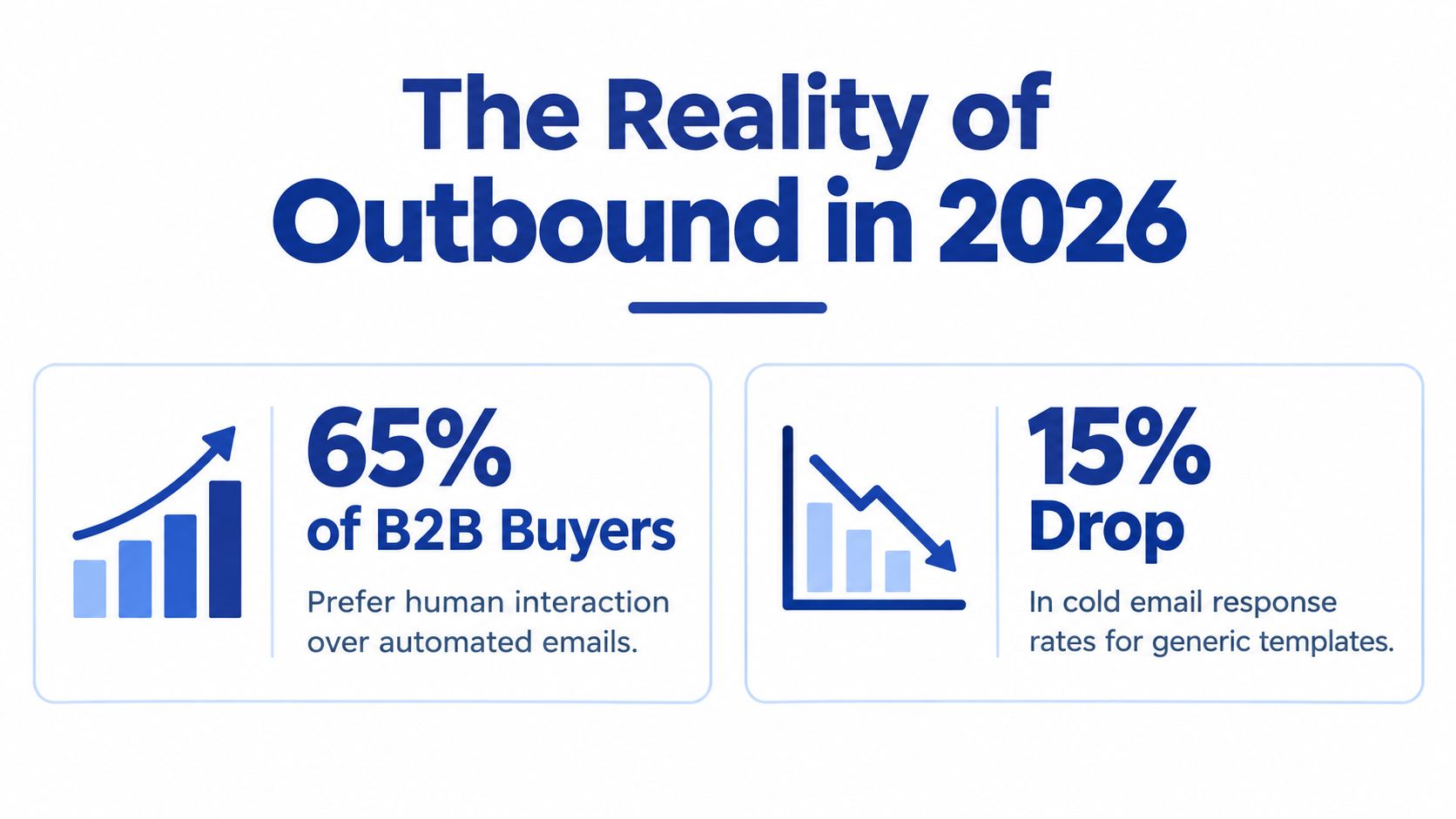
Outbound still works. Precision determines whether it produces pipeline or merely activity. Cold outreach remains a significant B2B channel, but its base rates are modest. Multiple 2026 benchmarks place cold-call success at approximately 2.3% to 2.7%, or roughly two to three booked meetings for every hundred dials, depending on targeting and execution. The same benchmark source notes that connecting with a lead typically takes three cold-call attempts, while another benchmark reports that 80% of sales require five or more follow-up calls. The current cold-call benchmark data supports a practical conclusion: persistence matters only when each attempt reaches a plausible buyer with a relevant reason to engage.
Email produces a similar operating problem. One analysis found that 91.5% of analyzed outreach emails received no reply. That figure does not prove the channel is broken. It points your team toward the variables that determine whether the send was worth making: account fit, contact accuracy, timing, message relevance, and follow-up quality. The outbound email benchmark analysis from LeadHaste provides a useful baseline for judging performance without treating every silent inbox as a copywriting failure.
Why volume creates false confidence
Send counts are easy to report and easy to misuse. A large list can contain companies with no relevant application, contacts who have no influence on the purchase, and stale records that waste rep time. The resulting activity may look healthy while qualified pipeline remains thin. List quality has an economic value. Every poor-fit record consumes research time, damages deliverability, or diverts a follow-up that could have gone to a better account.
Outbound and inbound perform different jobs. Inbound helps buyers discover and evaluate a supplier. Outbound lets a sales team approach accounts that match its commercial priorities. The comparison in outbound vs inbound marketing B2B explains why a growth system can use both without expecting identical buying behavior or measurement.
Industrial buying adds more research activity before a reply. Buyers may use an average of 10 channels, while digital channels represent about 80% of supplier-buyer interactions, according to recent B2B sales benchmark coverage. A technical buyer may review your website, check specifications, consult colleagues, and compare alternatives before responding. Your outreach therefore needs to make sense alongside those other interactions.
Review the broader industrial marketing trends before increasing send volume. Ask whether the right person received a credible reason to respond, then check whether each follow-up added useful information instead of repeating the pitch.
Practical rule: Treat a reply-rate problem as a targeting and data-quality diagnosis before treating it as a volume problem.
Defining Your Ideal Customer Profile for Industrial Markets
An industrial ICP is more than an industry label or company-size range. It identifies organizations whose operating environment, technical requirements, buying process, and commercial reality match your solution.
That definition gives the team a practical reason to prioritize one account over another. It also tells a sales engineer what evidence to gather before making contact. Precision matters because a smaller list of well-matched accounts can produce better opportunities than a large list built from broad firmographic filters.
Build the profile around operating conditions
Start with the company, then examine the application. Document the production environment, including the processes, materials, equipment, certifications, and tolerances that shape the buyer's problem. Record the commercial fit, such as the project type, purchasing model, geography, and service expectations that make the account viable.
The profile should also capture technical constraints. These may include failure modes, integration requirements, maintenance concerns, lead-time pressures, or compliance issues your solution can address. Add trigger signals, such as a plant expansion, new equipment, leadership change, hiring activity, product launch, capacity constraint, or visible shift in the company's market. Finally, define disqualifiers, including an incompatible process, inadequate volume, unsupported geography, or a requirement your team cannot meet.
This level of detail prevents a common targeting error. A company can look attractive on paper and still be a poor prospect because its process does not match your capabilities.
Industrial buying also requires stakeholder mapping. Technical buyers often research online before contacting a vendor, while the final buying group may include people from engineering, procurement, operations, finance, and leadership. Build a role map for each priority account instead of assuming one contact represents the entire opportunity.
Map the people behind the account
A machine manufacturer evaluating a new inspection cell offers a useful example. A capacity expansion might be the observable signal. The likely consequence could be pressure to increase throughput without adding inspection failures or maintenance work. Quality or engineering may experience the issue first, while operations, procurement, finance, and an executive sponsor influence the decision. The proof needed to reduce risk might include a specification, integration explanation, process comparison, diagnostic question, or relevant technical resource.
That account hypothesis gives outreach a clear purpose. It connects the company's signal to a plausible operating problem, identifies the first role to contact, anticipates the other stakeholders who must agree, and defines what evidence the sales team should prepare. If the signal is weak or the operational consequence is implausible, the account should not receive the same priority as a better-supported opportunity.
Use a practical buyer persona framework for industrial marketing to turn this research into usable messaging. Keep the document grounded in job responsibilities, technical concerns, decision authority, and evidence requirements. A persona containing only job titles and personal preferences will not help a sales engineer open a useful conversation.
Review the profile against real opportunities and remove assumptions that do not survive account research. A narrow ICP may produce a smaller list. That is useful when each account has meaningful potential and the message reflects the prospect's actual environment.
Crafting Value-Led Outreach Across Multiple Channels
A good outbound message answers three questions quickly: Why this account, why this person, and why now? If the message can't answer those questions, adding more adjectives won't rescue it.
Email gives you room to explain a relevant observation. Phone gives you a fast way to test whether the problem exists. LinkedIn can provide context and familiarity, especially when the prospect publishes about their work. These channels aren't interchangeable, and a multi-channel process shouldn't copy the same pitch into three applications.
Compare the channel roles
Email works best when the prospect needs a concise explanation. Lead with a specific observation, connect it to a plausible operational issue, and offer a low-friction next step. Avoid a product catalogue in the first message. A manufacturing prospect is more likely to engage with a note about a process constraint than a paragraph describing every feature you sell.
Phone works best when speed and clarification matter. A call can test an account hypothesis in minutes, but the opening needs to respect the prospect's time. State who you are, explain the reason for the call, and ask a focused question. A prepared call is different from a blind dial.
LinkedIn works best as a context and relationship channel. The benchmark data is concrete. A dataset covering 13.2 million LinkedIn requests found a 28.5% connection acceptance rate, a 10.4% reply rate for outbound messages, and a 3.0% response rate for connection-request notes. Expandi's LinkedIn outreach benchmark provides useful targets, but your audience and message quality still determine whether your results approach them.
A separate report based on 180,155 connection requests recorded 27.1% acceptance, replies from 27.6% of accepted connections, and booked meetings from 2.0% of accepted connections. Reachium's 2026 LinkedIn research shows why you should measure the full funnel instead of celebrating connection volume alone.
Write from the signal
Signal-led outreach begins with something observable. It might be a new production line, a hiring pattern, a product announcement, a technical post, or a change in the company's service offering. The signal gives your message a reason to exist.
Use this structure:
- Observation: “You're adding capacity for a process that often creates scheduling pressure.”
- Implication: “That can make inspection, tooling, or maintenance availability harder to manage.”
- Relevant value: “We help teams evaluate whether their current setup can absorb that change.”
- Permission-based next step: “Would a short comparison be useful, or is this outside your remit?”
Don't pretend to know the prospect's pain with certainty. Use a reasonable hypothesis and invite correction. That tone demonstrates technical maturity.
For teams refining their opening lines, the Linkboost hook generator can help produce alternatives. Use it for ideation, not for replacing account research. A generated hook still needs to be checked against the prospect's actual business.
Personalization also has an economic limit. Research cited in the 2026 outbound benchmark summary from Apollo places a well-run campaign around 3% to 5% reply rate, while tightly matched segments with strong personalization can reach 8% to 12% or higher. The practical question isn't whether every message should be completely bespoke. It's whether the account is valuable enough to justify the research depth.
Building Your Multi-Channel Sequence and Tech Stack
A sequence should make the next action clear for the salesperson and relevant to the prospect. Build it around one shared record, defined exit conditions, and enough flexibility for a human to respond appropriately. Automation should manage handoffs, not decide what an account means.
Start with the data model. The CRM record should include the account, contact, role, data source, buying signal, last touch, next action, response, qualification status, and disqualification reason. Missing fields create blind spots. A sequence can continue sending messages even after the original assumption has become irrelevant.
Use a controlled sequence
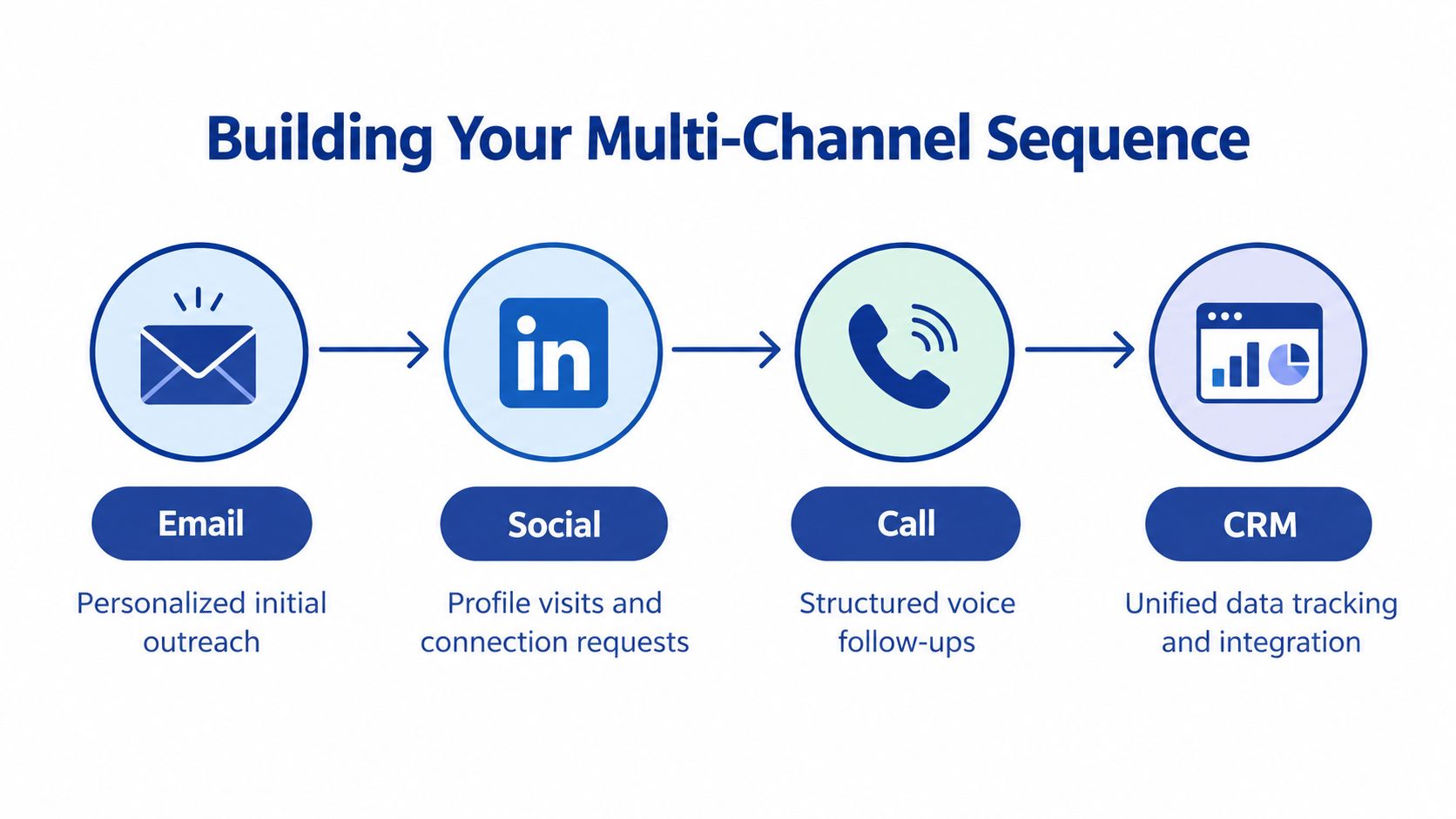
A practical sequence can follow this order:
- Email: Send a concise message tied to a verified account signal.
- Social: Review the contact's public context and send a connection request without forcing a pitch.
- Call: Use the account hypothesis to ask a direct, relevant question.
- CRM: Record the outcome, update the hypothesis, and schedule the next action or remove the contact from the sequence.
Timing should reflect the account and channel rather than an arbitrary automation setting. A technical prospect may need a useful specification or application note before a follow-up is appropriate. A contact who replies should leave the automated sequence immediately, with ownership assigned to a salesperson.
Data hygiene affects conversion. Contact records decay, and follow-up can underperform when messages go to unverified addresses or outdated roles. Belkins' research reports 28% average annual contact-data decay, 67% of contacted prospects having at least one stale data point, and 62% of cold email replies coming from follow-up steps. It identifies 4 to 6 emails as an optimal sequence length in its analysis. Belkins' cold-email response research supports a practical rule: verify records before enrollment, then stop automation as soon as new information changes the account context.
The CRM should tell your team what to do next, not merely document what happened last.
Keep the stack narrow
A workable stack includes a contact-data source, verification step, CRM, sequencing tool, calendar, and reporting layer. Each system should pass a defined record to the next one instead of creating a separate version of the prospect.
For example, a manufacturer targeting plant engineering managers can pull account and role data into the CRM, verify the email and company domain, then send only approved records to the sequencing tool. A reply, bounce, job change, or meeting request should write back to the CRM and stop the relevant automation. The salesperson then sees the source, verification status, message history, and next task in one record.
That handoff is more useful than adding another sending tool. The SalesHive outbound strategy research provides planning guidance for matching segmentation and automation to the campaign rather than treating every contact alike.
Teams evaluating public-data collection can compare a firecrawl alternative when selecting a research workflow. Use automation to collect and organize evidence, then have a person verify it before the evidence shapes an outbound message.
A practical marketing technology stack should show ownership, validation status, and handoffs across the workflow. Machine Marketing implements email outreach and automated follow-up campaigns that coordinate email, voicemail, SMS, and calls for manufacturers. Human review remains necessary for technical claims and replies.
Testing, Metrics, and Compliance for Sustainable Growth
Outbound performance improves when a team can connect activity to commercial results. A high send count only confirms that messages went out. It does not show whether the list was accurate, the audience had a relevant problem, or the offer deserved attention. Measure the campaign as a chain, then investigate where that chain breaks.
Review one campaign at a weekly operating meeting. Start with activity: confirm that the planned calls, emails, social touches, and follow-up tasks were completed. If execution is consistent, move to engagement. Check delivery, replies, meaningful conversations, connection acceptance, and meeting requests. Classify each response instead of treating every reply as progress. A positive response, a technical objection, a referral to another stakeholder, and an unsubscribe request require different actions.
Next, examine quality. A manufacturer may receive several replies from companies that cannot use its equipment, lack the relevant application, or have no role in the buying process. Those responses indicate attention, not necessarily opportunity. Compare the contact's role, account fit, operating condition, and stated problem with the ICP. Then review the commercial outcome: qualified meetings, opportunities created, sales acceptance, and revenue influence. If engagement rises while qualified conversations remain flat, the team may have improved the message while targeting the wrong accounts.
Use reply-rate benchmarks as directional evidence, not as a pass or fail rule. Interpret the result alongside segment size, deliverability, contact quality, offer relevance, and follow-up execution. A lower rate from a narrow group of high-value accounts can be more useful than a higher rate from a broad list. The review should answer why people responded and whether those responses created a path to a sale.
Test one failure point at a time
Weak replies do not justify changing the subject line, audience, channel, offer, and sequence at once. Check the likely failure points in order:
- Verify the contact and company data.
- Confirm that the person has a relevant role.
- Check that the trigger is real and recent enough to matter.
- Assess whether the account could plausibly have the stated problem.
- Review whether each follow-up adds useful information.
- Compare positive replies and qualified meetings, not replies alone.
This approach separates a weak campaign from a weak list and prevents vanity metrics from directing the next decision.
Treat compliance as part of design
Under GDPR, consent for email marketing requires a proactive opt-in. Pre-ticked boxes, implied agreement, and vague permission language do not meet that standard when consent is the lawful basis. The GDPR and CAN-SPAM compliance guidance from Instantly explains the relevant permission requirements.
For B2B outbound in Europe, Article 6(1)(f) legitimate interest is often used instead of consent, but the sender must document a Legitimate Interests Assessment before sending and show a real business purpose, necessity, and balance of interests. This European cold-email compliance guide describes those conditions.
The operating process should record the lawful basis, targeting rationale, sender identity, opt-out method, suppression status, and procedure for data requests. Compliance shapes the list, message, and automation rules from the start. When a prospect opts out, the system must remember that decision everywhere the contact is stored.
Putting It All Together and Your Next Steps
A manufacturer with inconsistent outbound usually doesn't need another script first. It needs a diagnosis. Review the last set of contacts and ask whether each account had a clear fit, a named buying role, a credible signal, verified contact details, and a reason for the chosen channel.
Then build a controlled pilot around a narrow segment. Select accounts that share a real application or operating condition. Write one email that demonstrates understanding of that condition, prepare a call opening that tests your hypothesis, and define what the salesperson should do when the prospect replies with interest, uncertainty, referral, or rejection.
Use this implementation checklist:
- Audit the list: Remove stale, irrelevant, duplicate, and unverified records.
- Rank accounts: Prioritize fit, signal strength, commercial value, and access to relevant stakeholders.
- Create the evidence: Gather the technical or operational facts that support the message.
- Assign ownership: Decide who researches, who sends, who calls, and who qualifies.
- Set exit rules: Stop automation when a person replies, opts out, changes role, or proves unsuitable.
- Review outcomes: Inspect qualified conversations and lost opportunities, not just activity totals.
The most common failure is stopping after the first touch. Benchmark data consistently shows that follow-up contributes materially to outbound results, but follow-up must earn its place. A second message that repeats the first adds friction. A second message that answers a likely technical question or shares a useful comparison gives the prospect a reason to continue.
Outbound B2B lead generation works when your team treats it as an engineered system. Define the right accounts, recognize meaningful signals, write for the buying role, coordinate channels, maintain clean data, measure qualified outcomes, and document compliance.
Machine Marketing helps manufacturers connect strategy, industrial SEO, content, CRM, and automated email outreach into a practical lead-generation system. Visit Machine Marketing to request a diagnosis of your current outbound process and identify the next improvements worth implementing.
