A plant manager opens a respected trade publication, sees a useful-looking article recommendation, and notices the same company appearing beside engineering content later that day. The reaction is usually simple: “Why is that ad following me?” For manufacturers, programmatic native ads can put a technical offer in front of the right research audience, but only when creative, targeting, inventory, and CRM measurement work as one system.
This channel isn't a shortcut around a long industrial sales cycle. Engineers and procurement teams still need evidence, specifications, application context, and a reason to trust the supplier. The practical question is whether native placements can help qualified buyers move from research to a measurable sales conversation.
Table of Contents
- What Programmatic Native Ads Actually Are for Manufacturers
- How Programmatic Native Ads Get Delivered
- Why Native Outperforms Standard Display for Industrial Audiences
- Targeting Engineers and Industrial Buyers Without Wasting Budget
- Creative Formats and Messaging That Engineers Actually Read
- Measurement and KPIs That Actually Matter in B2B
- Choosing a Programmatic Native Platform Without Overpaying
- Your 30-60-90 Day Programmatic Native Playbook
What Programmatic Native Ads Actually Are for Manufacturers
A plant manager reading about machining capacity may see an in-feed recommendation for a tooling guide, a capability brief, or a supplier comparison. It resembles the surrounding content because its layout, image treatment, and text fields adapt to the publisher's environment. It remains paid advertising, and a clear disclosure should make that distinction visible.
Native advertising has a long history. Paid editorial promotion appeared in print in the late 1800s, followed by sponsored radio in the 1930s and TV product placement in the 1940s. The term “native advertising” was coined in 2011, and the format expanded across mobile and digital content recommendation systems by the mid-2010s. In 2018, advertisers reported that 2 of every 5 dollars spent on native was being bought programmatically, showing how automated buying had become part of the category's commercial model (Ad.Style's native advertising timeline).
The working definition
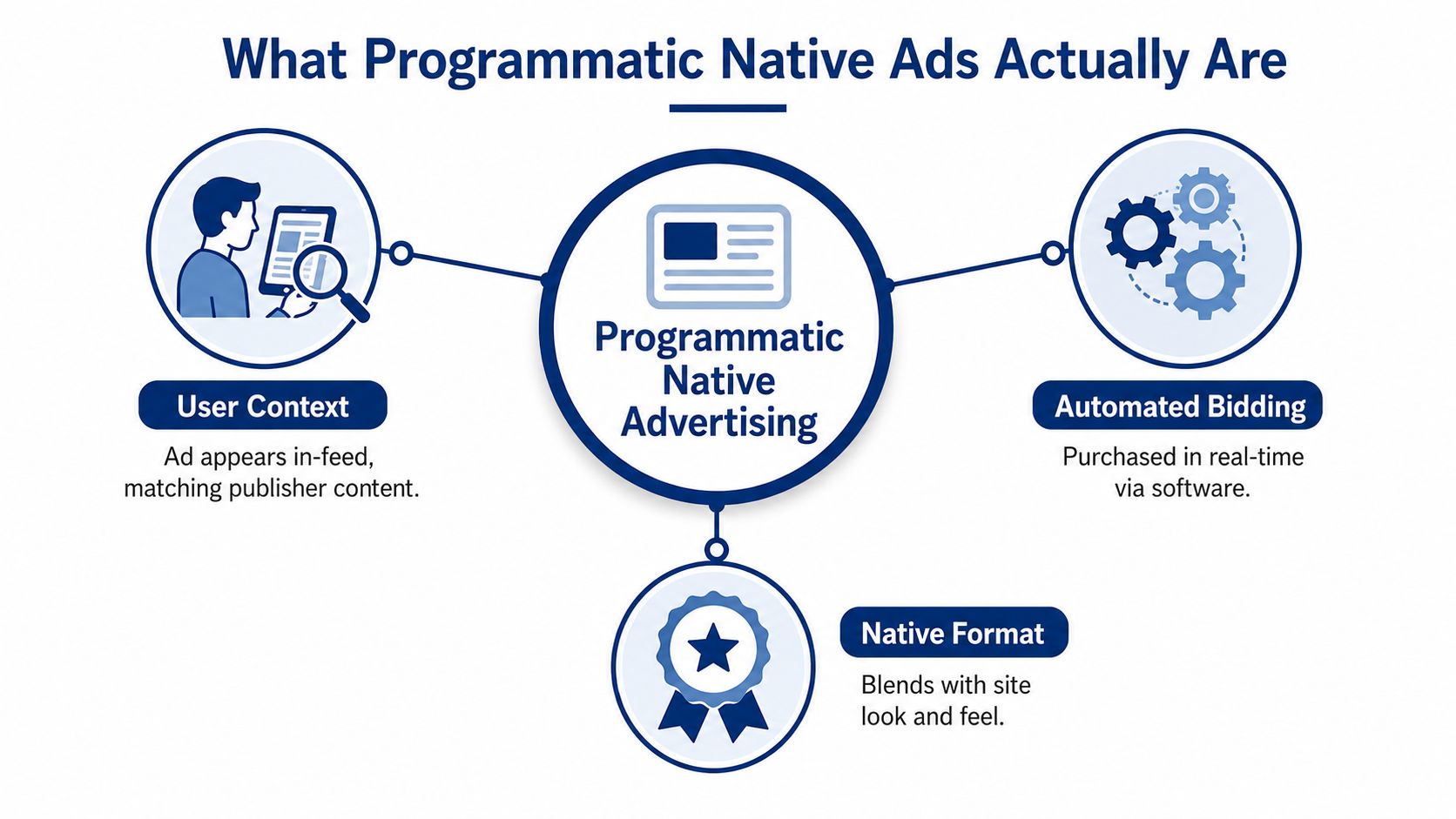
A programmatic native ad is a paid ad assembled to match the form and function of the page or feed where it appears, then purchased and delivered through automated advertising software. A DSP bids for an impression, the winning creative is selected, and the publisher renders fields such as the headline, image, description, and sponsor disclosure in its own layout.
That makes native different from a standard banner, which usually occupies a fixed ad rectangle with a separate visual treatment. It also differs from influencer content, where a named person or creator publishes sponsored material through a personal audience relationship. Native is a placement and creative format inside an automated media transaction.
For a skeptical engineer, the explanation can stay short: native matches the surrounding content, while programmatic handles the buying and delivery. It isn't disguised editorial, and it won't replace a strong technical offer.
Manufacturers should consider native when the buyer needs education before contacting sales, such as understanding a difficult process, comparing material options, or evaluating a production capability. If the offer is a simple emergency purchase with obvious search intent, paid search may capture demand more directly. A supply-side platform overview can also help your team understand the publisher side of the transaction.
How Programmatic Native Ads Get Delivered
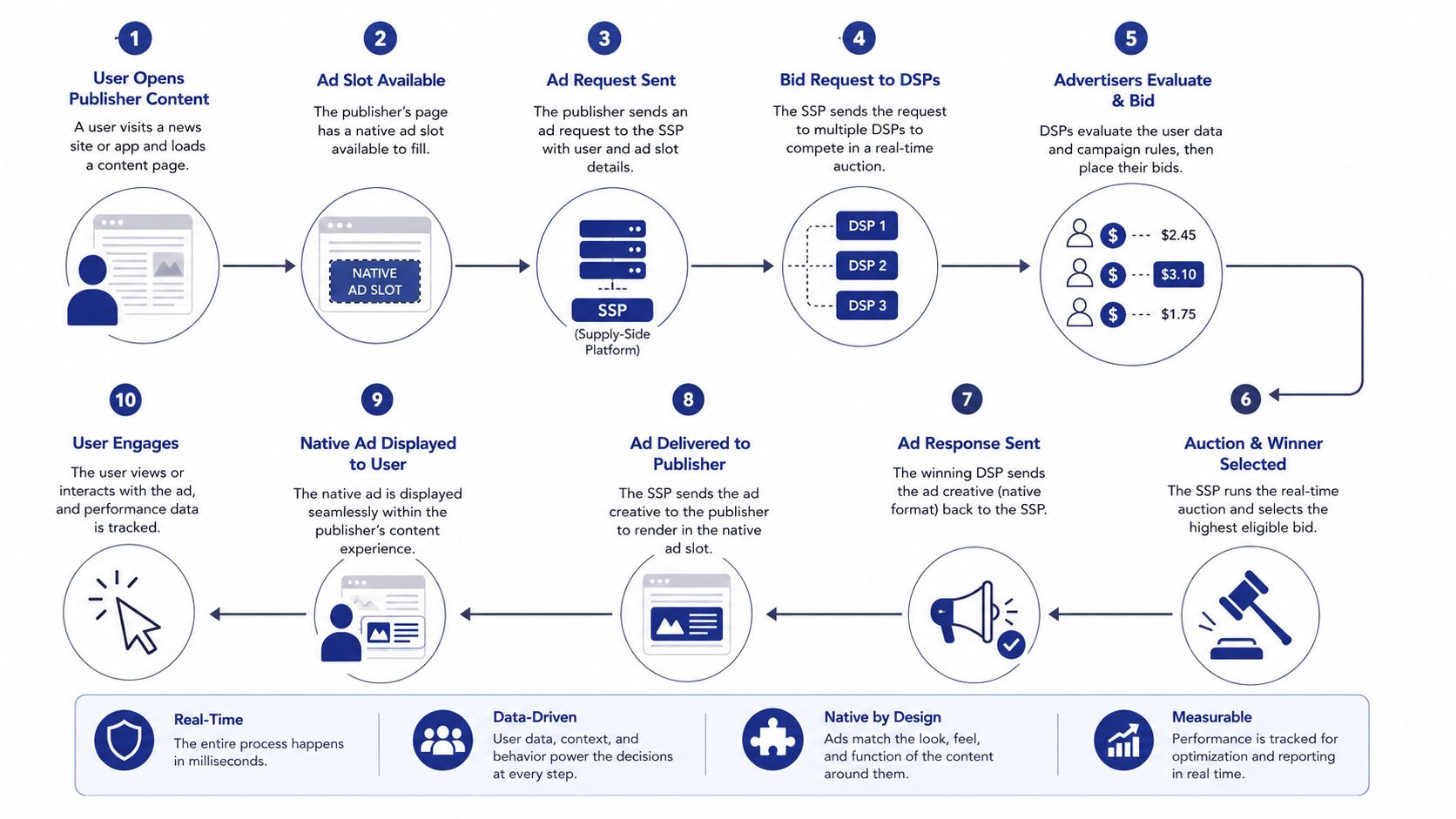
A machine shop can read the auction as a production workflow. The advertiser submits the job requirements, the DSP evaluates available opportunities, the SSP manages publisher inventory, and the exchange runs the bid. The publisher is the production floor where the selected ad is assembled for the reader.
From bid request to rendered creative
The process usually follows this sequence:
- A reader opens a page or feed with available native inventory.
- The publisher sends an impression opportunity through its SSP.
- The exchange passes details about placement, environment, and permitted ad fields.
- The DSP checks the opportunity against campaign rules.
- The advertiser's bid competes with other eligible bids.
- The winning ad object is returned.
- The publisher maps the structured fields into its native layout.
- The reader sees the ad with its required disclosure.
- The platform records delivery and engagement signals.
- The buyer uses those signals to adjust bids, audiences, inventory, or creative.
The technical foundation is standardization. The OpenRTB Dynamic Native Ads API specification, established in 2015, gave the programmatic ecosystem a common way to describe and serve native ads. The IAB Australia handbook explains that standardization made automated native products available to DSPs and supported optimization using contextual variables from the environment and consumer (IAB Australia Native Advertising handbook).
For a manufacturer, structured fields solve a practical problem. One fixed banner rarely fits every trade publication, mobile feed, and content recommendation unit. A native ad can provide separate headline, image, body copy, brand, and sponsor-label fields. The publisher controls how those fields fit its interface, while the buying system selects the eligible version.
The auction is only the delivery layer. Engineers and procurement teams still judge whether the message addresses a process constraint, material question, or supplier risk. Those signals need to connect with landing-page behavior, form quality, and CRM outcomes, rather than stopping at impressions or clicks.
Teams evaluating execution support can browse Helbling Digital Media's paid media solutions and compare how an external partner describes paid media management. The right partner should explain bidding, inventory controls, creative testing, and lead-quality reporting instead of promising automated reach.
Why Native Outperforms Standard Display for Industrial Audiences
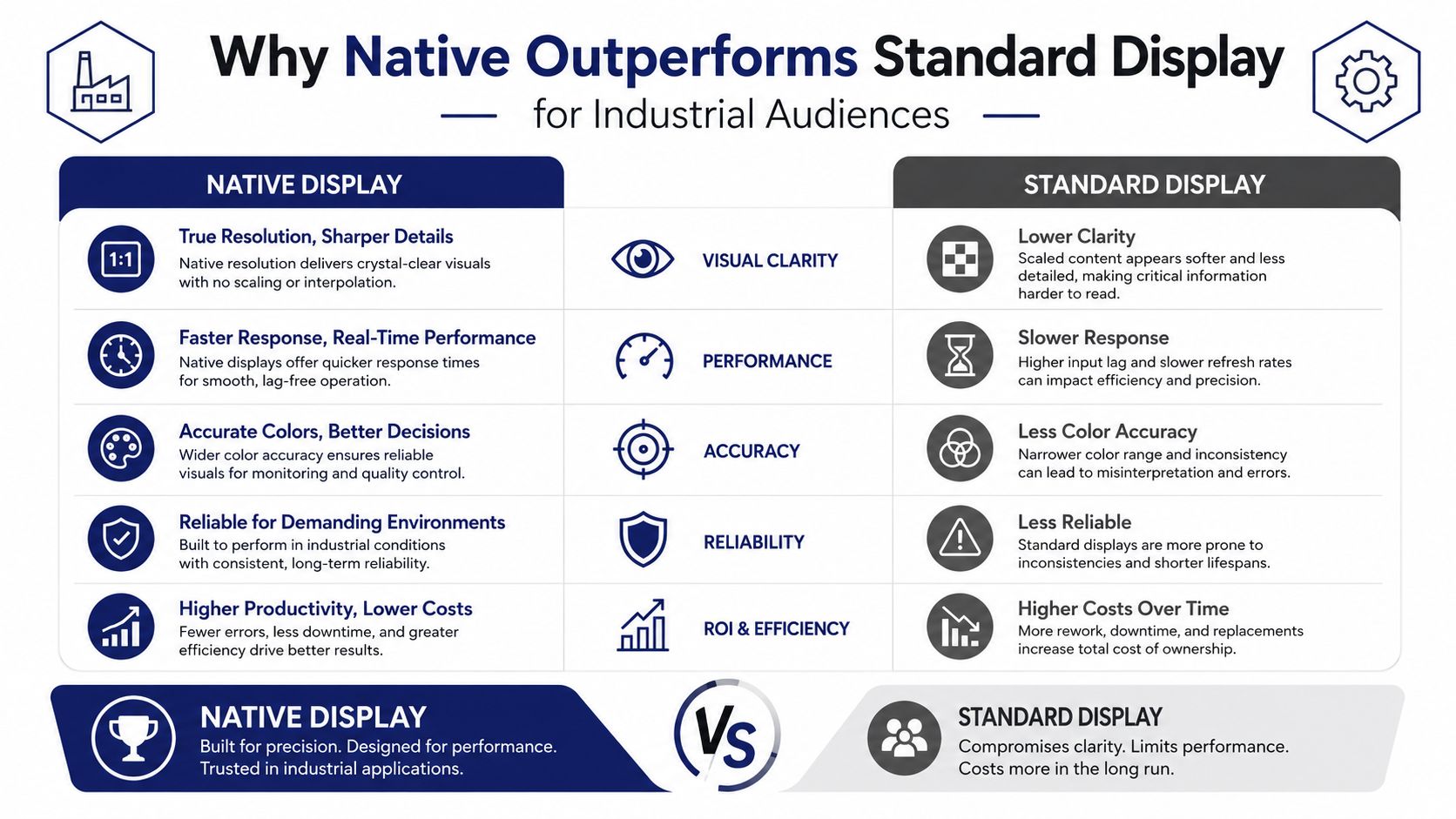
Native earns attention through fit, not camouflage. An engineer scanning an article about production methods is more likely to process a relevant recommendation placed inside that editorial flow than a disconnected banner sitting beside it. The creative still needs to prove relevance, but the surrounding experience gives it a better starting point.
StackAdapt reported that programmatically bought native ads were clicked almost three times as often as standard display ads across its platform. Its native CTRs averaged between 0.4% and 0.8%, compared with display benchmarks of 0.14% in Canada and 0.08% in the U.S., based on DoubleClick data cited in the same coverage (StackAdapt native programmatic benchmarks).
Those figures don't mean every native campaign will beat every banner campaign. They show why buyers examine the format when the audience is difficult to reach and the offer requires context. A banner can communicate a brand name quickly. Native gives you more room to connect a technical problem with a useful next step.
Where the premium can make sense
IAB Europe guidance reports native programmatic results in the sub-1% CTR range, with examples around 0.3% CTR for campaigns and 0.53% for native display, alongside a 55% view-through rate for native video (IAB Europe Programmatic Native Advertising White Paper). The operational lesson is important: native isn't automatically a high-volume click channel. Its value often comes from efficient engagement in content-adjacent placements.
For industrial campaigns, match the sub-format to the buying task:
- In-feed units work well for guides, application notes, and technical explainers.
- Content recommendation widgets can support broader discovery, but require strict placement and quality controls.
- Sponsored content suits deeper education, provided the disclosure is prominent.
- Native video can introduce a process, machine, or facility, but completion isn't the same as a qualified inquiry.
Budget rule: Pay the native premium when the surrounding context helps explain the problem your product solves. Don't pay more simply because the unit looks cleaner.
Targeting Engineers and Industrial Buyers Without Wasting Budget
Industrial targeting fails when marketers treat every engineer as a buyer. A person reading about CNC machining may be a student, a hobbyist, a supplier, a competitor, or a procurement professional actively comparing vendors. Programmatic systems can find patterns, but they can't infer a purchase timeline with perfect accuracy.
Build the audience in layers rather than relying on one broad segment.
Start with the account and environment
Use firmographic filters where the platform supports them, including relevant SIC or NAICS categories, company size, geography, and operating region. Then add contextual rules around the content itself. Useful environments may include machining, fabrication, industrial automation, maintenance, robotics, materials engineering, quality systems, plant operations, and procurement.
Contextual targeting matters more as privacy changes reduce dependence on third-party identifiers. Recent programmatic trend coverage identifies first-party data, alternative IDs, and contextual intelligence as core targeting pillars, while also describing contextual targeting as an important replacement for third-party cookies (programmatic advertising trends).
Use owned signals carefully
Your strongest signals often sit in your own systems:
- A spec sheet visit can indicate product research.
- A repeat visit to a capability page can justify a higher-value audience pool.
- A technical download can support lead scoring.
- A quote request should trigger suppression from acquisition ads and a sales workflow.
- CRM account status can separate open opportunities from new prospects.
Don't treat every content download as buying intent. Connect the event to company, product interest, repeat behavior, and sales disposition before increasing bids.
A practical brief should state:
- Who qualifies: target industries, locations, company characteristics, and excluded audiences.
- What context qualifies: publication categories, subject terms, and page environments.
- Which signals matter: technical visits, downloads, repeat sessions, and CRM stages.
- What gets excluded: employees, competitors, students, existing customers, and converted leads.
- What sales must report: accepted leads, rejected leads, opportunity creation, and reason codes.
If you need a separate professional-network layer for account targeting, this LinkedIn Ads setup guide provides a useful reference for campaign configuration. Keep the channel roles distinct. LinkedIn may help define accounts and job functions, while native can extend contextual reach around the research those buyers consume.
For a deeper explanation of the data layer, review what intent data means. The objective isn't to collect more audience labels. It's to create a defensible reason for every impression you buy.
Creative Formats and Messaging That Engineers Actually Read
Native creative is a structured asset package, not one banner resized across a network. A DSP may need multiple headlines, images, descriptions, logos, and disclosure treatments so the ad can fit different placements without becoming awkward or incomplete. Google's guidance emphasizes multiple assets per element, contextual targeting, and measurement for programmatic native campaigns (Google's programmatic native advertising guidance).
Build for variation, not volume
Start with multiple technical angles rather than minor rewrites of the same claim. One headline can focus on tolerance control, another on lead time, another on material capability, and another on documentation or certification. Keep the promise specific enough that an engineer can decide whether the click deserves attention.
| Asset | Minimum Count | Purpose |
|---|---|---|
| Headline | 8 to 10 | Test technical angles across placements |
| Image | 3 | Match equipment, application, and editorial contexts |
| Description | 3 | Preserve meaning when the feed truncates copy |
| Logo | 1 | Maintain recognition across layouts |
| Landing page | 1 per offer | Continue the same technical promise after the click |
| Disclosure label | Every unit | Identify paid content clearly |
The minimum counts above are a practical production baseline, not a performance guarantee. Images should show the actual machine, part, process, inspection method, or application whenever possible. Stock factory photography tends to communicate “industrial” without answering the buyer's real question.
Write for technical evaluation
Good native copy names the situation. “Reduce scrap in tight-tolerance aluminum components” gives an engineer something concrete to evaluate. “Improve your manufacturing outcomes” doesn't.
Test patterns such as:
- “A practical guide to [process or application]”
- “What to verify before outsourcing [component or operation]”
- “[Material or standard] requirements for [application]”
- “How [process constraint] affects part quality”
- “Questions to ask a supplier about [capability]”
Avoid unsupported superlatives, vague value propositions, and curiosity hooks that hide the subject. Engineers may click a clear technical question, but they won't reward a landing page that turns a precise headline into generic sales copy.
Disclosure protects the relationship. The IAB Native Advertising Playbook states that all three native ad types, including the content itself, must include disclosure so consumers understand that the material is paid advertising rather than publisher or platform content (IAB Native Advertising Playbook). The ad should blend with the interface, not mislead the reader about who paid for it.
Measurement and KPIs That Actually Matter in B2B
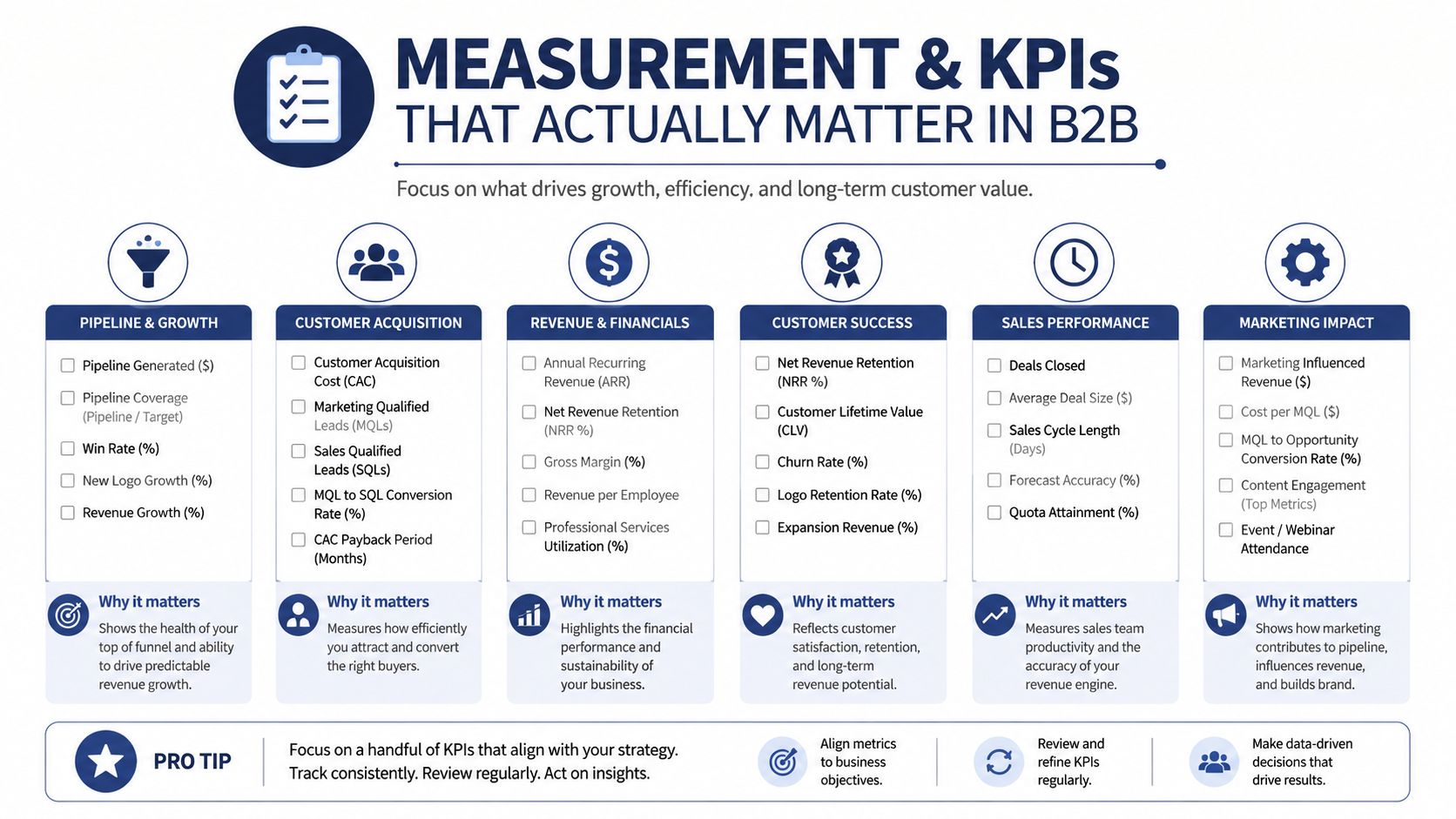
A click is an event, not a business outcome. Industrial marketers should report whether native traffic produces the kinds of contacts sales can accept, whether those contacts progress, and whether the campaign reaches accounts that fit the commercial strategy.
Use a layered scorecard
At the campaign level, monitor delivery, viewability, spend, CTR, and post-click engagement. These measures help diagnose creative and inventory, but they shouldn't dominate the report.
At the demand level, track:
- Cost per marketing-qualified lead: What did it cost to generate a lead that meets your agreed fit and behavior criteria?
- Cost per sales-qualified lead: What did it cost to produce a contact sales accepted for active follow-up?
- Lead acceptance rate: Which sources produce contacts sales keeps versus rejects?
- Pipeline influence: Which target accounts and opportunities interacted with the campaign?
- Engagement depth: Did visitors reach the spec sheet, capability page, download, or contact workflow?
- Native video view-through: Did viewers stay with the content, while recognizing that viewing alone doesn't prove buying intent?
Native video view-through rates around 55% are cited in IAB Europe's guidance, so the metric can help evaluate reach and attention. It must remain separate from lead quality because a completed view doesn't tell you whether the viewer works for a target account (IAB Europe's programmatic native guidance).
Audit the media, not just the leads
Brand safety, viewability, fraud prevention, supply-path optimization, and attention measurement remain active concerns in programmatic advertising (WARC programmatic trends coverage). Ask for domain-level reporting, placement exclusions, invalid-traffic controls, and a clear explanation of how the platform defines viewability.
Before signing, ask a DSP:
- Can you show the actual publishers, supply paths, and placement types receiving spend?
- Which controls prevent low-value inventory, made-for-advertising environments, and unsuitable content?
- Can you pass campaign, creative, source, and account data into our CRM with usable attribution fields?
A platform that reports clicks without lead acceptance or pipeline context is giving you an incomplete operating picture. For a broader framework, review this guide to measure marketing effectiveness with AI and compare its approach with your existing reporting. You can also document the conversion model in an ad effectiveness measurement framework before launch.
Choosing a Programmatic Native Platform Without Overpaying
Platform selection should start with operational fit, not a feature list. U.S. programmatic native spend was projected at $83.4 billion in 2022, and industry summaries estimated that native represented about 67.7% of total U.S. programmatic display spending in that period (Outbrain's native advertising statistics). The scale creates buying options, but it also gives vendors room to hide complexity inside fees, bundled inventory, and vague reporting.
Compare the buying models
A self-serve DSP can reduce service costs and give your team direct control. The trade-off is internal labor. Someone must build audiences, review supply, create assets, troubleshoot tracking, and explain results to sales.
A managed-service arrangement can provide execution support and campaign knowledge, but you trade margin for time savings. Ask whether the partner will disclose platform fees, media costs, data charges, and creative costs separately.
Your evaluation checklist should include:
- Supply transparency: Can you inspect domains, placements, exchanges, and paths?
- Native flexibility: Can the platform handle multiple headlines, images, descriptions, and disclosures?
- CRM connection: Can it pass source and conversion data into your existing system?
- Optimization controls: Can you adjust context, bids, frequency, geography, and exclusions?
- Reporting depth: Does reporting reach accepted leads and opportunities, or stop at CTR?
- Creative workflow: Can marketers update assets without repeated engineering tickets?
- Safety controls: Can you exclude unsuitable categories and low-quality inventory?
Three red flags deserve an immediate pause:
- The vendor promises qualified pipeline while discussing only impressions and clicks.
- The platform won't provide a clear supply-path or fee explanation.
- The team can't describe how sales feedback will change optimization.
Choose the system your staff can operate consistently. A cheaper platform that nobody audits can cost more than a managed program with accountable reporting.
Your 30-60-90 Day Programmatic Native Playbook
Use the first 30 days for diagnosis. Define target accounts, review existing CRM stages, audit contextual inventory, select exclusions, produce the asset package, and record baseline lead-quality measures. Sales should agree in advance on what makes a lead acceptable.
From days 31 to 60, launch with controlled tests across headline clusters, images, landing pages, and contextual groups. Hold a weekly review that prioritizes accepted-lead cost, account fit, and post-click behavior over raw CTR. Pause placements that generate activity without useful engagement or commercial relevance.
From days 61 to 90, shift budget toward the combinations that produce qualified actions, refresh weak creative, tighten exclusions, and connect campaign events to CRM follow-up. Sales should receive enough context to understand the account, content engaged with, and requested next step.
A focused six-figure test can help a typical mid-market manufacturer validate the channel without committing its full annual budget upfront, but the test should still have a defined audience, offer, measurement plan, and stop criteria (Outbrain's market coverage). The size of the test matters less than whether your team can trace media spend to commercial outcomes.
Machine Marketing helps manufacturers, machine shops, and industrial teams diagnose programmatic native opportunities, build technical creative, connect campaigns to CRM outcomes, and pressure-test the plan against your product line and sales cycle. Visit Machine Marketing to start a focused conversation about your next B2B lead generation campaign.