
Your website is live, you're paying for a CRM, and your sales team is calling accounts. Yet the quote calendar still swings between busy and quiet, while marketing reports clicks, posts, and contacts. We'd start by checking how those activities connect, not by adding another campaign.
B2B demand generation marketing should help qualified buyers verify fit before they call and give sales useful context when they do. For a smaller manufacturer, that means building technical self-service without sidelining your engineers, then judging progress through account-level evidence rather than form submissions alone.
Table of Contents
- Why Industrial Demand Stalls Before Sales
- Demand Generation Versus Lead Generation
- How Buying Groups Research Before They Call
- Channels That Create Technical Buying Intent
- Metrics That Show Demand You Cannot See
- Playbooks Manufacturers Can Run This Quarter
- How to Choose a Demand Generation Partner
- What to Fix in Your Demand System Next
Why Industrial Demand Stalls Before Sales
Consider a familiar machine-shop scenario. Your capabilities page lists equipment, your salesperson explains application fit, and your owner knows which jobs are profitable. But a prospective buyer has to speak with each person to assemble the full picture.
Meanwhile, marketing publishes general articles and sends everyone to the same contact form. Sales stores useful application notes in individual inboxes, while the CRM records names without capturing the technical problem behind the inquiry. Everyone's working, but nobody owns the connections.
We'd diagnose that as a disconnected demand system. You don't necessarily need more traffic or another salesperson. You need buyers to find consistent answers and your team to recognize when an account is moving toward a purchase.
Check the handoffs before adding activity
Start with questions your owner, marketing manager, and sales lead can answer together:
- Independent qualification: Can a technically qualified buyer tell you apart from alternatives without making a call?
- Shared explanation: Do engineering, procurement, and ownership encounter the same capabilities, limitations, and commercial expectations?
- Account visibility: Can anyone identify known accounts returning to technical resources before requesting a quote?
- Sales context: When an inquiry arrives, does the salesperson know the application, relevant content, and unresolved questions?
- Ownership: Who fixes a mismatch between the website, a sales presentation, and an actual production constraint?
Use a current opportunity to test the answers. Open the page that buyer likely visited, compare it with the sales email they received, and inspect the CRM record. Missing information becomes easier to spot when you follow an actual job rather than debate marketing in general.
Diagnosis rule: Don't buy another channel until you know which buyer question or internal handoff it will improve.
Name the operating gap
The gap might be technical depth, unclear positioning, weak follow-up, or records that separate related contacts from their account. Those problems require different fixes. Publishing more won't repair an unclear capability statement, and automation won't repair a sales process nobody follows.
You'll also face trade-offs. Ungated specifications support independent research but capture fewer names directly; detailed application content takes engineering time; account-level reporting leaves some channel credit unresolved.
We recommend accepting those trade-offs when they improve buyer decisions and sales judgment. The transformation isn't a busier marketing calendar. It's a coordinated system in which your website answers practical questions, your CRM preserves context, and your sales team knows where human expertise belongs.
Demand Generation Versus Lead Generation
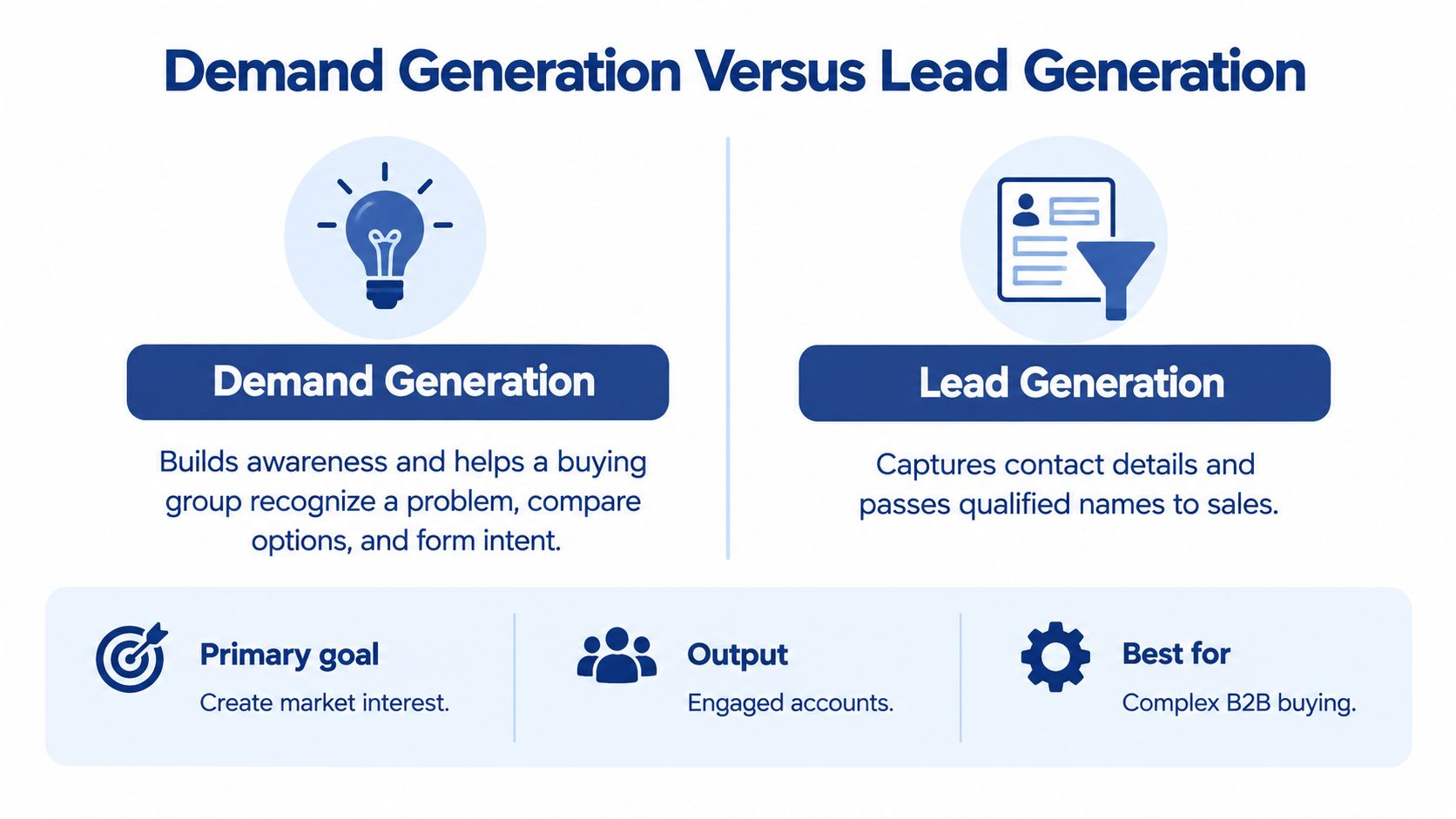
Demand generation builds understanding and preference. Lead generation captures an identifiable inquiry. You need both, but they shouldn't have the same job or qualification rules.
A material-selection guide can help a buying group recognize why its current process fails and compare alternatives. A drawing submission gives your team something concrete to evaluate. Treating those actions as equivalent creates inflated lead reports and premature sales outreach.
The distinction is straightforward:
Let the buying task determine sales involvement
Sales assistance remains valuable, but buyers don't need the same assistance for every purchase. In a 2017 McKinsey survey of more than 1,000 B2B buyers, 76% found speaking with a salesperson helpful for a new product or service, compared with about 50% for repeat purchases with new specifications and 15% for identical repurchases; 46% said they would purchase through an efficient supplier website, while only 10% were making online B2B purchases then, according to McKinsey's research on when buyers want digital interactions.
Those historical findings aren't a current adoption forecast. They support a practical distinction: buyers need different levels of help depending on novelty, uncertainty, and risk.
We recommend making basic specifications, process comparisons, documentation, and commercial context available without a meeting. Explain what affects price, what information a quotation requires, and which conditions change lead time. You don't have to publish a fixed price for a custom assembly to explain its cost drivers.
Reserve human involvement for evaluating fit, resolving conflicting requirements, building the business case, and accepting technical risk. A buyer should be able to understand your published operating envelope independently, then reach an engineer when the application approaches its limits.
Keep capture separate from qualification
| System | Buyer progress you support | Appropriate response |
|---|---|---|
| Demand generation | Understanding a problem or comparing approaches | Offer relevant technical education |
| Lead generation | Identifying a project and requesting assistance | Review fit and route the inquiry |
| Sales qualification | Confirming requirements and commercial potential | Assign an accountable sales owner |
Ask yourself:
- Intent: Are we scoring a tolerance-guide visit like a pricing request?
- Fit: Are we celebrating forms from companies we can't serve?
- Readiness: Does the buyer want guidance, or have we merely acquired an email address?
Marketing contributes before an inquiry arrives. Judge whether buyers can make meaningful progress independently, not just whether you've persuaded them to identify themselves.
How Buying Groups Research Before They Call
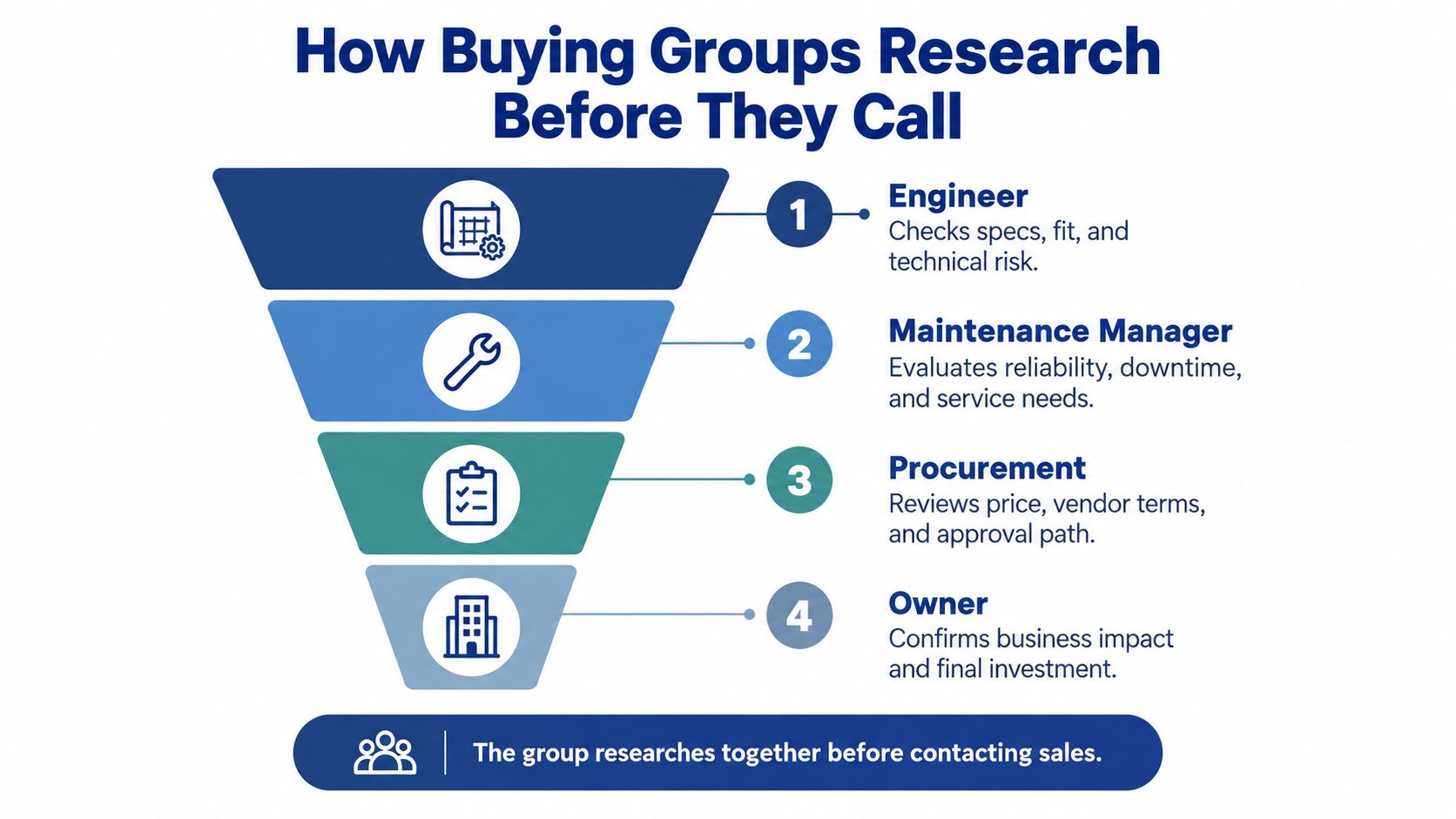
Follow a hypothetical equipment-replacement decision. An engineer starts by checking whether a different machine can handle the required material and geometry. The maintenance manager then examines access, service requirements, and the consequences of an unplanned stoppage.
Procurement investigates supplier terms and approval requirements. The owner considers the investment against production priorities and operating risk. These people may share resources internally without appearing as separate contacts in your CRM.
This role map shows the questions involved, not a compulsory sequence:
Map decisions rather than individual clicks
Your engineer might discover an application page through search, forward maintenance documentation to a colleague, and bring procurement into an email exchange. A remote discussion could lead to an in-person visit. The supplier explanation needs to remain consistent across those interactions.
McKinsey's 2025 global B2B Pulse research reported an average of 10 channels per purchasing journey, with buyers expecting smooth movement among in-person, remote, and digital interactions; it also found that 71% of B2B companies offered e-commerce, with roughly one-third of their revenue flowing through digital channels, according to McKinsey's analysis of the economics of B2B growth.
That isn't a mandate to operate every available channel. For a smaller manufacturer, it's a reason to maintain shared facts wherever buyers already encounter you.
Build a buying-group map using this template:
| Role | Decision to support | Evidence to provide |
|---|---|---|
| Engineer | Will this meet the application requirements? | Specifications, process limits, inspection approach |
| Maintenance manager | Can we operate and support it reliably? | Service access, maintenance documentation, support terms |
| Procurement | Can we approve and manage this supplier? | Quotation requirements, terms, qualification information |
| Owner | Does the investment make business sense? | Cost drivers, implementation requirements, operational trade-offs |
Keep account-based work manageable
Account-based demand generation means coordinating around selected companies and their buying questions. You can begin with a shared account list and your existing CRM rather than purchasing an enterprise platform.
Choose accounts that fit your capacity, capabilities, and commercial priorities. Record the relevant roles, known problems, open questions, and missing relationships. Use B2B customer journey mapping to organize the information around decisions rather than a generic marketing funnel.
Ask which roles remain invisible in your records. Then compare your capability page, sales deck, quotation notes, and distributor materials. Where do lead-time expectations or support promises change?
Assign someone to maintain the approved facts and flag exceptions. Adding channels without that discipline gives buyers more opportunities to encounter contradictions. Consistency beats channel volume when the purchase depends on technical confidence.
Channels That Create Technical Buying Intent
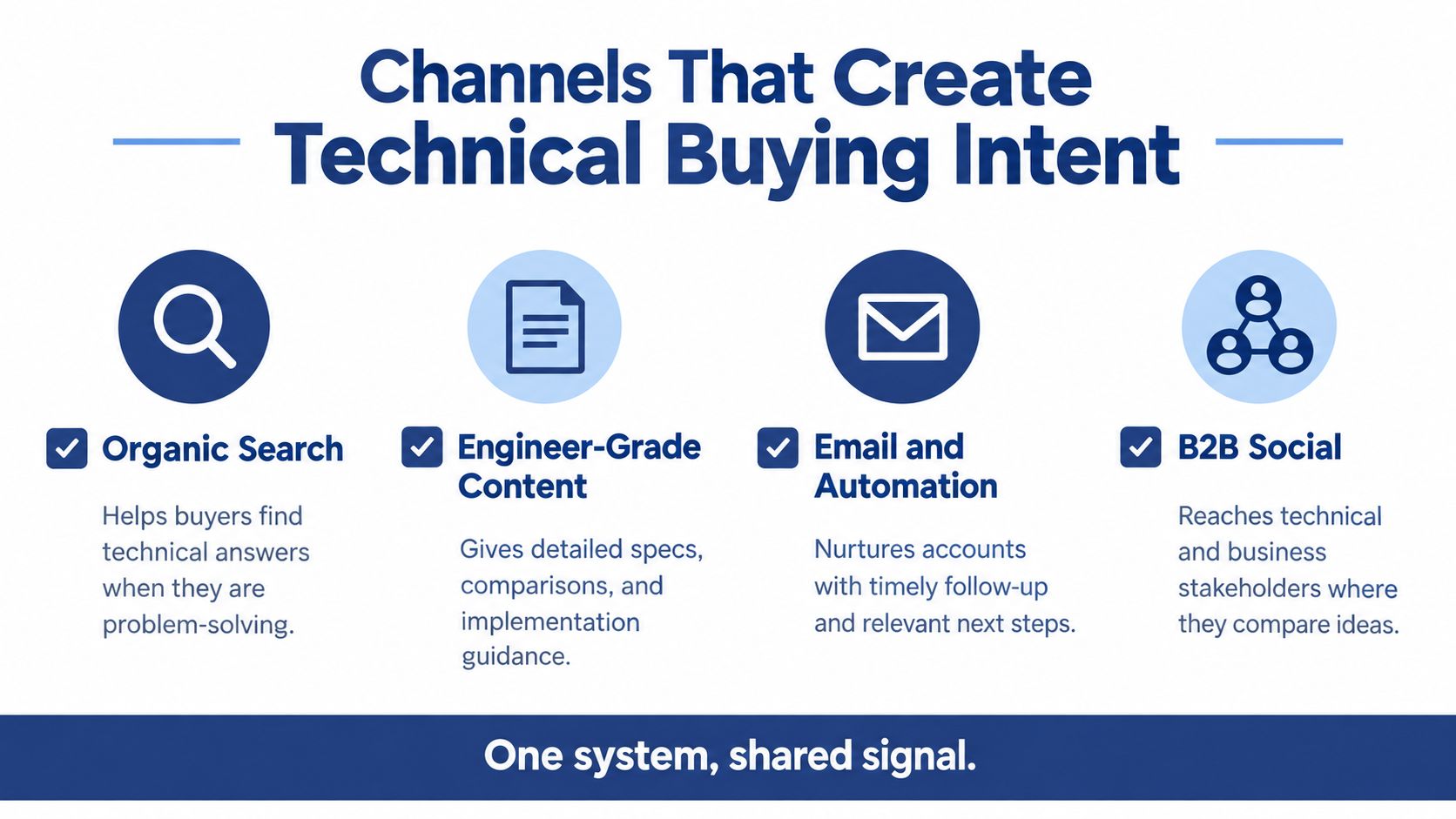
Give each channel a defined job. Search helps buyers discover answers, technical content supplies decision evidence, email supports relevant follow-up, and B2B social distributes useful proof. Don't ask every channel to generate an immediate quotation.
The operating model should remain understandable to your sales team:
Start with application questions and technical evidence
For organic search, investigate questions about material choice, achievable tolerances, machine capacity, surface finish, maintenance, and compliance. Select topics your company can answer from documented capabilities, not merely keywords with attractive traffic estimates.
A manufacturing-marketing benchmark reports that organic search accounts for 64.2% of industrial manufacturing website traffic, generates 69% of leads, and has an average lead conversion rate of 4.4%, according to Click-Vision's manufacturing marketing statistics. Treat those averages as context, not targets or promises; establish your own baseline by market, page type, channel, and lead quality.
Connect informational pages to the commercial evidence buyers need next. A surface-finish guide should point to relevant capabilities, inspection information, and a suitable quote path.
For engineer-grade content, interview a subject-matter expert about a recurring buying problem. Turn the approved explanation into a deep webpage, an application note, a sales leave-behind, and a nurture email. Our technical content marketing guidance provides a starting point for organizing that work.
The resource constraint is real: 54% of surveyed B2B marketers identified insufficient resources as a challenge and 45% lacked a scalable content-creation model, as summarized in Content Marketing Institute's content marketing statistics. Build a repeatable review workflow rather than treating every asset as a separate project.
Use distribution without creating unnecessary automation
Separate educational email from quote-ready communication. Send researchers relevant explanations; send active inquiries the information needed to advance their stated project. With a small list, don't build elaborate branching sequences before you can reliably segment contacts and handle replies.
If expected messages aren't reaching recipients, use MailGenius's guide on how to stop email from going to spam in Gmail as a troubleshooting resource. Review delivery practices before blaming the technical topic.
Use B2B social to share inspection examples, application explanations, and approved project evidence with relevant stakeholders. Link readers to the full technical resource instead of compressing every qualification detail into a post.
Before promoting an application, check its self-service assets:
- Fit information: Application-specific pages, tolerances, material guidance, and explicit limitations.
- Engineering resources: Downloadable specifications or CAD files where appropriate.
- Commercial context: Lead-time ranges, cost drivers, and quotation requirements.
- Decision support: Comparison checklists and maintenance documentation.
- Human escalation: A clear route to an engineer for unresolved requirements.
The production rule is shared evidence, adapted by channel. You don't need separate explanations of the same capability in every format.
Metrics That Show Demand You Cannot See
Don't let marketing-qualified leads, form fills, or last-touch credit determine your entire budget. A marketing-qualified lead is only a contact that meets your agreed marketing criteria. It isn't proof that a buying group has a viable project.
That distinction matters when distributors participate, existing customers research repeat purchases, and colleagues share documents outside your tracking. Your CRM can preserve visible evidence, but it can't reconstruct every interaction or assign precise commercial value to each one.
Replace false precision with useful evidence
In a 2025 survey of 980 B2B marketers, 29% rated their content strategy extremely or very effective and 58% rated it moderately effective; among respondents at moderate effectiveness or worse, 42% cited unclear goals, 56% cited ROI attribution difficulty, and 56% cited customer-journey tracking difficulty, while 74% overall reported generating demand or leads compared with 49% generating sales or revenue, according to Content Marketing Institute and MarketingProfs' B2B research.
Our recommendation is an evidence-based demand-signal framework. Combine behavioral observations with company fit and sales confirmation. Use marketing attribution to organize visible interactions, not to pretend you've measured the entire buying process.
Demand Signals Worth a Sales Review
| Signal | What it suggests | Review cadence | Do not decide budget from this alone |
|---|---|---|---|
| Target-account engagement | Relevant companies may be investigating | Weekly, marketing and account owner | Account identity or an engagement score |
| Return visits and engineering-document downloads | Continued technical evaluation may be underway | Weekly, marketing | Visits or downloads without application context |
| Email replies | A stated problem or question deserves review | Weekly, sales | Reply volume without fit |
| Branded search and direct-traffic patterns | Awareness or untracked discovery may be changing | Weekly, marketing | Aggregate traffic changes |
| Sales-accepted opportunities | Sales has confirmed a credible opportunity | Monthly, marketing and sales | Opportunity count without quality |
| Opportunity velocity | Buying stages are progressing or stalling | Monthly, sales | Speed without stage consistency |
| Revenue by account cohort | Selected account groups are producing business | Monthly, leadership and sales | Revenue without sales-cycle and capacity context |
A cohort is a group of accounts you evaluate together, such as those targeted for the same application. Compare their progress over time rather than claiming that an anonymous visit belongs to a specific person.
Assign each asset a stage role in the CRM: education, evaluation, or inquiry support. Capture available source and campaign parameters, preserve the original source when later interactions occur, and connect contacts to accounts and opportunities.
We'd rather make a defensible account decision from incomplete evidence than make a precise-looking budget decision from incomplete tracking.
During the monthly review, examine first touch, opportunity creation, sales notes, and revenue together. Distinguish awareness-producing resources from assets used during active evaluation. A late quotation form records an identifiable action, not necessarily when the buyer first developed interest.
Playbooks Manufacturers Can Run This Quarter
Choose bounded work your team can finish and review. We recommend a technical self-service path for a valuable application and a separate reactivation effort for suitable known accounts.
Bring marketing, sales, and an engineering representative together to agree on ownership before launch.

Build an application-specific self-service path
Select an application where your capabilities are established and your team understands the qualification questions. Don't start with an unfamiliar market just because it appears attractive.
A 2025 study of more than 250 manufacturing executives and managers found that 85% conducted preliminary supplier-website research before high-value purchases, 64% actively sought independent, objective information, and 33% believed vendors lacked adequate technical depth and clear differentiation, according to Industrial Equipment News' manufacturing buying research coverage.
Build the path in this order:
- Publish the application page: Explain the problem, operating requirements, suitable processes, and limits.
- Attach usable evidence: Provide an approved specification sheet or CAD-style download where relevant, plus a comparison checklist.
- Clarify operating expectations: Add current lead-time context, maintenance notes, and conditions requiring review.
- Create the quote-readiness form: Ask for drawings, material, quantity requirements, operating constraints, and project timing as applicable.
- Assign the response: Route drawing submissions to an engineer and flag repeat specification engagement for review when you can reliably associate it with a qualified account.
Keep poor-fit researchers in an appropriate educational path only if you have permission and a useful reason to continue communicating. Don't automate a technical recommendation merely because someone downloaded a file.
Use the video below as a discussion prompt during your planning meeting.
Run a 90-day known-account reactivation
Start with CRM contacts your sales team recognizes and can legitimately contact. Remove unsuitable records, check account ownership, and exclude contacts already in active discussions.
Choose a documented problem those accounts may face. Build a problem-led email sequence around an approved proof asset, such as an inspection example or application note. End with a direct offer to review a current part, production constraint, or machine issue.
At day 30, inspect delivery, relevant replies, resource use, and sales follow-up. Correct confusing language or a weak offer before expanding the audience.
At day 90, review qualified conversations, drawing submissions, accepted opportunities, and unresolved objections. Continue, revise, or stop based on those observations, not on a promised performance lift.
These are review checkpoints, not guaranteed result dates. Neither playbook repairs a website that can't explain capacity, tolerances, or support, and neither should automate engineering judgments your team hasn't approved.
How to Choose a Demand Generation Partner
Choose who will own the system before choosing another tool. Your realistic options are to keep the work inside your team, purchase software for a defined gap, or bring in a strategy partner.
Each route can be appropriate. The wrong choice is the one that adds responsibility without assigning someone the time and authority to carry it.
Compare the routes against your constraints
| Route | Appropriate when | Main trade-off |
|---|---|---|
| In-house team | You have an accountable lead, technical access, and implementation time | Competing responsibilities can delay coordination |
| Tool purchase | You've diagnosed a specific functional gap and assigned an operator | Software doesn't define your strategy or handoffs |
| Strategy partner | Existing people and tools need a shared operating plan | You still owe technical input and leadership decisions |
If you stay in-house, protect time for technical interviews, CRM maintenance, and sales reviews. Make the marketing lead accountable for a documented plan, not just a publishing schedule.
If you buy software, write the required workflow before attending a demonstration. Identify the missing function, who will operate it, what information it needs, and how you'll confirm it works. Keep functioning tools unless there's a clear reason to replace them.
A strategy partner should begin with target accounts, buying questions, and sales constraints. Ask the partner to trace an inquiry through your existing website, CRM, email, and follow-up process before proposing a replacement stack.
Require a diagnosis you can act on
Use these questions when comparing providers:
- Technical understanding: Can they explain which buyer decisions your content must support?
- Integration judgment: Can they connect existing tools without unnecessary migration?
- Sales boundaries: Will they specify when self-service is sufficient and when an engineer must intervene?
- Commercial reporting: Will they review pipeline influence and accepted opportunities, not only visits and forms?
- Operational ownership: Will you receive clear responsibilities, review cadences, and a usable standard operating procedure?
Machine Marketing is a strategy-partner option for manufacturers, machine shops, and industrial owners who already have people and tools but lack a coordinating plan. We connect manufacturing marketing strategy, industrial SEO, content for engineers and owners, CRM and automation, email, and B2B social around a measurable demand system rather than isolated campaigns.
A partner is the wrong spend if leadership won't give subject-matter experts time or review account evidence with sales. Outside support can organize the work; it can't invent your technical knowledge or make capacity decisions for you. Staying in-house is sensible when your team can own those responsibilities and execute consistently.
What to Fix in Your Demand System Next
Your next move should be a diagnosis of an application path, not a broad campaign launch. Pick an account cohort you understand and inspect what those buyers can verify today.
The desired change is practical: buyers establish fit earlier, sales spends more time on configuration and risk, and management evaluates account progress without requiring every researcher to submit a form. Those outcomes require clear information and disciplined follow-through, not perfect visibility.
Complete an owner's check this week
- Select the application: Choose work you want more of and can support operationally. Write down why those accounts fit.
- Capture the buying questions: Ask what engineering, maintenance, procurement, and ownership must confirm before approving the purchase.
- Inspect the evidence: Open the relevant webpages and documents. Mark missing specifications, unclear limits, unsupported claims, and unexplained trade-offs.
- Test the CRM distinction: Confirm that a researcher, an explicit quote request, and an accepted opportunity have different statuses and owners.
- Schedule the review: Book a monthly meeting with sales to examine the selected accounts, unresolved questions, and the next useful action.
Bring a current inquiry to that meeting. Ask the salesperson which questions they had to answer that should already have been clear, then ask engineering which questions genuinely required judgment. That comparison gives you a practical boundary between better self-service and necessary consultation.
Give the repair an owner
Choose the most consequential gap and assign responsibility for fixing it. Write down the required asset or workflow change, the person who approves it, and the evidence you'll inspect after implementation. Keep the scope small enough that the team can finish rather than launch another open-ended initiative.
Capacity check: No checklist creates a credible offer when your capabilities, available capacity, or lead-time expectations remain unclear.
Resolve those operating facts before asking marketing to amplify them. If you can't state a firm delivery expectation, explain the variables and how buyers obtain a current answer.
Try the checklist on your selected account cohort, then use the findings to prioritize the repair. You don't need to redesign the entire marketing operation to begin. You need a buyer question worth answering, a responsible owner, and a sales review that checks whether the change helped.
We help manufacturers diagnose how their website, technical content, CRM, and sales follow-up connect, then turn the findings into a practical demand generation plan. Visit Machine Marketing to discuss your current system and identify the gap to fix first.
