The most popular advice about a problem solving framework is also the least useful: choose one method and apply it to every issue. That approach creates paperwork for simple faults and false confidence for complex ones. Manufacturing teams need a better question, what kind of problem are we solving, and what level of diagnosis, experimentation, containment, or monitoring does it require?
A fixture adjustment, a recurring customer escape, and a gradual yield decline don't belong in the same process. We'll compare PDCA, DMAIC, A3, 8D, and root cause analysis techniques, then show how to select and implement the right structure without turning your improvement system into a compliance exercise.
Table of Contents
- Why Most Problem Solving Frameworks Fail in Practice
- What a Problem Solving Framework Actually Does
- Comparing PDCA and DMAIC and A3 and 8D for Manufacturing
- Root Cause Analysis Techniques That Fit Inside Larger Frameworks
- How to Match the Right Framework to Your Problem Type
- Implementing Your Chosen Framework on the Shop Floor
- Building Verification Loops That Prevent Framework Drift
Why Most Problem Solving Frameworks Fail in Practice
Most frameworks don't fail because the underlying logic is weak. They fail because leaders deploy the same template for every operational issue, regardless of urgency, complexity, evidence, or customer exposure.
A minor line stoppage can often be diagnosed and corrected through a focused PDCA cycle. If the team instead has to complete a full 8D with broad sign-offs, the process becomes slower than the problem. Operators learn that the official system is an administrative burden, so they return to verbal handoffs and local workarounds.
The reverse mistake is more dangerous. A lightweight Five Whys exercise may be sufficient for a straightforward, linear cause. It isn't sufficient for a defect pattern involving interacting machine settings, material variation, measurement uncertainty, and environmental conditions. A plausible answer can look like a root cause while leaving the actual process mechanism untouched.
Practical rule: Standardization should mean standard decision logic, not one universal form.
The mismatch creates predictable failure
A framework carries a level of structure. That structure is useful when it matches the risk and uncertainty of the problem. It becomes counterproductive when the method is either too heavy or too shallow.
- Overbuilt response: Teams spend more time documenting a contained issue than testing the correction.
- Underbuilt diagnosis: Teams select a cause without enough evidence, then mistake implementation for proof.
- Wrong objective: A containment crisis gets treated like a long-term improvement project, or process drift gets handled as a one-time incident.
- No ownership: The team completes actions, but nobody verifies whether the process remains stable.
The OECD's PISA 2012 Problem Solving Framework is useful historical context because it formalized problem solving as a distinct, measurable competency and defined cognitive process coverage for international assessment. The important lesson for manufacturers isn't the education application. It's that a framework becomes valuable when it makes thinking explicit, comparable, and assessable.
Start with diagnosis, not preference
Before choosing PDCA, DMAIC, A3, or 8D, classify the issue:
- Is the priority immediate containment?
- Is the cause known, or does the team need controlled experimentation?
- Does the issue recur across shifts, products, or sites?
- Will a customer, auditor, or executive need a traceable explanation?
- Can the available data support statistical analysis?
The best problem solving framework is the one that makes the next decision safer and clearer. A method that fits the problem helps people learn. A method that doesn't fit teaches them to work around the system.
What a Problem Solving Framework Actually Does
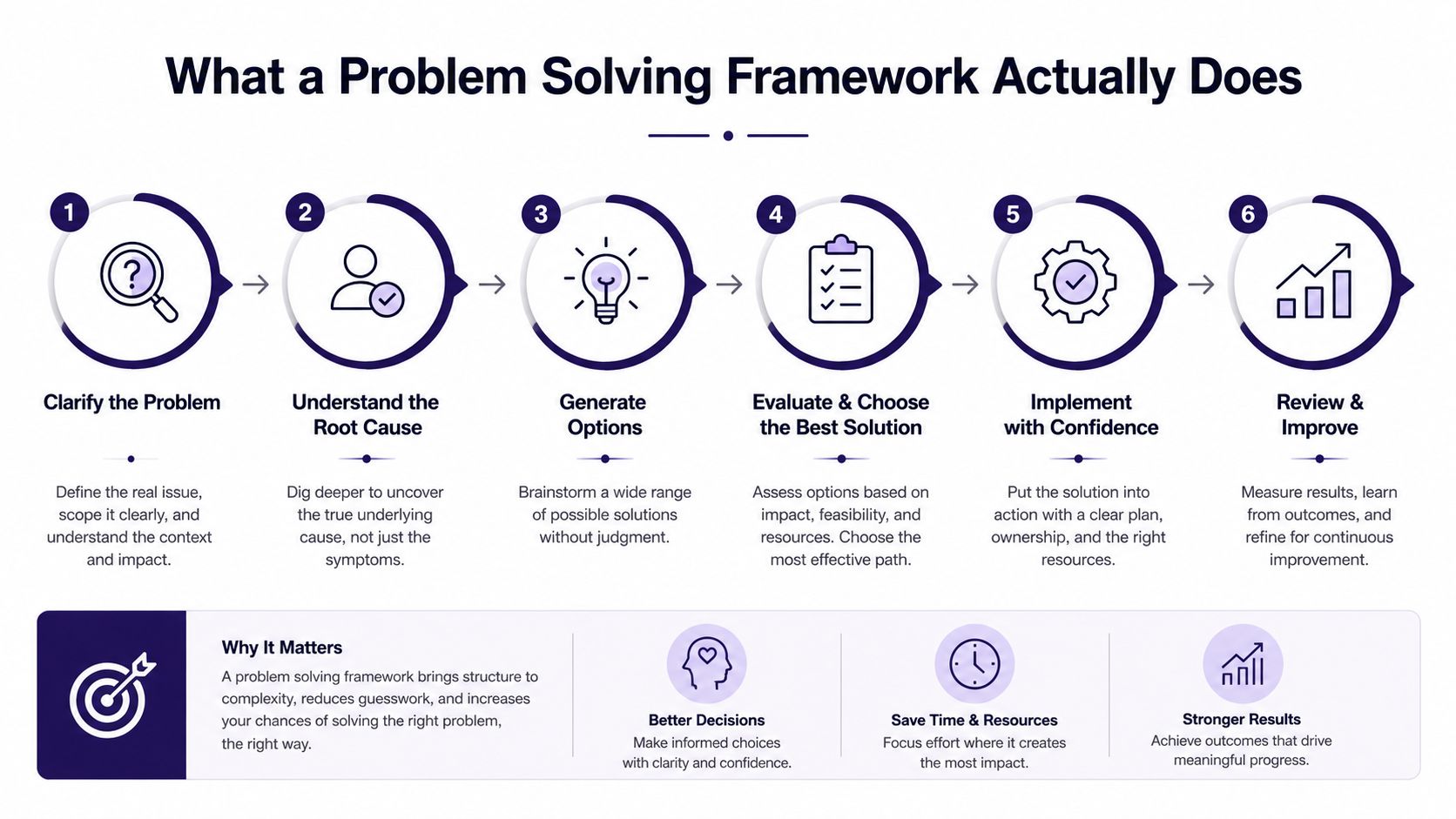
A problem solving framework is operational scaffolding. It tells a team how to define the issue, collect relevant evidence, form a hypothesis, test an intervention, and decide whether the result is strong enough to standardize.
That distinction matters on a shop floor. Experienced technicians often solve faults through pattern recognition and accumulated knowledge. Their judgment can be excellent, but it may remain local. If the solution isn't recorded with the conditions that made it work, the next shift may repeat the same investigation.
A framework converts useful intuition into a process other people can follow and challenge. It establishes boundaries around the problem, separates observations from assumptions, and creates a record that can support customer communication or an audit.
Structure prevents common reasoning failures
The late twentieth-century formalization of PPDAC, Problem, Plan, Data, Analysis, Conclusions, shows how problem solving moved from informal advice toward a repeatable investigative sequence. The Cobb and Moore reference on PPDAC describes it as an organizational framework used by professional statisticians, while the later GAISE approach echoes the sequence through questions, data collection, analysis, and interpretation.
Manufacturing teams need the same discipline, even when they aren't conducting a formal statistical study. The sequence helps prevent several familiar errors:
- Vague problem statements: “The line is unreliable” doesn't identify product, process, condition, or boundary.
- Premature solutions: A team changes a parameter before confirming what changed and when.
- Confused causality: A factor that appears alongside a defect gets treated as the cause.
- Unverified closure: An action item is marked complete without evidence that performance improved.
- Knowledge loss: The next team can't see the reasoning behind the standard work.
The framework isn't the answer. It creates a controlled path toward an answer.
Auditable doesn't mean bureaucratic
The strongest systems are proportionate. A short, visible record may be enough for a contained adjustment. A recurring defect with customer implications needs stronger evidence, clear ownership, and a defined follow-up process.
The ISO process approach for ISO 9001 maps PDCA to planning, implementation, checking, and action. It also identifies essential problem-solving activities such as defining the issue, collecting and analyzing data, implementing a preferred solution, and evaluating effectiveness.
That is the practical purpose of a framework. It makes the work repeatable, transferable, and defensible, without asking the team to document activity that has no effect on the decision.
Comparing PDCA and DMAIC and A3 and 8D for Manufacturing
These four methods overlap, but they don't create the same operating behavior. PDCA is built for learning through cycles. DMAIC is designed for disciplined analysis of variation. A3 compresses reasoning into a concise narrative. 8D organizes team-based containment and corrective action, particularly when a customer or supply chain partner needs evidence.
| Criteria | PDCA | DMAIC | A3 | 8D |
|---|---|---|---|---|
| Best fit | Known process requiring iterative improvement | Complex variation with uncertain causes | Clear problem narrative, alignment, and follow-through | Customer-facing or cross-functional corrective action |
| Problem complexity | Low to moderate | Moderate to high | Moderate, depending on analysis depth | Moderate to high, especially for escapes |
| Time-to-result | Fast cycles | Slower, analysis-heavy | Flexible, often focused | Urgent containment followed by deeper correction |
| Data requirements | Practical process data | Strong measurement and statistical evidence | Data-driven, but adaptable | Traceable evidence from process and quality records |
| Team involvement | Small working team | Cross-functional specialists | Owner-led with stakeholder review | Formal cross-functional team |
| Main weakness | Can become informal experimentation | Can become over-engineered | Can hide weak analysis behind concise presentation | Can become paperwork when applied to minor issues |
PDCA works when learning can happen quickly
PDCA, Plan, Do, Check, Act, fits a known process where the team can make a controlled change, observe the outcome, and refine the standard. It's practical for setup improvements, work instructions, fixture changes, and small process experiments.
Its weakness is discipline. Teams often skip the checking step or treat an operator's positive observation as sufficient evidence. That turns PDCA into “try something and keep it,” which isn't a closed loop.
DMAIC earns its weight on complex variation
DMAIC means Define, Measure, Analyse, Improve, Control. The American Society for Quality's DMAIC guidance describes Define as establishing the problem, goals, customers, and requirements. Measure identifies and documents the true process, while Analyse focuses on critical inputs and root causes of variation or poor performance.
Use DMAIC when the process has multiple variables, the baseline is uncertain, or the team needs stronger evidence before changing the system. Don't use it merely to make a small improvement look more complex. Its analytical burden can delay action when immediate containment matters more.
A3 makes reasoning visible
A3 is a structured 10-step scientific method connecting issue definition, background, current condition, goal, root cause analysis, target condition, countermeasures, implementation, testing, and follow-up, as documented in the A3 framework research. The method maps to PDCA and recommends a 1–2 week pilot test followed by a 30–90 day audit window to verify whether the countermeasure closes the gap.
A3's strength is compression. A single-page narrative forces the author to show the link between condition, cause, action, and evidence. Its weakness is that a clean page can conceal weak measurement if reviewers focus on presentation rather than verification.
8D protects customers while the team learns
8D is appropriate when a defect has escaped, a customer is exposed, or several functions must coordinate containment and correction. In automotive supply chains, root cause analysis is embedded in 8D corrective action processes, as described by Symestic's manufacturing RCA overview.
8D is not the fastest response for every internal issue. Its value comes from containment, accountability, traceability, and corrective-action proof. Start with 8D when the business risk demands a formal response, then use deeper analysis inside the investigation rather than assuming the template itself will reveal the cause.
Root Cause Analysis Techniques That Fit Inside Larger Frameworks
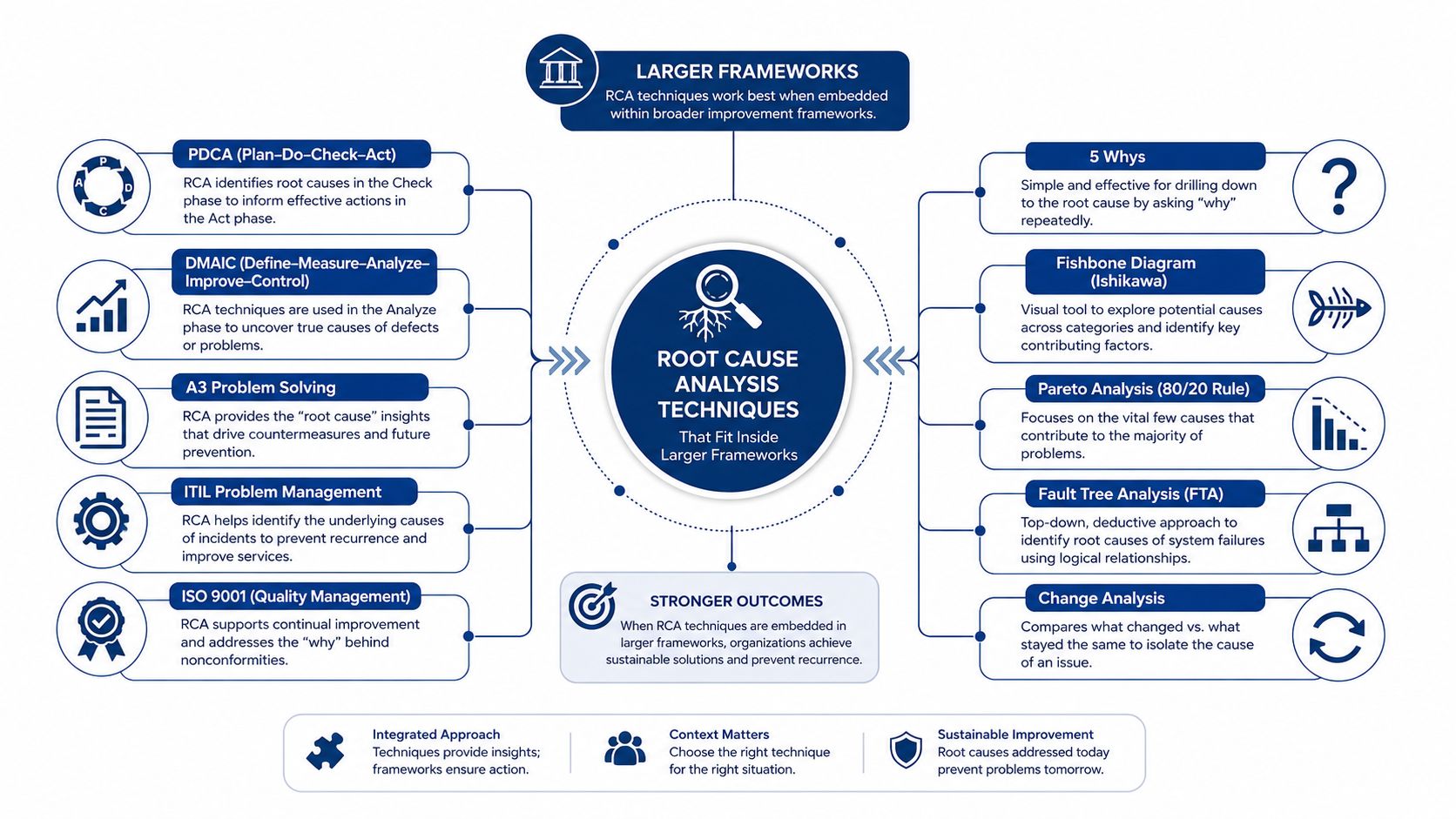
Root cause analysis techniques are diagnostic engines, not complete operating systems. They belong inside PDCA, DMAIC, A3, or 8D at the point where the team needs to explain why the gap exists.
Use Five Whys for linear cause chains
Five Whys works best when the problem is clearly bounded and the causal path is reasonably direct. The team defines the issue, asks why about each answer, and continues until the final answer is actionable and systemic. It isn't limited to exactly five questions, as explained in this Five Whys process guide.
A strong session doesn't accept the first plausible explanation. Gather the right people, agree on the problem statement, record multiple answers to the first why, and follow each branch before selecting the most likely systemic cause. The documented Five Whys team procedure recommends tracking branches on a whiteboard, flip chart, or cards so the group can test reasoning rather than follow the loudest voice.
Five Whys breaks down when teams force a single chain onto a multi-variable process. “The operator missed the instruction” may be true, but it may also avoid questions about standard work, training design, workload, measurement, or process controls.
Ishikawa exposes competing hypotheses
An Ishikawa, or fishbone, diagram is valuable when several functions hold part of the explanation. Categorizing possible causes through areas such as machine, method, material, manpower, measurement, and environment gives the team a shared map for investigation.
The diagram doesn't prove anything. It improves the quality of the hypotheses the team chooses to test. Put it in the analysis phase of A3, DMAIC, or 8D, then connect each serious candidate to production records, maintenance history, measurement checks, or controlled testing.
Pareto helps you spend investigation effort wisely
Pareto analysis is a prioritization filter. Use it before a deep dive when the operation has many defect types, downtime codes, or sources of scrap. Rank the categories using reliable process data, then focus investigation on the contributors that matter most to the business problem.
Don't confuse a high-frequency category with a confirmed cause. Pareto identifies where to look first. Five Whys or Ishikawa can help explain the selected category, while DMAIC or PDCA provides the structure for testing and control.
Diagnostic rule: A cause becomes useful only when the team can connect it to evidence and show that changing it affects the original problem.
How to Match the Right Framework to Your Problem Type
Framework selection becomes easier when you classify the issue by the work it demands. Manufacturing problems usually fall into three practical archetypes: containment crises, experimentation challenges, and monitoring gaps.
| Problem Characteristic | PDCA | DMAIC | A3 | 8D |
|---|---|---|---|---|
| Immediate customer or safety exposure | Limited fit, after containment | Analysis support | Possible, if ownership is clear | Strong fit |
| Known process with a testable change | Strong fit | Often excessive | Strong fit | Usually excessive |
| Multiple interacting variables | Useful for focused tests | Strong fit | Useful for alignment | Useful for formal correction |
| Need for visible sustainment | Moderate | Strong through Control | Strong through follow-up | Strong when customer closure matters |
| Limited data maturity | Practical starting point | Weak until measurement improves | Adaptable | Useful for containment and evidence building |
Containment crises need control before explanation
A customer escape, safety concern, or serious quality incident creates an immediate obligation to protect the customer and the process. Use 8D to assign the team, define interim controls, identify affected material, and maintain a traceable record. Don't wait for a perfect root cause before containing the risk.
Once the immediate exposure is controlled, the investigation may shift into A3 or DMAIC. That transition preserves urgency without treating emergency action as permanent corrective action.
Experimentation challenges need evidence
Yield improvement and cycle-time reduction usually require a change, observation, and learning loop. PDCA suits a known process with limited uncertainty and accessible feedback. DMAIC is better when the team needs stronger measurement, must separate interacting inputs, or can't explain the variation through direct observation.
For a broader operating view, connect the improvement work to the 3 Horizons framework, especially when immediate process fixes need to coexist with longer-term capability building.
Monitoring gaps need ownership and visibility
Recurring defects and process drift often indicate that a previous solution wasn't sustained or that the control plan is too weak. A3 can help make the condition, target, owner, and review logic visible. DMAIC may be appropriate when the process behavior is unclear, but don't launch a large analysis effort if the immediate need is to restore an agreed standard and monitor adherence.
Ask these five qualifying questions before opening a report:
- Recurrence: Has the issue returned after prior corrective action?
- Data maturity: Can you trust the available measurements and timestamps?
- Team reach: Does the problem cross departments, shifts, suppliers, or sites?
- Customer visibility: Is an external party waiting for containment or explanation?
- Time pressure: Do you need protection now, or learning over a longer cycle?
The answers should determine the method. Your preferred framework shouldn't.
Implementing Your Chosen Framework on the Shop Floor
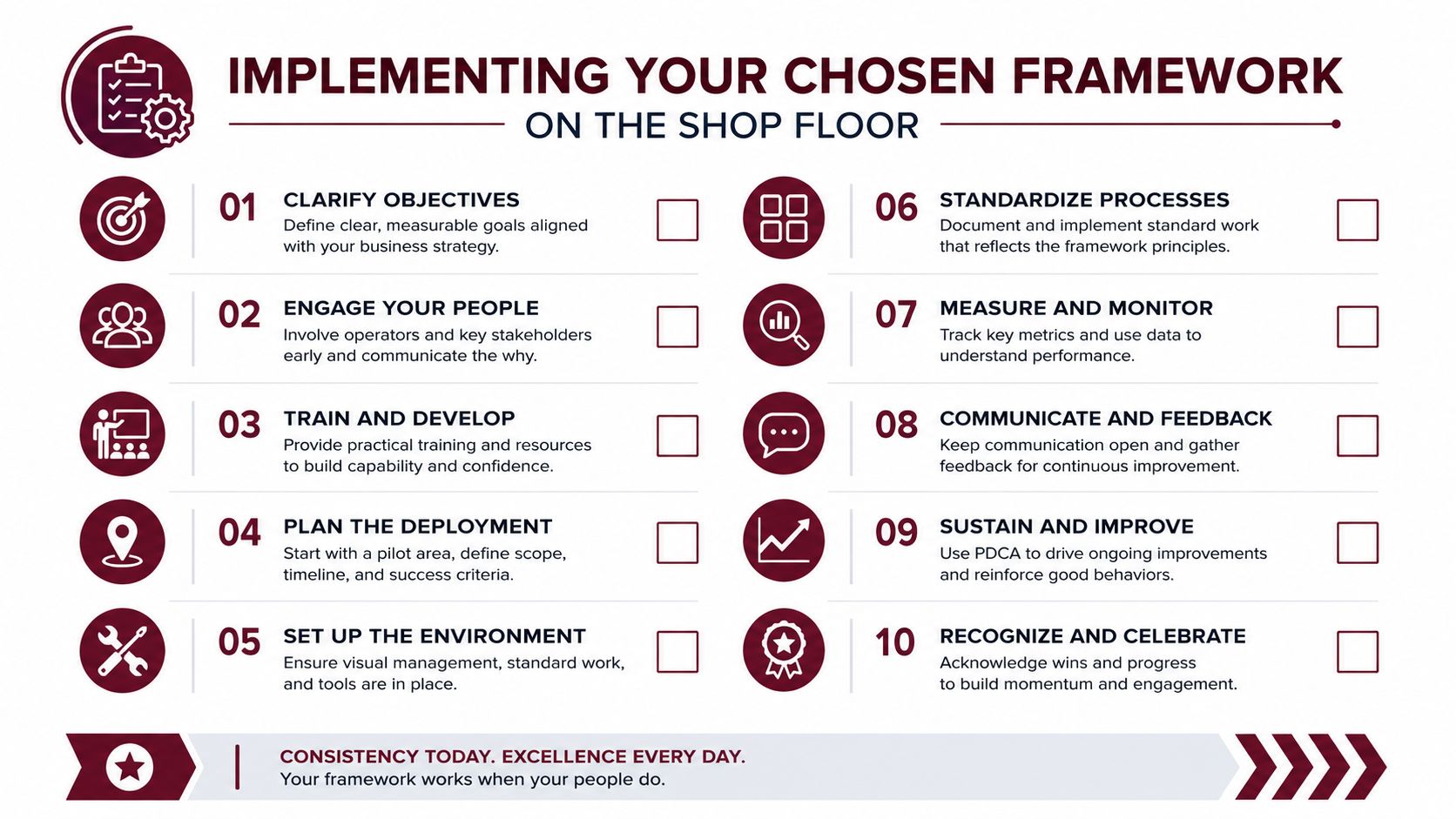
Choosing the method is only part of the work. Adoption depends on whether the team can use it during production pressure, with clear roles, visible evidence, and a review rhythm that doesn't compete with the operation.
Start with a contained pilot
Don't begin with the plant's most politically difficult chronic issue. Select a visible problem with a defined boundary, an engaged process owner, and enough data to observe the effect of a change.
Build the pilot around clear responsibilities:
- Facilitator: Keeps the method honest and removes process confusion.
- Process owner: Owns the condition and approves changes to standard work.
- Operators and technicians: Supply direct observations and challenge assumptions.
- Quality or engineering representative: Confirms measurement and evidence requirements.
- Leader: Removes obstacles and reviews decisions rather than rewriting the analysis.
Set the meeting cadence around production reality. A short daily check may suit an active containment effort, while a recurring improvement review can focus on evidence, open hypotheses, and decisions needed from leadership.
Before declaring success, define the verification rule. An action being completed doesn't prove the problem is solved. The team needs to compare the original performance measure with the post-change condition and record what would trigger a return to analysis.
Measure activity, outcome, and sustainability separately
Activity metrics tell you whether the system is being used, such as problems logged or causes investigated. Outcome metrics show whether the process changed, such as fewer defects or avoided cost. Sustainability metrics test whether the improvement remains in place, including recurrence checks at 90 and 180 days, as specified in the implementation guidance for this approach.
This separation prevents a common management error. A full queue of closed reports can look productive even when the same issue repeatedly returns.
For useful context on the wider discipline around process controls, review this resource on quality assurance in manufacturing. It can help teams connect problem solving with inspection, documentation, and prevention rather than treating corrective action as an isolated event.
Use a simple digital record if it improves access and ownership. Machine Marketing can support the same systems mindset in commercial operations through its EOS Traction approach for manufacturers, where priorities, accountability, and review rhythms connect execution to leadership decisions.
A short training session isn't enough for plant-wide adoption. Coach facilitators on live problems, review completed work with leaders, and publish examples that show what good evidence looks like. Scale the method only after the pilot demonstrates that teams can use it without excessive paperwork.
Building Verification Loops That Prevent Framework Drift
Teams don't lose control during the initial analysis. They lose it after the countermeasure is installed, the report is closed, and responsibility returns to the daily schedule.
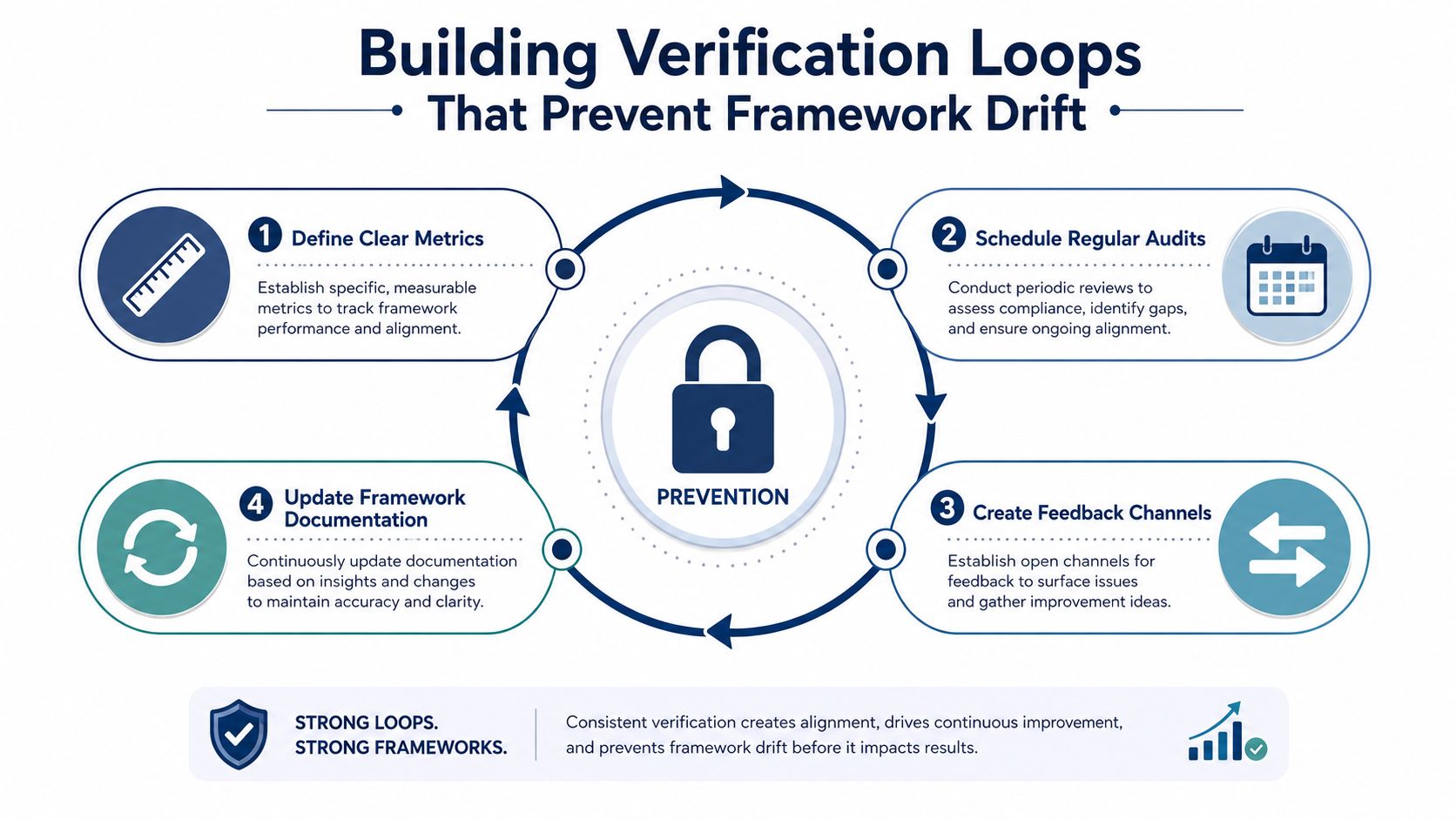
Verification must be designed before implementation. The team should know which measure will change, who reviews it, when the review occurs, and what evidence would show that the process is reverting.
Build the review loop into ownership
A useful cadence includes 30, 60, and 90 day audit checkpoints, aligned with the original problem measure and the new standard work. The quality team can coordinate the first review, but the process owner should eventually own sustainment. Otherwise, quality becomes the permanent babysitter and the operating department never absorbs the correction.
At each checkpoint, review four things:
- Performance: Is the original gap still closed?
- Process adherence: Are operators following the revised standard?
- Input conditions: Have materials, tooling, settings, or staffing changed?
- Response trigger: What action starts if the result moves outside the agreed condition?
A failed sustainment review doesn't mean the team should reopen the same form. If the process is reverting, return to containment when risk is active, or re-enter analysis when the cause or control is no longer valid.
Treat verification as a management system
A closed-loop system also needs a feedback channel. Operators should have a practical way to report that the new method is difficult, unavailable, or producing a different result than expected. Supervisors need to escalate recurring signals instead of normalizing them.
Teams working through broader organizational change can use these change management strategies for 2025 as a supporting resource, particularly when new behaviors, ownership, and communication routines must become part of daily work.
Digital transformation can strengthen this loop when it connects process data, maintenance history, quality records, and ownership. It doesn't replace judgment, but it can make drift easier to see. The manufacturing digital transformation guide offers a useful lens for connecting operational systems to broader improvement priorities.
Sustainment test: If nobody can state the metric, owner, review date, and escalation trigger, the corrective action isn't fully controlled.
The practical sequence is simple:
- Define the original condition and target.
- Record the evidence required for closure.
- Assign the process owner before the report closes.
- Schedule the audits in the operating calendar.
- Re-enter containment or analysis when the control fails.
A framework earns its place when it changes how your team thinks and works after the form is filed. Select it by problem type, use root cause tools where they add diagnostic value, and make verification part of the process rather than an optional ending.
Machine Marketing helps manufacturers connect operational discipline with clearer B2B marketing, lead generation, CRM, SEO, and growth systems. Visit Machine Marketing to request a practical diagnosis of the gaps between your strategy, tools, ownership, and measurable next steps.