Professional service firms sell intangible expertise, often measured through billable hours, rather than physical products. At the top end, Deloitte, PwC, EY, and KPMG together employ more than 1.5 million people across 150+ countries and generated roughly $220 billion in combined global revenue in their 2024 fiscal years.
You may recognize the operating tension. Your firm has capable specialists, strong client results, and a reputation built through years of difficult work, yet the pipeline still feels unpredictable. Marketing produces activity, sales depends on personal relationships, and delivery teams are measured by billable capacity. Standard product marketing playbooks miss the problem because they treat expertise like an item that can be packaged, priced, and purchased without a long trust-building process.
We diagnose professional service firms differently. The key questions are operational: How does expertise become demand? Where does non-billable friction reduce capacity? Can your CRM connect an inquiry to a qualified opportunity, proposal, engagement, and retained client? Growth becomes more reliable when marketing, sales, delivery, and finance operate as one system.
Table of Contents
- Defining the Professional Service Firm
- The Economics of Knowledge-Based Work
- Common Marketing and Sales Challenges
- Strategic Frameworks for B2B Growth
- Navigating the Complex B2B Buyer Journey
- Operational Tools for Scaling Your Firm
- Measuring Success and Next Steps
Defining the Professional Service Firm
An industrial business owner may know exactly how to solve a difficult technical problem but still struggle to explain that value before a sales conversation. The firm's engineers can identify failure points, recommend a process, or design a solution, but the website says little beyond “quality,” “experience,” and “customer service.” Prospects see competence, but they don't see a clear reason to start a conversation.
That business may be a professional service firm when its primary output is specialist knowledge applied to a customized client problem. The client isn't buying an object from inventory. They're buying judgment, analysis, representation, design, compliance expertise, or a project outcome delivered by trained professionals. The firm converts human capability into revenue through assignments, milestones, and relationships.
Research on professional service firms identifies four connected dimensions: customization, knowledge, governance, and identity. These firms adapt work to the client, rely on specialist expertise, govern through substantial professional autonomy, and build cohesion around standards such as ethics, independence, quality, and client service. The model differs from a centrally controlled factory because core producers often own or control the assets that create value, namely their expertise, judgment, and professional relationships.
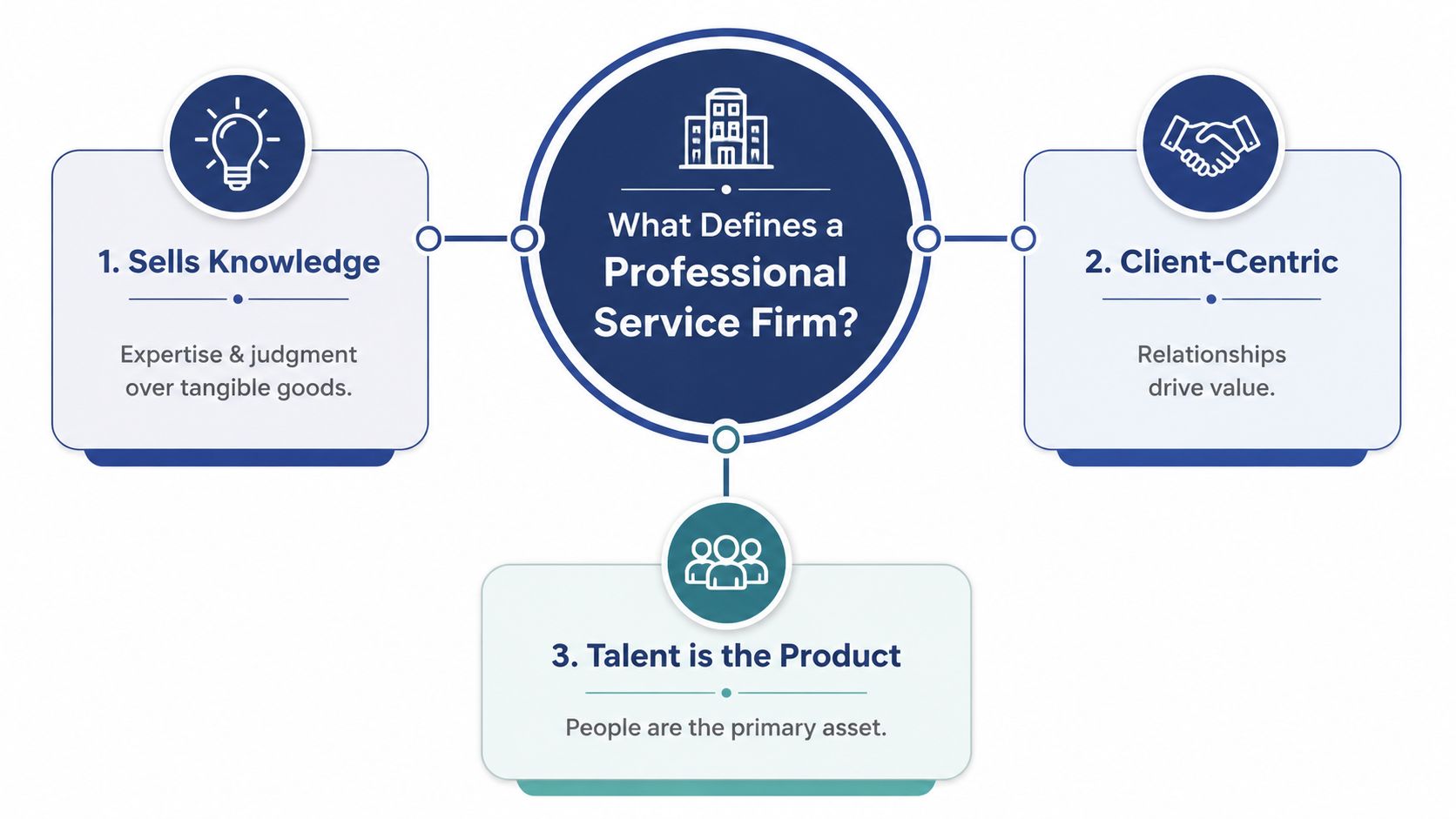
The four operating pillars
- Customization means the firm solves a client-specific problem rather than moving identical units through a production line.
- Knowledge intensity places expertise at the center of value creation. A legal opinion, audit judgment, engineering design, or strategic recommendation depends on trained interpretation.
- Governance must balance autonomy with accountability. Specialists need room to exercise judgment, but leaders still need consistent standards, scopes, approvals, and delivery controls.
- Identity gives the firm its professional promise. Buyers evaluate not only what the team can do, but whether it will act with competence, independence, discretion, and integrity.
A widely cited taxonomy adds low capital intensity and a professionalized workforce to knowledge intensity. The firm may need software, offices, and equipment, but physical assets aren't usually the primary source of value. That makes talent acquisition, retention, knowledge transfer, and positioning central business problems.
Marketing must therefore make invisible expertise easier to evaluate. Define the client problem, explain the decision process, show the risks of inaction, and make the next conversation specific. A useful companion resource on defining client engagement can help clarify what happens after an interested prospect responds. Firms recruiting scarce specialists may also find Google Maps lead generation for hiring useful when geographic talent discovery is part of the growth constraint.
The Economics of Knowledge-Based Work
A product company can add machinery or inventory to increase output. A professional service firm must increase the amount of valuable work its specialists can deliver without reducing judgment, quality, or trust. Its economic engine is the coordinated use of people, expertise, time, reputation, and repeatable delivery methods.
Revenue usually follows billable hours or project milestones. An expert records time against a client matter, or the firm invoices after completing a defined deliverable. This makes capacity visible, but capacity is divided among competing demands. The same senior person may sell work, supervise delivery, recruit, manage risk, develop intellectual property, and serve clients. Only some of those hours produce billable revenue.
Billable utilization is calculated as Billable Hours ÷ Available Hours × 100, as explained by Centsight's professional services finance analysis. Delivery roles often sit around 70% to 80%, while partners and senior leaders are commonly managed around 40% to 60%, because leadership work includes business development, governance, and people management. A consultant moving from 75% to 70% utilization loses 5% of annual billable capacity without any change in headcount or pricing.
Utilization is therefore a planning variable, not a target to maximize blindly. SPI-based benchmark summaries report that higher-maturity firms can reach roughly 85% on-time delivery and about 56% project margin, while lower-maturity firms are closer to 60% on-time delivery and around 16.5% project margin. The benchmark summary is available through Timelog's professional services maturity reference. Forecasting, scope control, and delivery discipline can protect margin more effectively than assigning every available hour to client work.
Scale comes from compounding impact, not just headcount
Productivity per employee is a useful test of whether a firm is converting expertise into repeatable economic output. Statista's worldwide revenue-per-employee series for professional services organizations tracks the sector from 2013 to 2023. The U.S. Department of Commerce recorded a $114 billion trade surplus in professional and business services in 2019, while PwC's Professional Services industry index stood at 117 on a FY19=100 basis. Together, these indicators show the value of exporting expertise and maintaining productivity through disruption.
Scale also changes the margin problem. Larger networks can spread technology, specialist knowledge, quality systems, and business development across more offices and client engagements. They must also coordinate more complex staffing, governance, and cross-border delivery. Deloitte, PwC, EY, and KPMG together employ more than 1.5 million people across 150+ countries and generated roughly $220 billion in combined global revenue in their 2024 fiscal years, according to StrategyCase's overview of the Big Four. In FY2025, Deloitte reported $70.5 billion, PwC $56.9 billion, EY $53.2 billion, and KPMG $39.8 billion in global revenue. Their size illustrates the reach of networked delivery, while also highlighting the management systems required to preserve quality as coordination costs rise.
Practical rule: Protect senior capacity for selling, quality control, and direction. A full calendar can conceal weak forecasting, poor scope control, or insufficient time for building the next pipeline.
Common Marketing and Sales Challenges
The first mistake is treating expertise as self-explanatory. Technical teams often describe capabilities from the inside out, listing credentials, methodologies, and services before naming the business problem that creates urgency for the buyer. The prospect has to do too much translation.
The second mistake is treating sales as a straight line. A buyer may discover a firm through a technical article, disappear while internal priorities change, return through a referral, involve procurement, and then request a proposal after several private conversations. Marketing attribution becomes difficult because the visible conversion is often far removed from the first useful interaction.
Why activity doesn't equal commercial progress
Professional service firms frequently measure contacts, downloads, meetings, or website traffic because those metrics are easy to collect. They're less useful when they aren't connected to qualification, opportunity stage, scope, proposal status, and delivery economics.
Ask these questions:
- Problem clarity: Does each major service page explain the trigger that causes a buyer to seek help?
- Audience precision: Can an engineer, owner, legal lead, or finance director recognize the content as relevant to their decision?
- Commercial continuity: Does the CRM record what happened after the form submission or referral?
- Delivery fit: Can sales identify work that matches available expertise and acceptable margin?
AI adds another layer. A 2025 Thomson Reuters report found organizational GenAI use nearly doubled from 12% in 2024 to 22% in 2025, while 50% were still planning or deciding and just 13% said GenAI was central to workflow today, as reported in Harvest's professional services trends coverage. The UK's 2026 AI Adoption Plan for Professional and Business Services reported usage rising from 31.4% in December 2024 to 43.4% in December 2025, using the same source.
The bottleneck isn't whether people can access AI. It's whether the firm can redesign workflow, governance, pricing, and delivery around it. Faster drafting may reduce the hours available to bill. If the firm still sells time, automation can improve client value while weakening revenue unless leadership changes the commercial model.
Strategic Frameworks for B2B Growth
A professional service firm needs a marketing system that turns expertise into evidence. The system should help a buyer recognize a problem, understand the consequences, assess your approach, and take a low-friction next step.
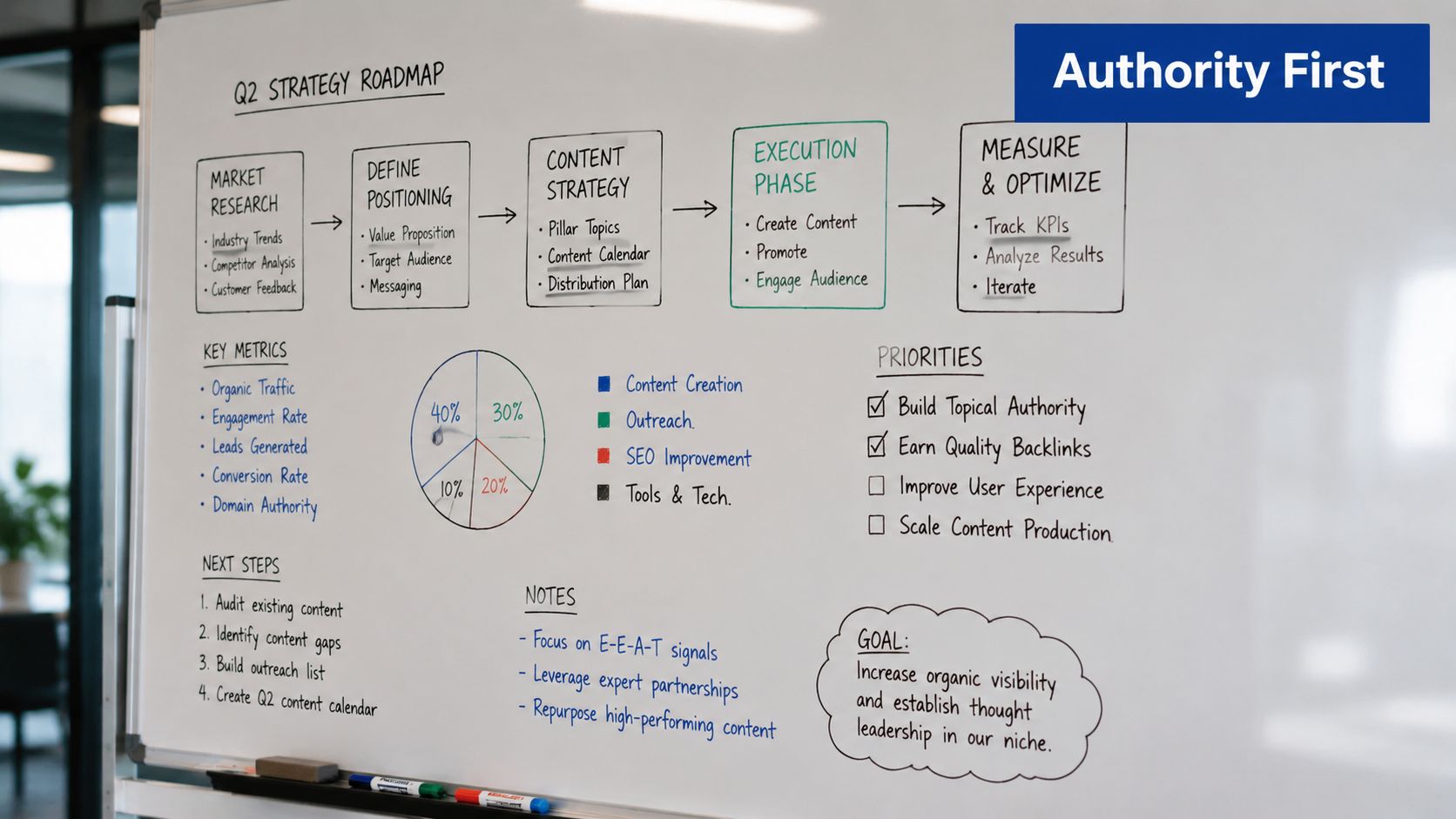
Build the system around buyer problems
Start with a service-to-problem map. For every profitable engagement type, document:
- The trigger: What changed for the buyer? A compliance requirement, stalled project, capacity gap, quality issue, market expansion, or leadership decision.
- The risk: What happens if the buyer delays or chooses poorly?
- The evidence: Which results, methods, credentials, process documents, or technical explanations establish credibility?
- The next step: What can the prospect do without committing to a full engagement?
This framework prevents generic content. Instead of publishing “five benefits of consulting,” create a page that addresses a recognizable operational decision, such as how to evaluate an outsourced engineering partner before a project enters procurement. Your subject-matter experts already know the questions clients ask. Capture those questions in search-oriented language, then answer them with enough technical detail to be useful.
Use technical SEO as a trust asset
Technical SEO isn't just a traffic tactic. For professional service firms, it organizes expertise so buyers can find and validate it. Build topic clusters around the problems you solve, connect educational articles to service pages, and include clear author expertise, process detail, assumptions, and limitations.
A strong content plan usually contains:
- Decision pages: Service pages for buyers comparing approaches or providers.
- Technical explainers: Articles that clarify difficult concepts without hiding behind jargon.
- Risk content: Guidance on common failure modes, scope gaps, and implementation constraints.
- Proof assets: Case material, anonymized examples where appropriate, methodologies, and diagnostic checklists.
- Conversion paths: Consultation requests, assessment forms, project scoping calls, or downloadable tools tied to the reader's problem.
Outbound email can support this system, but poor data quality undermines it. Before a campaign, use tools for bulk email verification to reduce invalid contacts and protect the quality of your prospecting database. Verification isn't a substitute for relevant messaging, but it removes an avoidable infrastructure problem.
The broader positioning choice is whether you compete in a crowded category or define a narrower problem where your expertise is unusually relevant. Our blue ocean strategy summary provides a useful way to examine that decision.
This video offers another practical perspective on connecting strategy to execution:
Don't publish content without an owner, a target query, a defined reader, and a follow-up path. A useful article that enters no CRM workflow is a library asset, not a growth system.
Navigating the Complex B2B Buyer Journey
A buyer rarely wakes up wanting “professional services.” They experience a problem first. The project is late, a regulation changes, an internal team lacks capacity, a technical decision carries unacceptable risk, or leadership needs an outside view.
The first marketing job is to name that problem accurately. Search content, referral conversations, industry discussions, and internal recommendations help the buyer frame the issue. At this stage, a firm shouldn't push a proposal. It should reduce confusion and demonstrate that it understands the operating context.
Match proof to the decision stage
As the buyer learns, the question changes from “What is happening?” to “What options do we have?” Then it becomes “Who can help us execute safely?” Your content and sales process should answer each question with a different asset.
| Buyer concern | Useful evidence | Commercial purpose |
|---|---|---|
| Problem definition | Technical guide or diagnostic checklist | Help the buyer classify the issue |
| Approach selection | Comparison article or methodology page | Make trade-offs visible |
| Provider evaluation | Case material, credentials, and delivery process | Reduce perceived risk |
| Internal approval | Scope outline, assumptions, and governance model | Give the champion material to share |
| Engagement design | Proposal, milestones, and communication plan | Turn interest into a controlled commitment |
Trust grows when the firm explains what it won't do, where assumptions apply, and how it manages uncertainty. A polished brochure can create awareness, but a clear explanation of scope, exclusions, decision rights, and delivery checkpoints helps a buying group justify selection.
Connect marketing to the buying group
Multiple stakeholders may evaluate the same firm differently. An engineer wants technical competence. A finance leader wants commercial clarity. An owner wants confidence that the engagement won't create management overhead. Procurement wants comparable scope and terms.
Create a content path for each role, then record engagement in the CRM. Don't assume the person who submits a form is the only decision-maker. During qualification, ask who needs to approve the work, what information they need, and which deadline or risk makes the decision important now.
The goal isn't to force a linear funnel onto a non-linear journey. The goal is to provide useful evidence at each point where uncertainty blocks progress. That makes marketing attribution more honest and gives sales better context than a source field alone.
Operational Tools for Scaling Your Firm
A professional service firm can have excellent content and still lose opportunities through slow follow-up, inconsistent qualification, or scattered client records. The operational question is simple: Can your team see the status of every meaningful relationship without asking three people or opening several spreadsheets?
A spreadsheet may work while a founder personally handles every inquiry. It becomes fragile when several specialists, services, or markets share the pipeline. An integrated CRM doesn't fix weak positioning, but it can make the commercial process visible and repeatable.
Manual and automated systems compared
| Operating area | Manual spreadsheets and inboxes | Integrated CRM and lead capture |
|---|---|---|
| Lead capture | Team members copy information from forms, email, and referrals | Forms and source details enter a shared record |
| Qualification | Notes vary by person and may be difficult to find | Required fields and defined stages create consistency |
| Follow-up | Reminders depend on individual memory | Tasks and sequences support timely action |
| Handoffs | Context can disappear between marketing and sales | Activity, notes, and ownership remain attached to the contact |
| Reporting | Leaders assemble reports manually | Pipeline views connect activity to opportunity stages |
| Governance | Access and version control can be unclear | Permissions, fields, and process rules can be standardized |
Automation should remove repetitive administration, not eliminate professional judgment. Use it for confirmation emails, task creation, lead routing, reminders, and dormant-contact reactivation. Keep qualification, scoping, pricing, and technical fit with people who understand the work.
Track the operating chain
Set up a minimum viable CRM around the questions leadership needs answered:
- Which source created the inquiry?
- Which problem or service does the prospect need?
- Who owns the next action?
- What stage is the opportunity in?
- What delivery capacity and expertise would it require?
- Did the opportunity become a client, pause, or close-lost?
- Did the client return or expand?
Review the system weekly. Delete fields nobody uses, define what each stage means, and require a next action for active opportunities. If your firm is building a repeatable operating model, this guide to scaling a service business provides a useful implementation reference.
Machine Marketing offers CRM implementation and management, contact database reactivation, and website setup and maintenance. Those services can fit firms that have disconnected tools but need a clearer process connecting acquisition, follow-up, and ongoing client relationships.
Measuring Success and Next Steps
Professional service firms don't need more disconnected campaigns. They need a commercial system that links positioning, technical content, lead capture, CRM workflow, sales qualification, and delivery feedback.
An isolated SEO project may attract relevant visitors but fail to create opportunities. A CRM may store contacts without improving the message that brings buyers in. AI may accelerate production while the billing model still rewards time spent. Each tool can function correctly while the overall system produces weak growth.
Use an operating checklist
Start with these actions:
- Audit your service pages: Replace broad capability language with specific client problems, decision triggers, scope boundaries, and next steps.
- Interview delivery staff: Collect the questions clients ask before buying, the objections that delay work, and the project conditions that create margin pressure.
- Map the buyer journey: Identify what each stakeholder needs before a first conversation, proposal, approval, and engagement.
- Instrument the CRM: Define source, service need, owner, stage, next action, proposal status, and outcome.
- Review utilization by role: Protect senior time for business development and oversight instead of applying one target to everyone.
- Choose one automation bottleneck: Begin with lead routing, follow-up, data entry, or reactivation, then measure whether the workflow improves visibility and response quality.
For financial review, use a focused reference on financial KPIs for founder-led firms, then connect those measures to marketing and delivery records. Revenue, utilization, margin, retention, pipeline quality, and client concentration become more useful when leaders can examine the relationships between them.
The transformation is operational clarity. You won't get it from publishing more content or buying another platform in isolation. Build the system around how expertise is sold, delivered, measured, and improved, then let each channel support that design.
Machine Marketing helps manufacturers and professional service teams connect strategy, industrial SEO, content, CRM implementation, automation, and lead reactivation into a practical growth system. Visit Machine Marketing to request a diagnosis of the gaps between your expertise, pipeline, and follow-up process.