You've published a few technical articles, updated the website, and asked sales to share the latest case study. Yet a serious manufacturer still reaches out knowing more about the problem than your website explains. By the time an engineer or operations leader calls, several people may already have reviewed your capabilities, searched for alternatives, and decided whether your company looks credible.
That's the problem this guide addresses. We'll define what B2B content marketing is, show how it supports long industrial buying cycles, and build a practical system for creating content that helps buyers make decisions before sales enters the conversation.
Table of Contents
- Introduction Why Your Best Buyers Decide Before They Call You
- What B2B Content Marketing Really Means and How It Works
- Why B2B Content Marketing Matters for Manufacturers and Industrial Firms
- Core Content Types and Channels That Drive Industrial Buying Decisions
- Measurable Goals and KPIs That Prove Content Is Working
- Your Starter B2B Content Strategy Checklist From Diagnosis to Execution
- Common Mistakes to Avoid and Quick Next Steps to Get Started
Introduction Why Your Best Buyers Decide Before They Call You
A machine manufacturer receives an inquiry from an operations manager who wants to improve a production process. The contact form looks simple, but the decision rarely is. An engineer may be checking technical fit, procurement may be comparing suppliers, finance may be assessing risk, and an owner may be asking whether the investment can be justified.
Your sales representative might be the first person you speak with, but they're not necessarily the first source the buying group consults. Buyers often research specifications, implementation requirements, service expectations, and alternatives privately. If your website only says what you sell, it leaves your prospects to fill in the gaps themselves.
That gap has a cost. When buyers can't find clear answers, they may delay contact, shortlist another supplier, or treat your sales call as an early education session rather than a serious evaluation.
B2B content marketing gives your company a way to answer those questions in advance. It includes useful articles, technical guides, comparison pages, case studies, webinars, calculators, videos, and email resources. The format matters less than the job each asset performs. Does it explain the problem? Does it prove your approach? Does it help someone justify the purchase internally?
We can diagnose the system in three stages:
- Diagnosis: Identify what your buyers need to know, who needs to know it, and where your current marketing leaves uncertainty.
- Solution: Build content around real buying questions, technical proof, and the stages of evaluation.
- Transformation: Give sales assets that support active opportunities while your website earns trust with buyers who haven't contacted you yet.
This isn't about publishing for the sake of activity. It's about making your expertise visible, usable, and credible at the point when buyers are deciding whether to engage.
What B2B Content Marketing Really Means and How It Works
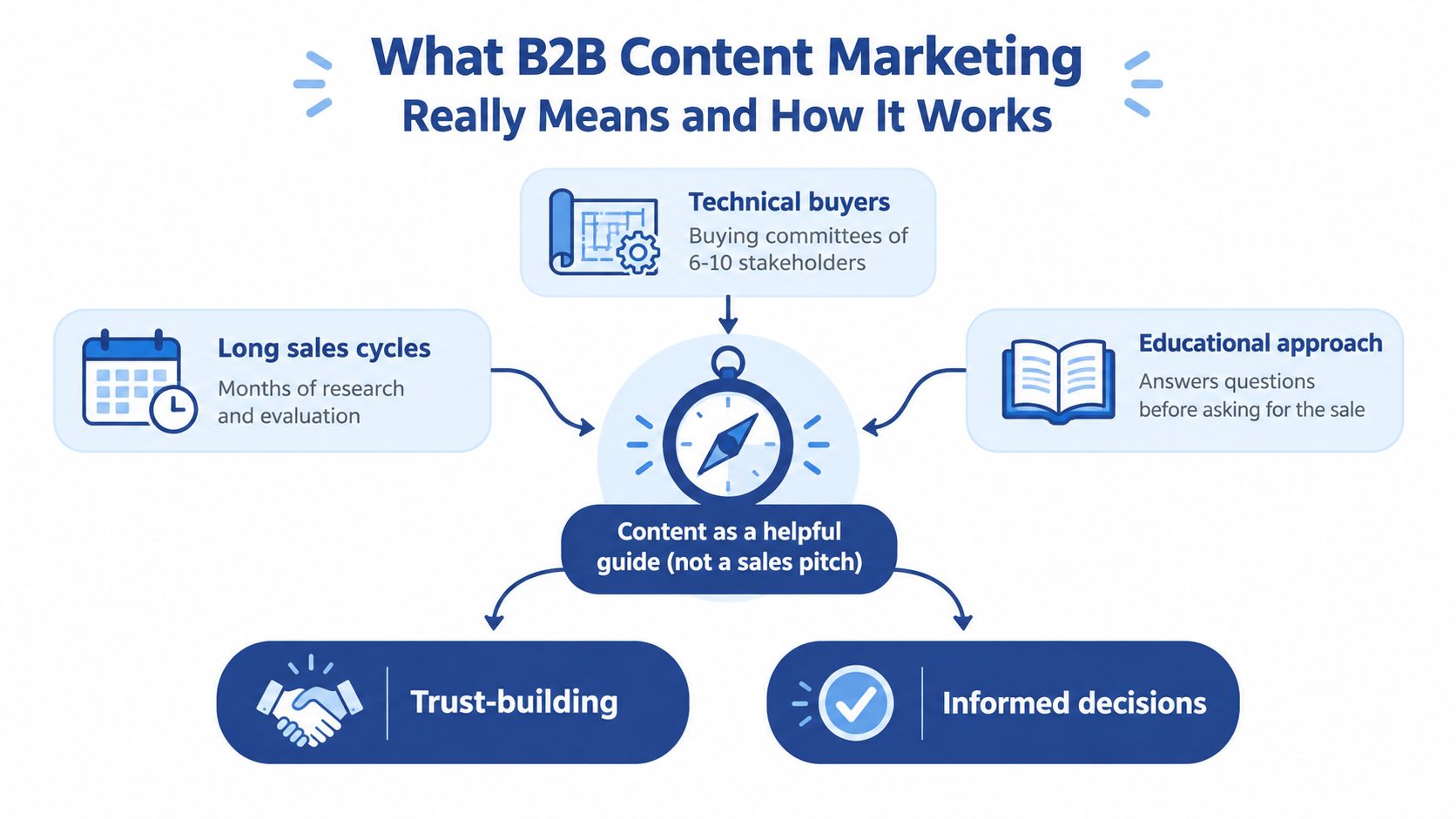
Start with a simple analogy. A helpful salesperson answers questions before asking for an order. Content marketing does the same work through your website, email, search presence, social channels, and sales materials.
A technical article might explain how to diagnose a recurring production issue. A comparison guide might help a buyer evaluate different approaches. A case study might show how a similar company handled installation, training, maintenance, or process change.
That's the basic idea. B2B content marketing creates and distributes useful information that helps business buyers understand a problem, evaluate solutions, and choose a supplier.
Why B2B buying requires more than blog posts
Consumer purchases often involve one person, a shorter evaluation, and a relatively simple comparison. Industrial purchases usually involve more technical requirements, greater operational risk, and several stakeholders with different priorities.
A plant engineer may want tolerances and integration details. An operations leader may care about uptime and implementation. Procurement may need commercial clarity, while an executive may need confidence that the decision supports broader business goals.
Your content should serve those different questions without forcing every visitor into the same sales path.
- Education content helps buyers define the problem.
- Technical content helps engineers assess fit.
- Comparison content helps stakeholders evaluate alternatives.
- Proof content helps the group reduce perceived risk.
- Implementation content helps decision-makers understand what happens after purchase.
The best programs connect these assets into a sequence. One article introduces the issue, a technical guide explains possible approaches, a comparison page frames the options, and a case study gives the buyer evidence to share internally.
For manufacturers, content marketing for industrial companies works best when subject-matter expertise becomes a repeatable publishing and sales-support system rather than a collection of disconnected posts.
B2B content marketing is now standard operating practice. In 2026, 97% of marketers reported having a content strategy, and 91% of B2B organizations said they use content marketing in some form, according to Content Marketing Institute research. The adoption is broad, but broad adoption doesn't guarantee useful execution.
Working definition: B2B content marketing is a decision-support system that helps multiple business buyers understand, validate, and justify a purchase before and during sales engagement.
Why B2B Content Marketing Matters for Manufacturers and Industrial Firms
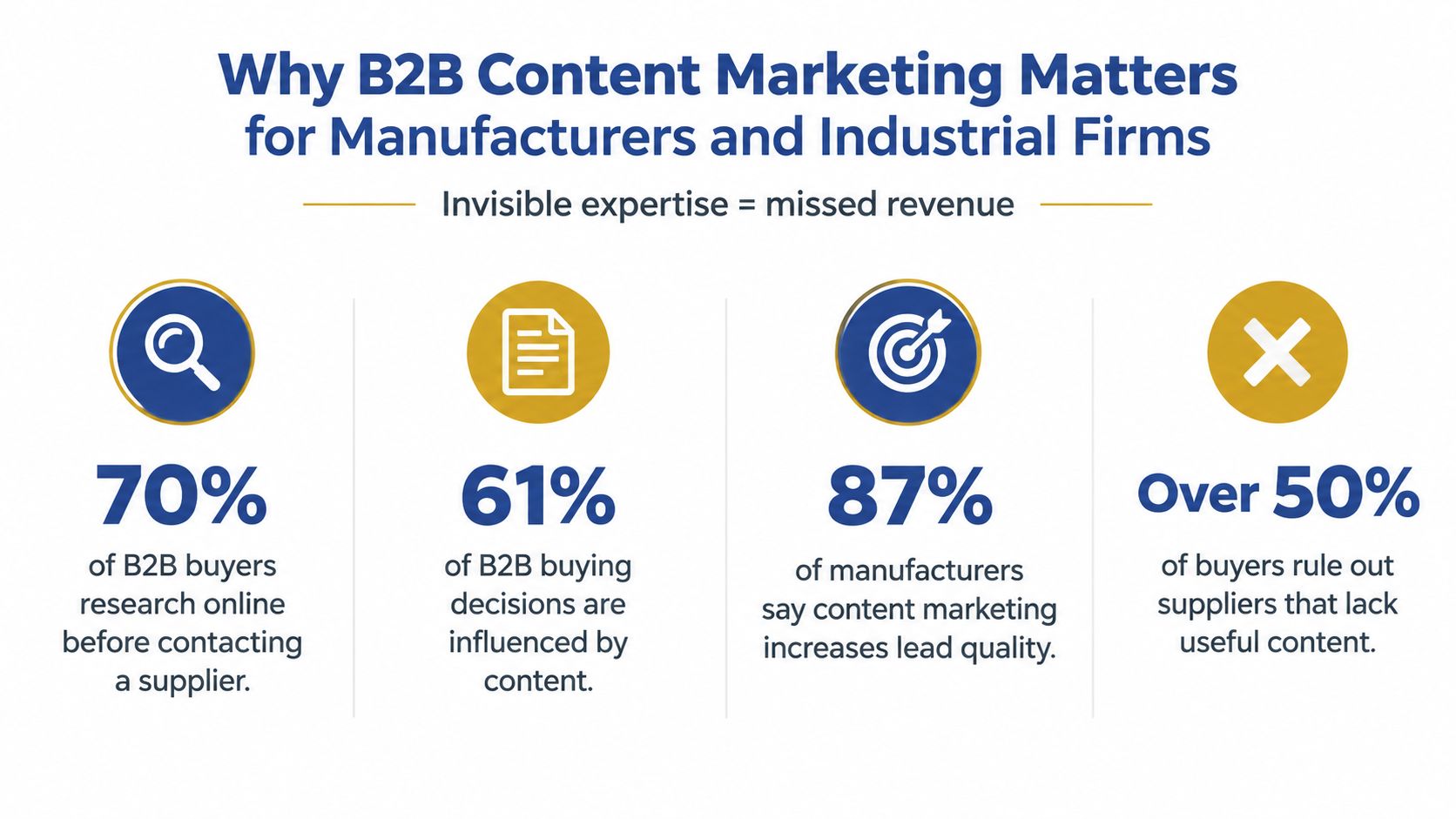
Manufacturers often possess deep expertise that buyers can't see. Your team may know exactly how to select a material, configure a machine, avoid an installation mistake, or improve a process. If that knowledge only exists in conversations, internal documents, or the experience of one salesperson, it can't support buyers who are researching after business hours.
Content makes that expertise accessible. It can answer technical questions before a sales representative gets involved, give prospects language for discussing the problem internally, and help your sales team follow up with something more useful than a generic brochure.
Content has become a core marketing investment
B2B organizations allocate an average of 26% of their total marketing budget to content marketing, according to compiled Content Marketing Institute data reported by ZoomInfo. That level of investment changes the question for an industrial business owner. The issue is no longer whether content belongs in the marketing mix. The issue is whether the content investment supports revenue or merely produces activity.
Adoption and effectiveness aren't the same thing. The market has standardized around owned channels such as websites, blogs, and email, but many companies still publish without a clear connection to sales conversations.
The operational value for industrial firms
Useful content can support several business outcomes at once:
- Visibility: Buyers can discover your company while researching a technical issue.
- Trust: Clear explanations demonstrate competence without relying on promotional language.
- Sales alignment: Representatives can share the right resource for a buyer's specific question.
- Internal justification: A prospect can use a guide, case study, or calculator to explain the purchase to colleagues.
- Consistency: Your company communicates its expertise even when a particular salesperson isn't available.
The transformation is not “more traffic.” It's a buying process with fewer unanswered questions. A strong content system gives engineers evidence, gives managers context, gives executives confidence, and gives sales a useful follow-up path.
Diagnostic question: If your best salesperson left tomorrow, could a serious buyer still understand your technical value from the website and supporting content?
Core Content Types and Channels That Drive Industrial Buying Decisions
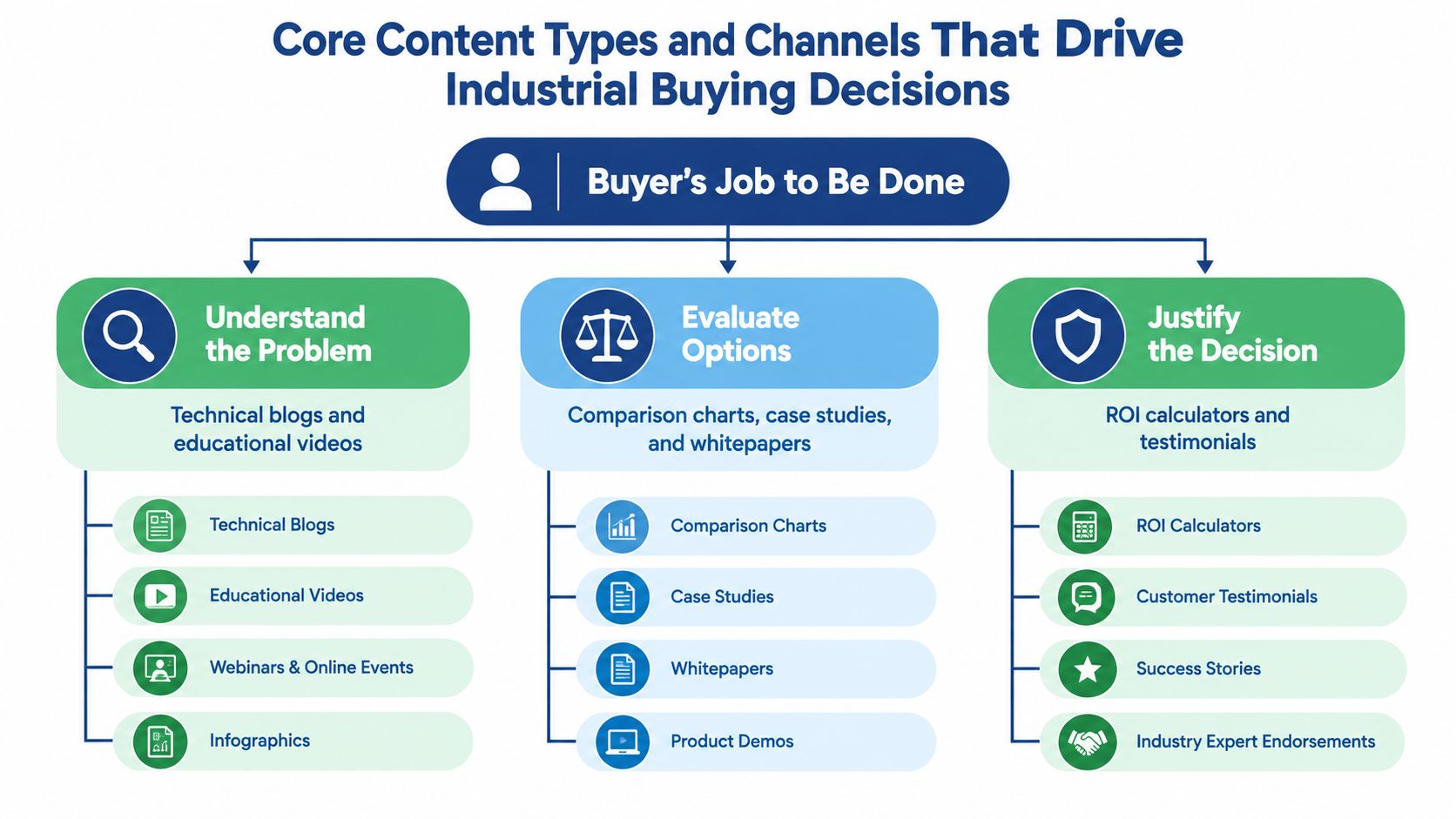
Choose content by the buyer's job, not by the format that happens to be popular. A blog post, webinar, or video is only useful when it helps someone move from uncertainty toward a decision.
When buyers are trying to understand the problem
Use technical blog posts, educational videos, glossaries, process explainers, and troubleshooting guides. These assets should answer questions in plain language while respecting the reader's technical knowledge.
For example, a machine shop might publish a guide to choosing a manufacturing process for a particular part requirement. A machine builder might explain the operational factors that affect automation integration. The aim isn't to force an immediate inquiry. It's to help the right buyer recognize the problem and understand its implications.
Publish this material openly on your website. Use search optimization to make it discoverable, then distribute it through LinkedIn, email, YouTube, and sales follow-up.
When buyers are evaluating options
Comparison guides, technical briefs, case studies, whitepapers, and demonstration videos are more useful here. Buyers need evidence, boundaries, trade-offs, and implementation details.
A comparison page should explain which conditions favor one approach over another. A case study should describe the original challenge, the decision criteria, the work performed, and the practical result without turning into an exaggerated success story.
For teams building technical content marketing, subject-matter expert interviews can turn internal knowledge into a core article, derivative LinkedIn posts, an email, and a sales resource.
When buyers need to justify the decision
Use ROI calculators, checklists, implementation plans, testimonials, proposal support documents, and webinars. Gate a high-value asset when the exchange is reasonable. A detailed implementation guide or calculator can justify a form. A basic educational article usually shouldn't require one.
A plurality of B2B buyers consume 3 to 5 pieces of content before engaging sales, while about 30% consume more than 5 pieces, according to Demand Gen Report findings summarized by MarketingCharts. Build a connected path rather than expecting one asset to close the gap.
Measurable Goals and KPIs That Prove Content Is Working
Content becomes easier to manage when you define the business outcome before choosing the topic. A pageview can indicate attention, but it doesn't tell you whether the visitor fits your market, understands your offer, or progresses toward a sales conversation.
The right measurement system connects each goal to a small group of useful signals. You don't need to track every available metric. You need to know what evidence would show that the content is doing its assigned job.
Use the goal to choose the metric
| Business Goal | Primary KPIs to Track | Signal of Success |
|---|---|---|
| Build awareness | Qualified organic visits, search visibility, returning visitors | The right audience finds and revisits relevant resources |
| Build trust | Engaged sessions, guide downloads, webinar registrations, sales feedback | Buyers spend time with technical and proof-oriented content |
| Generate demand | Form submissions, qualified inquiries, webinar leads, conversion rate | Content produces contacts that match your target market |
| Support sales | Asset shares, opportunity engagement, content usage by sales | Representatives use content in active conversations |
| Influence pipeline | Opportunities touched, sourced or influenced pipeline, revenue association | Content appears in meaningful buying activity |
Use a funnel model to connect these signals to buyer stages. The marketing funnel example models from Keywordme can help teams visualize how awareness, consideration, and decision-stage activity fit together.
Don't confuse activity with effectiveness
Content marketing helped 76% of B2B marketers generate demand or leads in 2023, up from 67% in 2022, according to The Insight Collective's demand-generation benchmark roundup. The same source reports that webinar content generates the most high-quality top-of-funnel leads for 53% of marketers.
That doesn't mean every manufacturer should launch a webinar program. It means you should test formats against your objective. If technical education and early qualification are priorities, a focused webinar may be more useful than another general blog post.
Review performance with sales, not marketing data alone. Ask which assets prospects mention, which resources representatives share, and which topics repeatedly appear in qualified conversations. For a manufacturing-specific KPI framework, see marketing KPIs for manufacturing.
Your Starter B2B Content Strategy Checklist From Diagnosis to Execution
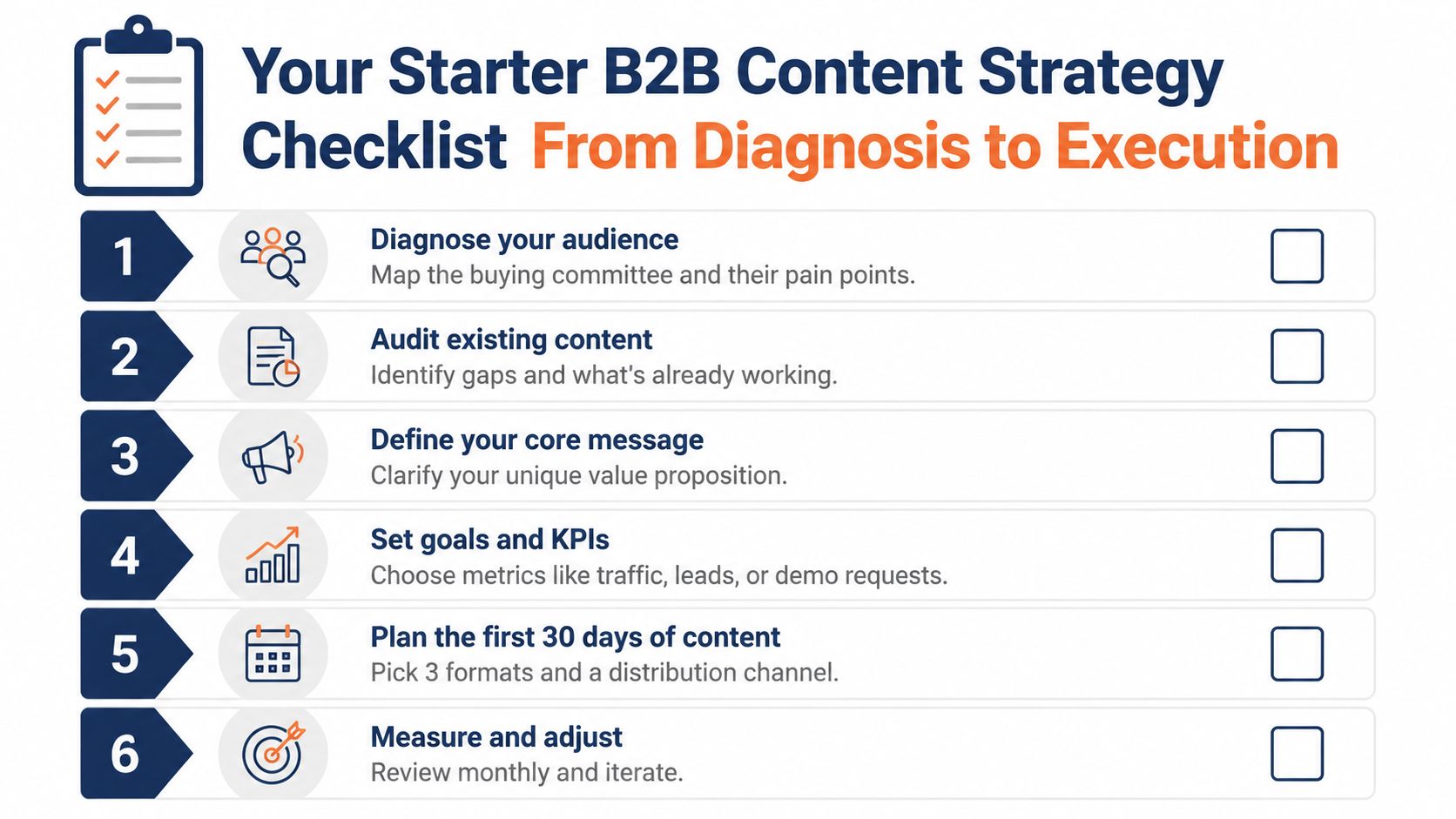
A strategy becomes useful when someone can follow it without guessing. Use the checklist below as a starting SOP. Keep the first version practical, then improve it as sales conversations reveal new questions.
1. Diagnose your audience
Map the buying committee, not just the person who fills out the form. List the engineer, operator, procurement contact, manager, executive, or owner who may influence the decision.
Ask yourself: What does each person need to believe before supporting the purchase?
Next action: interview sales and service staff. Capture the questions buyers ask before requesting a quote, during evaluation, and after implementation discussions.
2. Audit existing content
Review your website, brochures, videos, case studies, emails, and sales documents. Mark each asset by buyer stage and audience.
You may find plenty of broad educational material but very little comparison or implementation content. You may also find valuable technical knowledge hidden in PDFs that buyers can't easily discover.
Next action: create three lists, keep, improve, and create.
3. Define the core message
Clarify the problem your company solves, the conditions where your approach fits, and the proof that supports your claims. Avoid vague promises such as “high quality” unless you explain what quality means in the buyer's operating context.
Ask yourself: Why should a technically informed buyer trust our approach over another supplier's?
Next action: write a short positioning statement and collect the technical proof points, process details, certifications, testimonials, and examples that support it.
4. Set goals and KPIs
Choose the business result first. Awareness, demand, sales enablement, and pipeline influence require different measures.
Next action: select a primary KPI and a supporting KPI for each content initiative. Record the owner, review date, and source of truth.
5. Plan the first 30 days of content
Start with a manageable mix. For example, choose one technical article, one comparison resource, one sales enablement asset, and one distribution channel your team already uses consistently.
Next action: assign a subject-matter expert, writer, reviewer, publisher, and sales owner. Put review deadlines on the calendar before production begins.
6. Measure and adjust
Review performance with both marketing and sales. Look for evidence of audience fit, useful engagement, qualified inquiries, and asset usage in real opportunities.
Next action: hold a recurring review and ask three questions:
- What did buyers use?
- What questions remain unanswered?
- What should we stop producing?
Document the answers. That record becomes the beginning of a repeatable content operating system.
Common Mistakes to Avoid and Quick Next Steps to Get Started
The biggest mistake is treating content volume as the strategy. More publishing can create more noise, especially when the topics are generic, the technical review is weak, or sales has no reason to use the finished assets.
Another mistake is stopping at awareness content. Industrial buyers need practical proof, comparisons, implementation guidance, and internal justification. A polished thought-leadership article won't replace a clear technical guide when a buyer is deciding between suppliers.
Gated content still has a role when the asset solves an expensive or difficult problem. NetLine's report, based on 6.2 million first-party content registrations, found that gated B2B content demand rose 14.3% year over year and 77% since 2019, while time to consume slowed by 2.5 hours, as reported in the 2024 State of B2B Content Consumption and Demand Report. Use that evidence carefully. Don't gate every article. Create fewer, deeper resources that earn the exchange.
Start today with three actions:
- Ask sales for the questions buyers repeat most often.
- Audit your existing content against those questions and the buying committee.
- Select one decision-stage asset and define the KPI that will show whether sales and buyers use it.
The transformation is straightforward, but it requires discipline. Your content should reduce uncertainty, make expertise visible, and help multiple stakeholders move toward a confident decision.
Machine Marketing helps manufacturers and industrial firms connect content strategy, technical expertise, SEO, sales enablement, and measurement into one practical system. Visit Machine Marketing to discuss a diagnosis of the gaps between your current marketing tools and the growth you want.